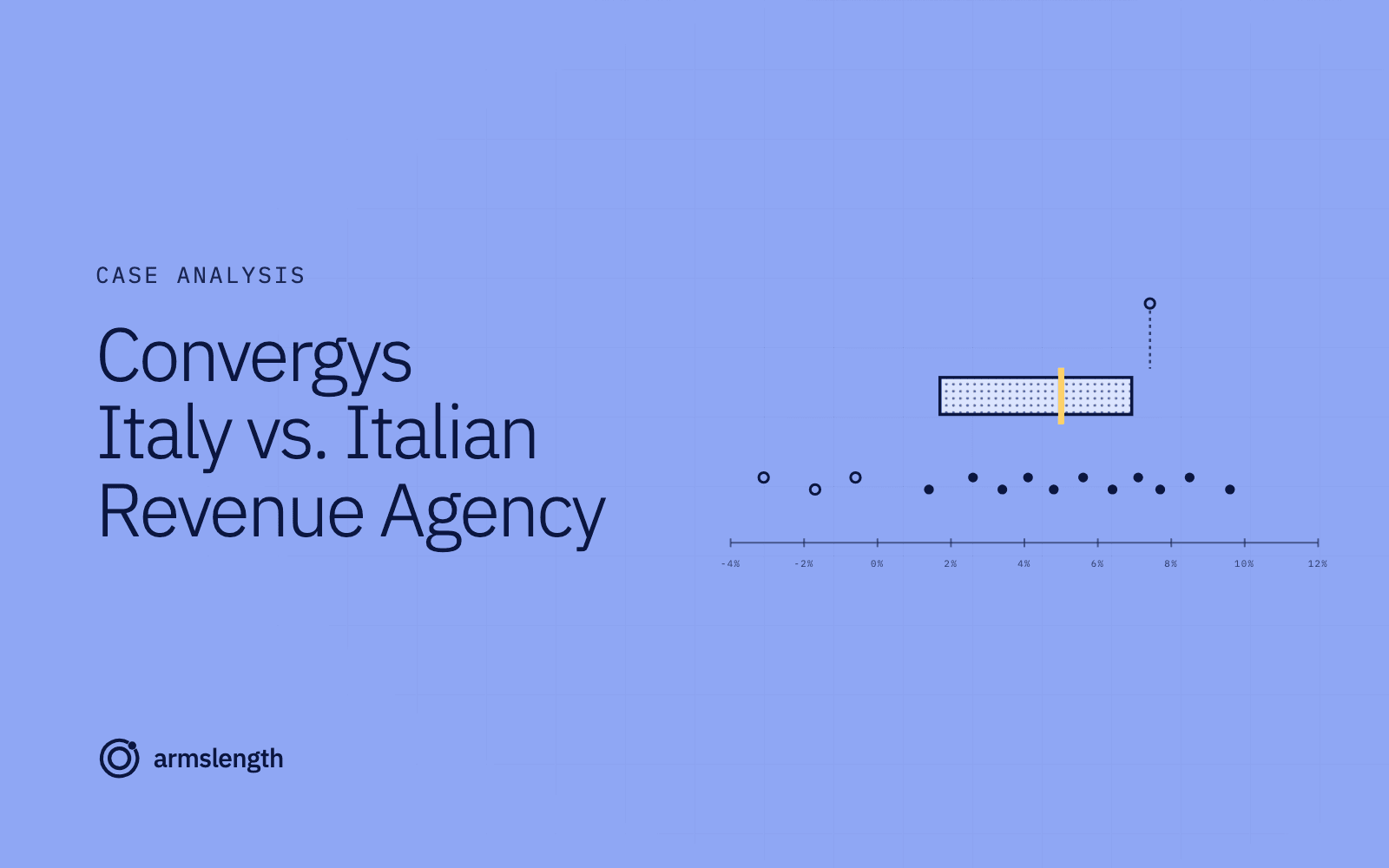
Convergys Italy vs. Italian Revenue Agency (July 2024): Transfer Pricing Case AnalysisConvergys Italy vs. Italian Revenue Agency (July 2024): Transfer Pricing Case Analysis
In this Italian transfer pricing case, the Supreme Court addressed when loss-making comparables may be retained and why exclusions require case-specific support under OECD-aligned analysis.
Borys UlanenkoCEO of ArmsLength AI
15min read
Contents↓
Contents
TL;DR key takeaways
Italian Supreme Court ruled against automatically excluding loss-making comparables in TP benchmarking.
Exclusion requires case-by-case justification, not just applying filters, aligning with [OECD guidance](/resources/oecd-guidelines/chapter-iii-comparability-analysis).
Robust functional analysis and detailed documentation remain crucial for defending TP positions.
The ruling reinforces the need for Italian TP practices to adhere closely to [OECD standards](/resources/oecd-guidelines).
In this landmark Kenyan transfer pricing case, the Tax Appeals Tribunal upheld the tax authority's rejection of the Resale Price Method in favor of TNMM, resulting in a significant tax adjustment for Avic's vehicle assembly operations.
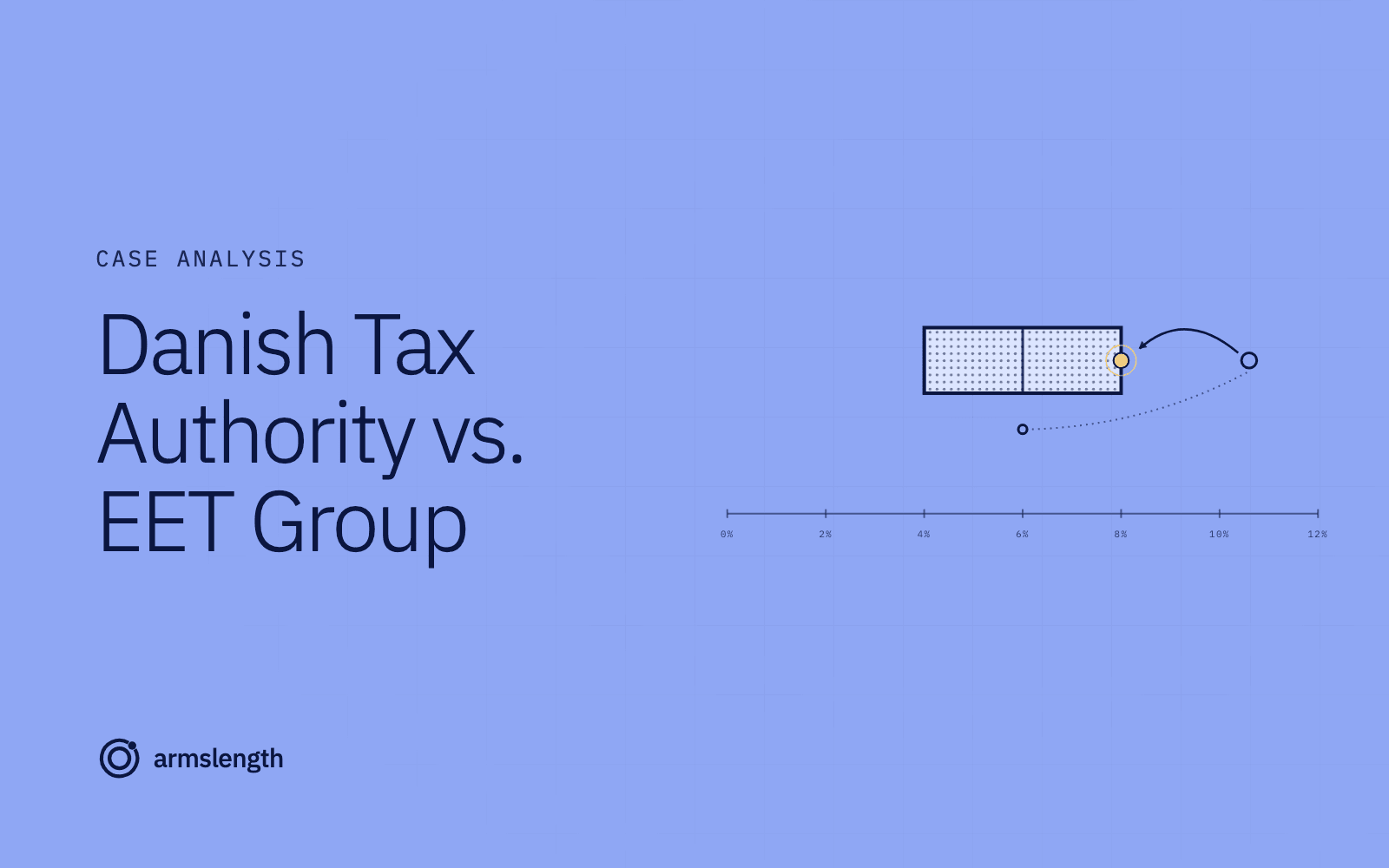
In this landmark Danish transfer pricing dispute, the Eastern High Court ruled in favor of EET Group, rejecting a DKK 129 million adjustment and setting important precedents for method selection and range application.
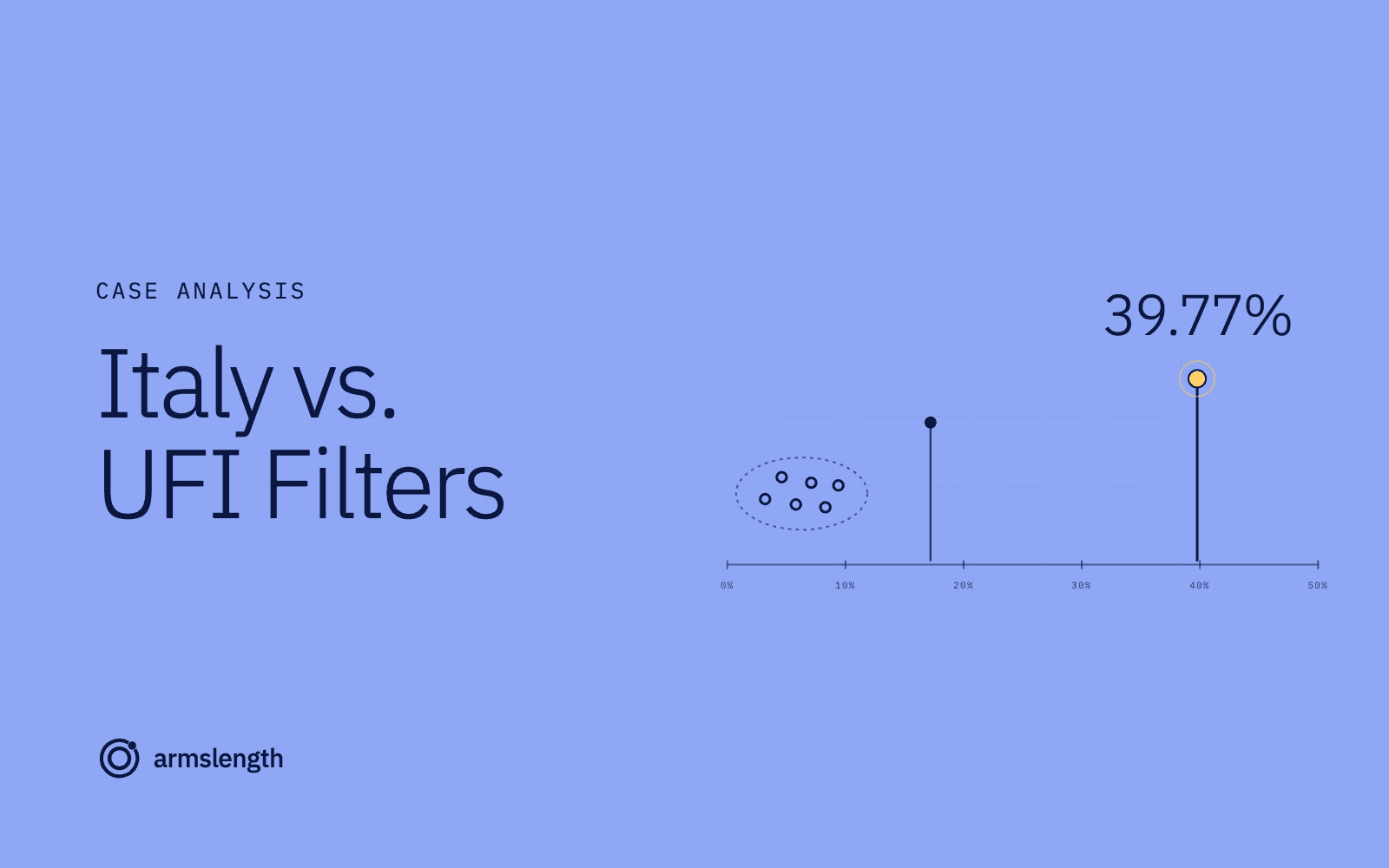
In this high-profile transfer pricing case, UFI Filters successfully defended its 39.77% intra-group markup against the Italian tax authority, highlighting the critical importance of proper comparability analysis.
More resources for your next workflow stepMore resources for your next workflow step
Browse the full resource library or contact us if you want recommendations for your specific use case.
In a groundbreaking Italian transfer pricing case, the tax authority sought to raise Convergys Italy's profit markup from 5% to 7.42% – a nearly 48% increase – on services provided to its Dutch affiliate. This seemingly small percentage difference escalated into a 12-year dispute covering fiscal years 2008–2010 and culminated in a July 16, 2024 Supreme Court ruling, marking the first time Italy's highest court endorsed using loss-making comparables in transfer pricing analysis. The ruling aligns Italian practice with OECD guidance on comparables and has broad implications for tax administration and multinational enterprises operating in Italy.
1. Overview & Context
Case Background
Convergys Italy S.r.l. (formerly Stream Italy S.r.l.) is an Italian call-center service provider that rendered intra-group customer support services to its Dutch affiliate, Stream Europe B.V. The arrangement was on a cost-plus basis, with Convergys Italy earning a 5% mark-up on its costs.
Transaction Structure Analysis
Convergys Italy S.r.l.
🇮🇹
Italian Service Provider
Call-center Services
Limited Risk Profile
Tested Party
Cost + 5% markup (disputed)
Call-center Services
Cost + 5% Payment
Stream Europe B.V.
🇳🇱
Dutch Affiliate Company
Principal Entity
Deducts Service Costs
May face double taxation if adjustment not matched
Key Dispute Focus
The Italian Revenue Agency challenged the 5% markup as too low, claiming it should be 7.42%. The Supreme Court eventually ruled that loss-making comparables should not be automatically excluded from the benchmarking analysis.
Italian Revenue Agency audits for FY 2008, 2009, and 2010 challenged the 5% mark-up as too low. In 2012, the Agency issued assessment notices for additional corporate income tax (IRES), regional business tax (IRAP), and value-added tax (VAT) on the upward adjustment of Convergys Italy's taxable profits.
Convergys Case Timeline: 12-Year Dispute
2008
2012
2015
2018
2024
Hover over or click any point to see details about that stage of the Convergys case
Financial and Policy Significance
Adjusting the mark-up from 5% to 7.42% would substantially increase Convergys Italy's taxable income and potentially result in millions of euros in extra taxes and penalties. The dispute had high stakes for the company's liability and risk of double taxation, since the Dutch affiliate's corresponding deductions were not initially adjusted via any tax treaty procedure.
Beyond the money at stake, this case became a bellwether for transfer pricing policy in Italy. It raised fundamental questions about how strictly Italian tax authorities must adhere to international standards (OECD Guidelines) when determining arm's-length prices.
2. Core Transfer Pricing Issues
Several key transfer pricing issues lay at the heart of the Convergys Italy dispute:
Benchmarking Method & Mark-Up Determination
Both taxpayer and tax authority applied the Transactional Net Margin Method (TNMM), a one-sided method akin to a cost-plus approach for services. However, they clashed over the appropriate profit mark-up.
Convergys Italy's analysis found 5% to be arm's length – a figure at the upper end of the comparables range in its study. The tax authority re-ran the benchmark with stricter criteria and insisted on a 7.42% mark-up (the median of its revised comparables set) as the correct arm's-length result.
This raised the methodological question of whether an arm's-length range or a single point (median) should be used, and if so, how that point is selected. The choice between using the full interquartile range vs. the median became a contentious point – with the taxpayer arguing 5% was comfortably within an acceptable range, and the authority claiming only the median guaranteed arm's-length compliance.
Comparables Selection (Loss-Making Companies)
A central dispute was the treatment of loss-making or data-deficient comparables in the benchmarking analysis. The Italian Revenue Agency's approach was to exclude any companies that had losses in two out of three years or lacked complete financial data, on the presumption that persistent losses render a company non-comparable.
By filtering out these firms, the authority's analysis yielded a much higher arm's-length margin (7.42%). Convergys Italy, by contrast, had included all functionally-similar companies from the database (AIDA) regardless of short-term losses, as long as they were comparable in activities.
This raised the broader issue: should loss-making comparables be automatically rejected in a TNMM benchmark for a routine service provider? The answer hinges on interpretations of both Italian law and the OECD Transfer Pricing Guidelines, which caution that independent enterprises can have legitimate business reasons for low or negative profits in certain years.
Note
The Italian law framework (Article 110(7) of the TUIR) does not explicitly mandate excluding unprofitable comparables – leaving room for OECD-consistent approaches.
Functional Analysis & Risk Profile
The dispute underscored the importance of accurately assessing the functions, assets, and risks of the Italian entity versus the affiliate, and ensuring the comparables used have a similar profile. Convergys Italy was characterized as a "routine" service provider – essentially a captive call-center performing back-office customer support on behalf of the Dutch group entity.
As a limited-risk service operator, it would expect a relatively stable but modest profit margin in line with its low-risk profile (justifying a cost plus method). The choice of comparables and mark-up needed to reflect this profile.
The tax authority's exclusion of loss-makers implicitly assumed that no comparable firm with a similar low-risk profile should incur losses (since routine service providers are generally guaranteed a mark-up). The taxpayer, however, pointed out that even companies performing similar services might incur losses due to market conditions or strategic pricing, without ceasing to be valid comparables.
Thus, the functional analysis issue boiled down to: were the excluded companies truly not comparable (e.g., because they bore more risk or were in unusual situations), or were they just inconvenient data points? The Supreme Court required a nuanced answer to this, rather than a blanket rule.
Evidentiary Standards & Documentation
Another underlying issue was the standard of proof and documentation in justifying transfer prices. Convergys Italy had prepared contemporaneous transfer pricing documentation (a global report and Italian local file with a benchmarking study from an Italian database) which supported the 5% mark-up.
This likely protected the company from penalties and gave it a strong evidentiary basis in court. The tax authority, in making its adjustment, needed to substantiate why its alternate set of comparables was more reliable – essentially proving that the excluded companies were not truly comparable.
The Supreme Court found that the lower appellate court had erred by accepting the tax authority's approach without a proper analysis of the rejected comparables' circumstances. This highlights that in transfer pricing disputes, thorough reasoning and evidence are required whenever comparables are excluded or adjustments made – mere formulaic or one-size-fits-all approaches are vulnerable on appeal.
3. Stakeholder Positions
Both the taxpayer and the tax authority presented contrasting positions on the transfer pricing method, comparables, and results:
Key Positions in the Convergys Transfer Pricing Case
Taxpayer (Convergys Italy)
Applied TNMM (Cost Plus) method. Chose Convergys Italy as the tested party, appropriate for a captive service provider. A single profit mark-up of 5% on total costs was used, consistent with the company's limited-risk profile.
Tax Authority (Agenzia delle Entrate)
Agreed on using TNMM (cost-plus) for a service provider, but argued the 5% mark-up was too low. The authority recalculated the arm's-length result and asserted that 7.42% was the correct mark-up.
Supreme Court Reasoning
Focused on the methodology of comparables selection rather than disputing the transfer pricing method itself. Affirmed that the method was appropriate but the implementation required scrutiny.
4. Analysis & Court Decision
Court's Reasoning – Strengths of Each Side
The Italian Supreme Court (Corte di Cassazione) ultimately found the taxpayer's arguments more convincing, striking down the Revenue Agency's rigid approach. The Court's analysis provides insight into the strengths and weaknesses of each side's position:
Taxpayer's Position Strengths
Convergys Italy's case was bolstered by its consistency with OECD Guidelines and a well-prepared benchmarking analysis. The Court agreed that low or negative margins in some years do not automatically invalidate a comparable, noting that "in the normal course of business, loss-making companies do exist."
The taxpayer's inclusion of such comparables was vindicated by pointing to legitimate business strategies (e.g., market penetration) where independent companies might accept lower profits or losses to build future gains. The Supreme Court highlighted OECD Guidelines (para. 1.57–1.59 and 3.43 in the 2010 version; see in the 2022 version for equivalent business strategy guidance) which recognize that business strategy is a comparability factor – companies may incur losses to increase market share, and this "should not automatically disqualify" them as comparables.
Warning
Applying blanket filters to exclude loss-making companies without analyzing the reasons for those losses contradicts OECD Guidelines and proper transfer pricing practice.
Furthermore, Convergys Italy had selected a mark-up at the higher end of the range, which the Court likely saw as evidence of acting in good faith to comply with the arm's-length principle (had the company chosen the bottom of the range, its position might have been viewed with more skepticism).
The taxpayer's functional profile as a low-risk entity was not seriously challenged, and the 5% mark-up appeared in line with that profile, especially considering that OECD guidance now even provides a simplified 5% safe-harbor for low value-adding intra-group services (introduced in 2017).
Overall, the legal grounding of the taxpayer's case – invoking the OECD standards which Italian law indirectly embraces – was a key strength. The Supreme Court fully agreed that the automatic exclusion of comparables was unjustified and unlawful in light of those standards.
Tax Authority's Position Weaknesses
While the Italian Revenue Agency had a facially logical concern (that chronic loss-makers aren't reliable benchmarks for a routine service firm), the Supreme Court found its approach too mechanical and unsupported by evidence.
The Agency's failure was in not demonstrating that the excluded companies were truly in "special" non-comparable situations (such as startups or bankruptcy). The Court noted that only companies in particular situations that clearly impair comparability (e.g., a company in liquidation) may be excluded – and this requires analyzing the reasons behind the losses, not simply the fact of losses.
In this case, the Revenue Agency omitted any analysis of whether the loss-making comparables were in fact startups, failing businesses, or simply operating in a competitive low-margin environment. By blindly applying a two-years-of-loss filter, the tax authority contradicted the OECD Guidelines and Italian jurisprudence that demand a case-by-case comparability assessment.
The Supreme Court also implicitly critiqued the lower court (CTR) for accepting the tax authority's approach without scrutinizing the rationale for excluding those comparables. In essence, the evidentiary standard was not met by the tax authority – they did not carry the burden to show that 7.42% was more arm's length than 5%.
Another weakness in the authority's stance was that it disregarded the fact that 5% was within the original arm's-length range (indeed at its higher end); typically, if a tested result falls within a reasonable range, it is acceptable. The Agency's insistence on the median as the only point was not supported by any specific law – it was more of an administrative practice.
Court Decision & Ruling
The Supreme Court's ruling (No. 19512/2024) overturned the Regional Tax Court's decision that had favored the tax authority, and remanded the case back to the Milan Regional Tax Court (Corte di Giustizia Tributaria di secondo grado della Lombardia) for reconsideration.
In doing so, the Supreme Court effectively sided with the taxpayer on principle, instructing that the 7.42% mark-up cannot be justified after reinstating the comparables that were wrongly excluded. The case isn't fully closed – the lower court must now re-evaluate the facts using the correct criteria as directed by the Supreme Court.
However, given the clear guidance, it is likely that Convergys Italy's original pricing (5% mark-up) will be upheld as arm's length, or at most a minor adjustment might be made if any truly non-comparable firms are identified with proper justification. The decision has been hailed as "groundbreaking" in the transfer pricing community for Italy, aligning Italy's jurisprudence with international standards.
Potential Resolution Paths
At this juncture, several paths could finalize the dispute:
Revised Appellate Decision: The Regional Tax Court, on remand, could issue a new decision following the Supreme Court's instructions. The expectation is that it will confirm the legitimacy of the 5% mark-up (or something very close to it) since the previous rationale for increasing it was deemed invalid.
Settlement: It's notable that Convergys Italy attempted a settlement (accertamento con adesione) with the tax authorities back in 2012, before the case first went to trial, but no agreement was reached. With the Supreme Court's favorable stance for the taxpayer, the incentive for Convergys to settle now is low.
Mutual Agreement Procedure (MAP): If any portion of the adjustment remains, Convergys and the Dutch entity can still seek MAP relief under the Italy–Netherlands tax treaty to eliminate double taxation.
Advance Pricing Agreement (APA) for Future: While an APA cannot retroactively wipe out past disputes, Convergys (or similar companies) might consider bilateral APAs between Italy and the Netherlands to fix an agreed mark-up for future years and avoid repeats of this conflict.
5. Broader Implications and Parallel Cases
The Convergys Italy case is part of a broader trend in transfer pricing disputes about how to handle comparables that don't fit the mold:
In Italy, this ruling is a milestone, but lower courts have wrestled with similar issues. The decision reinforces that Italian tax jurisprudence must reflect the OECD arm's-length standards. We may see the Revenue Agency update its administrative practice or circulars to formally allow inclusion of loss-making comparables with justification, to avoid future litigation losses.
In other jurisdictions, courts have taken varied approaches on loss-making comparables. Notably, the Czech Republic's Supreme Administrative Court in April 2022 (Aisan Industry Czech case) upheld the exclusion of loss-making comparables in a transfer pricing dispute – essentially the opposite outcome of Convergys under that country's facts.
OECD's 2017 Guidelines on low value-adding services permit a 5% cost-plus mark-up "safe harbor" without requiring rigorous benchmarking. While not directly at issue in Convergys (which predated that guidance and involved higher value call-center operations), it's interesting that the disputed 5% markup falls squarely within what OECD now considers an acceptable return for routine services.
Tip
The Supreme Court's decision strengthens the hand of taxpayers in defending reasonable transfer pricing positions, while sending a message to tax authorities that transfer pricing enforcement must be grounded in thorough economic analysis, not just statistical shortcuts.
In summary, the Supreme Court's analysis in Convergys Italy balanced the need for principled, evidence-based adjustments against the avoidance of simplistic rules that could skew results. It favored a holistic evaluation: only exclude a comparable if you can prove a genuine comparability defect, and otherwise consider the full spectrum of market outcomes (including losses) that independent companies may experience.
6. Key Takeaways
The Convergys Italy v. Italian Revenue Agency case offers several important lessons and implications for taxpayers, advisors, and policymakers involved in transfer pricing:
Don't Exclude Comparables Without Justification
A clear takeaway is that loss-making companies cannot be excluded from a benchmarking set without a solid rationale. It is "normal to find loss-making companies in a free market" and they may be legitimate comparables if their losses are normal or temporary. Only in exceptional cases (e.g., start-ups, companies in liquidation or undergoing extraordinary circumstances) should such firms be discarded.
Actionable advice: When preparing benchmarks, carefully document the reasons for any exclusion of a potential comparable – whether due to functional differences or truly anomalous conditions. Avoid blanket rules (like dropping all loss-makers); instead, perform a case-by-case analysis of each comparable's situation.
Align Transfer Pricing Analysis with OECD Standards
The case underlines that Italian courts expect adherence to the OECD Transfer Pricing Guidelines as a yardstick for correctness. Taxpayers should ensure their transfer pricing documentation explicitly references compliance with OECD criteria (e.g., considering business strategies, using interquartile ranges properly).
Actionable advice: MNEs should stay updated on Italian guidance changes and mirror OECD language in their benchmarking reports to fortify their positions. Engaging professional benchmarking services that follow the latest OECD-compliant practices (including inclusion of companies with volatile earnings when appropriate) will improve the defensibility of transfer pricing sets.
Robust Functional Analysis is Crucial
Establishing the correct functional profile of the tested entity is the foundation for the entire TP method and comparable selection. In this case, portraying Convergys Italy accurately as a low-risk service provider was key to justifying a cost-plus method and a lower arm's-length margin.
Actionable advice: Taxpayers should thoroughly document their functions, assets, and risks (FAR) analysis, and ensure the chosen comparables have a matching profile. If a comparable has a different risk level, that difference should be adjusted for or explained – not merely ignored or used to cherry-pick results.
Evidentiary Standards & Documentation Quality
The outcome highlights the importance of comprehensive documentation and credible evidence in transfer pricing disputes. Convergys Italy's victory was aided by having prepared a detailed benchmark analysis in advance, which the court took into account. Tax authorities must meet a high evidentiary bar to overturn such analysis.
Actionable advice: Always prepare contemporaneous transfer pricing documentation that includes not just numbers, but narrative – describe why comparables are selected or rejected in economic terms. This will serve as primary evidence of your good-faith effort and analytical rigor.
Broader Policy Implications
This case may signal a gradual shift toward more taxpayer-favorable and OECD-aligned jurisprudence in Italy. We might see the Revenue Agency reconsider its internal guidelines (for instance, its historically skeptical view on loss-making comparables or its preference for the median).
For transfer pricing practitioners and multinational companies, the ruling provides a supportive precedent to cite in future controversies – not only in Italy but as persuasive reasoning internationally (especially in Europe, where courts often look at each other's decisions).
Final Thoughts
The Convergys Italy case shows that reasonable, well-supported transfer pricing positions can prevail even against aggressive audit adjustments, provided they are backed by solid analysis and documentation.
Transfer pricing benchmarking services must also adapt – ensuring their default filters and practices do not run afoul of the nuanced approach endorsed by this ruling. As Italy aligns more closely with OECD norms, taxpayers and advisors should align their compliance efforts accordingly, emphasizing transparency, thorough analysis, and proactive risk mitigation.
These practices improve transfer pricing compliance and reduce audit risk.
Frequently Asked Questions
How does the Convergys case impact transfer pricing benchmarking in Italy?
The case dramatically changes the approach to benchmarking in Italy, requiring tax authorities to provide specific justification for excluding loss-making comparables rather than applying mechanical filters. Companies operating in Italy should review their existing benchmarking studies to ensure they follow this more nuanced, OECD-aligned approach.
Should companies now include all loss-making comparables in their benchmarking studies?
Not necessarily. The court didn't rule that all loss-making comparables must be included, but rather that their exclusion requires a case-by-case analysis and proper justification. Companies should still evaluate if a comparable truly reflects the functional profile and business circumstances of the tested party, regardless of its profit or loss position.
What is the significance of the 5% markup in this case?
The 5% markup is notable because Convergys selected it from the higher end of their benchmarking range, demonstrating good faith compliance. Additionally, though not mentioned specifically in the case, 5% aligns with the OECD's simplified approach safe harbor for low value-adding services introduced in 2017, suggesting the taxpayer's position was reasonable by international standards.
How does this ruling affect taxpayers currently under audit in Italy?
Taxpayers currently under audit should review whether the tax authority has excluded loss-making comparables without proper justification. This case provides strong grounds to challenge such exclusions and any resulting adjustments. If the tax authority has insisted on using only the median of a comparables set, taxpayers can now cite this ruling to defend positions that fall within the arm's length range but differ from the median.
What documentation practices should multinational companies adopt in light of this ruling?
Companies should enhance their functional analysis documentation to clearly establish the risk profile of the tested entity and ensure this aligns with the selected comparables. When excluding any potential comparable, document specific reasons tied to functional differences or extraordinary circumstances—not just financial results. Also, explicitly reference relevant OECD Guidelines in documentation to strengthen the alignment with international standards that Italian courts now clearly follow.
 Borys UlanenkoCEO of ArmsLength AI