Form 8975 is the U.S. Country-by-Country Report. U.S. UPEs with prior-year group revenue ≥ $850M must file it with the return (including extensions).
Borys UlanenkoCEO of ArmsLength AI
16min read
Contents↓
Contents
TL;DR key takeaways
File Form 8975 if you’re the U.S. ultimate parent entity and prior-period consolidated revenue is ≥ $850M (Treas. Reg. §1.6038-4; TD 9773).
Form 8975 is attached to the U.S. income tax return—due date is the return due date, including extensions (Instructions for Form 8975).
Prepare one Schedule A per tax jurisdiction (including US, and sometimes X5 ‘stateless’); Part I totals must match the Part II entity list.
Clean CbCR data is increasingly reused for Pillar Two transitional CbCR safe harbour screens—definition drift can create risk even if you ‘filed’ (OECD Safe Harbours, Dec 2022).
EU Public CbCR requires large groups to publish income-tax KPIs by jurisdiction. Most calendar-year groups first report FY2025 and publish by 31 Dec 2026.
Quick Answer: Form 8975 (U.S. Country-by-Country Reporting)
Form 8975 is the IRS country-by-country report (CbCR) for large U.S.-headed multinational groups, implementing BEPS Action 13 in the United States. A U.S. ultimate parent entity generally must file Form 8975 when the group’s prior reporting period consolidated revenue is $850 million or more (Treas. Reg. §1.6038-4; TD 9773, IRB 2016-29). The form is filed as an attachment to the U.S. income tax return and is due on the return due date including extensions (Instructions for Form 8975). Each filing includes Schedule A for each tax jurisdiction, where Part I amounts are aggregated across the Part II entity list for that jurisdiction.
Note
Although this guide is “2025,” the current IRS Instructions for Form 8975 and Schedule A are dated 12/2020, and the IRS “About Form 8975” page showed “Recent Developments: None at this time” as of its last update on August 27, 2025. Always confirm whether the IRS has issued a later revision before you lock your filing playbook.
Key Takeaways
→Form 8975 is an attachment to the U.S. return—not a standalone 12‑month-after-year-end filing in U.S. mechanics.
→The $850M threshold is tested on prior-period group revenue and was calibrated to the OECD’s €750M reference point (Jan 1, 2015).
→Schedule A Part I must reconcile to the entities shown in Part II for that jurisdiction; population errors cascade into every metric.
→CbCR data is now frequently repurposed for Pillar Two transitional safe harbour screening—define metrics once and control them.
What is Form 8975—and why tax teams treat it as “high-stakes” data
Form 8975 (Country-by-Country Report) is the U.S. reporting vehicle that collects jurisdiction-by-jurisdiction indicators of where an MNE group earns revenue, reports profit (loss), pays (and accrues) income taxes, and has people and tangible assets—plus a roster of constituent entities and their main business activities (Instructions for Form 8975).
It matters for three practical reasons:
Automatic exchange: the IRS may exchange CbCR with foreign tax authorities under competent authority arrangements. That means data quality issues can become multijurisdictional questions.
Risk analytics: CbCR is designed for high-level risk assessment, not transaction-level pricing. OECD guidance emphasizes “appropriate use” limitations (BEPS Action 13, 2015 Final Report, paragraph 59; see also Annex IV to Chapter V, Section 5).
Pillar Two convergence: even though Pillar Two is a separate regime, many groups use CbCR-style datasets to support Transitional CbCR Safe Harbour screens (OECD Safe Harbours, Dec 2022). In practice, Form 8975 often becomes the data spine for global minimum tax readiness.
Note
OECD “appropriate use” is not just theory. CbCR data is not intended to replace a transfer pricing analysis or be used for formulary apportionment adjustments (OECD BEPS Action 13, 2015 Final Report, paragraph 59; Annex IV to Chapter V, Section 5). Treat Form 8975 as a transparency and risk-assessment filing—and maintain the documentation that supports it.
Form 8975 filing requirement (who must file and the $850M threshold)
The core rule: U.S. UPE + prior-period revenue ≥ $850M
A U.S. person must file Form 8975 (with Schedules A) if it is the ultimate parent entity (UPE) of a U.S. MNE group and the group’s annual revenue for the immediately preceding reporting period is $850,000,000 or more (Treas. Reg. §1.6038-4; Instructions for Form 8975).
The $850M threshold is the U.S. “near equivalent” of the OECD’s €750M threshold reference point as of January 1, 2015 (TD 9773, IRB 2016-29; OECD BEPS Action 13 ¶52).
Definitions that drive scope (UPE, reporting period, constituent entities)
Two definitional points typically drive scoping debates:
Ultimate parent entity: generally the top entity required to consolidate the group (or would be required to consolidate if publicly traded) and not owned by another consolidating entity (Treas. Reg. §1.6038-4; see also our CbCR preparation guide).
Reporting period: tied to the UPE’s applicable financial statement period (often 12 months; sometimes 52–53 week years) ending with or within the UPE’s taxable year (Treas. Reg. §1.6038-4).
For entity population, the IRS instructions adopt an Action 13-style approach—your Part II list on each Schedule A should include the constituent entities resident in that tax jurisdiction, and Part I must aggregate those entities (Instructions for Form 8975).
Quick decision tree (practitioner version)
Decision Criteria
01You file Form 8975 if you are a U.S. person that is the UPE of a U.S. MNE group and prior-period consolidated revenue ≥ $850M (Treas. Reg. §1.6038-4).
02You generally do not file if prior-period consolidated revenue < $850M, or you are not the UPE (another entity consolidates you).
03If you are a U.S. territory UPE, you may designate a U.S. business entity to file (Instructions for Form 8975—role code SUR).
04If your facts involve fiscally transparent entities or ‘stateless’ classifications, validate jurisdiction coding and whether an X5 Schedule A is required.
Warning
Don’t assume that “we’re under €750M” answers the U.S. question. The U.S. threshold test is explicitly $850M and is based on the prior reporting period (Treas. Reg. §1.6038-4).
Form 8975 deadline, extensions, and how it is filed
Due date: attached to the U.S. income tax return (including extensions)
Form 8975 is not filed on a separate “12 months after year-end” timeline in U.S. mechanics. Instead, it is attached to the filer’s income tax return and is due on the return due date, including extensions (Instructions for Form 8975).
The IRS instructions list multiple return types that can carry the attachment (depending on the filer), including Forms 1120, 1065, 1120-S, 990-T, 1041, etc. (Instructions for Form 8975). In most UPE structures, the attachment is made to the corporate income tax return.
Electronic filing and schema expectations
The IRS has long emphasized electronic filing through MeF and XML schema support for Form 8975 in its CbCR resources (see IRS “U.S. Multinational Enterprises” page). Even when paper filing is technically possible in narrow cases, most large U.S.-headed groups should plan for schema validation and data normalization (country codes, role codes, TIN conventions).
Warning
Two operational rules create avoidable last‑minute failures:
Form 8975 cannot be filed as a standalone form—it must be filed with the income tax return (IRS CbCR resources).
If you e-file, Form 8975 and Schedules A generally must be attached in the required XML (schema) format—PDF/binary attachments aren’t accepted for this purpose (IRS CbCR FAQs).
Tip
Treat Form 8975 as a structured-data project. If you wait until the return is being assembled to “format” the output, you’ll spend the most time on the least value: fixing codes, truncations, and schema rejections instead of validating the underlying numbers.
Amended reports and administrative periods
Amended filings are indicated via the amended report checkbox at the top of Form 8975 (Instructions for Form 8975). For earlier implementation periods, Rev. Proc. 2017-23 addressed “early reporting period” filings and mechanics for amended returns and electronic submission (Rev. Proc. 2017-23, IRB 2017-07).
Operationally, amended Form 8975 filings have two “gotchas” that matter in practice (IRS CbCR FAQs):
If you amend, you generally must file an amended Form 8975 and all Schedules A, including those that did not change.
The amended submission method must generally match the original (i.e., e-filed original → e-filed amended, paper original → paper amended). Paper filers are also requested to mail a copy of page 1 of Form 8975 to Ogden to notify the IRS of the paper-filed CbCR attachment.
Anatomy of IRS Form 8975 and Form 8975 Schedule A
At a high level, the U.S. format closely mirrors the OECD Action 13 template:
Form 8975 (main form): identifies the filer, reporting period, and includes an optional narrative section.
Schedule A (Form 8975): completed once per tax jurisdiction and includes both:
Part I: aggregated financial and operational metrics for that jurisdiction
Part II: the constituent entity list for that jurisdiction + business activity codes
Part III: narrative—data sources, explanations, and item reference codes (CBC601–CBC610)
Main form: what the IRS expects
Form 8975 (main form) typically includes:
Reporting period start/end
Amended report checkbox
Number of Schedules A attached
Part I: filer identity and role code (e.g., ULT)
Part II: additional information (optional); amounts reported should be in U.S. dollars when provided (Instructions for Form 8975)
Schedule A count: “one per jurisdiction” (including US—and sometimes “X5” stateless)
You must generally prepare a separate Schedule A for each tax jurisdiction in which the group has constituent entities resident (Instructions for Form 8975). Many groups will have at least:
Schedule A (US) for U.S. resident constituent entities, and
Schedule A (foreign jurisdictions) where the group operates
A “stateless” Schedule A (code X5) may be required for certain entities that have no tax jurisdiction of residence for these purposes (Instructions for Form 8975).
Note
Minimum required Schedule A set (practitioner checklist)
Most U.S.-headed groups should expect at least two Schedules A in a typical cross‑border structure:
US (U.S. tax residents), plus
Each non‑U.S. jurisdiction where the group has resident constituent entities.
A key exception: a U.S. MNE group with only fiscally transparent U.S. business entities may omit a US Schedule A and instead report those entities on a stateless (X5) Schedule A (IRS CbCR FAQs).
Warning
The IRS has warned in its CbCR FAQs that failing to submit either a US Schedule A or a stateless (X5) Schedule A (when required by your facts) can result in an IRS notice requiring an amended return before exchange occurs. Build a checklist that forces an explicit conclusion: “US Schedule A exists” or “X5 covers US fiscally transparent entities.”
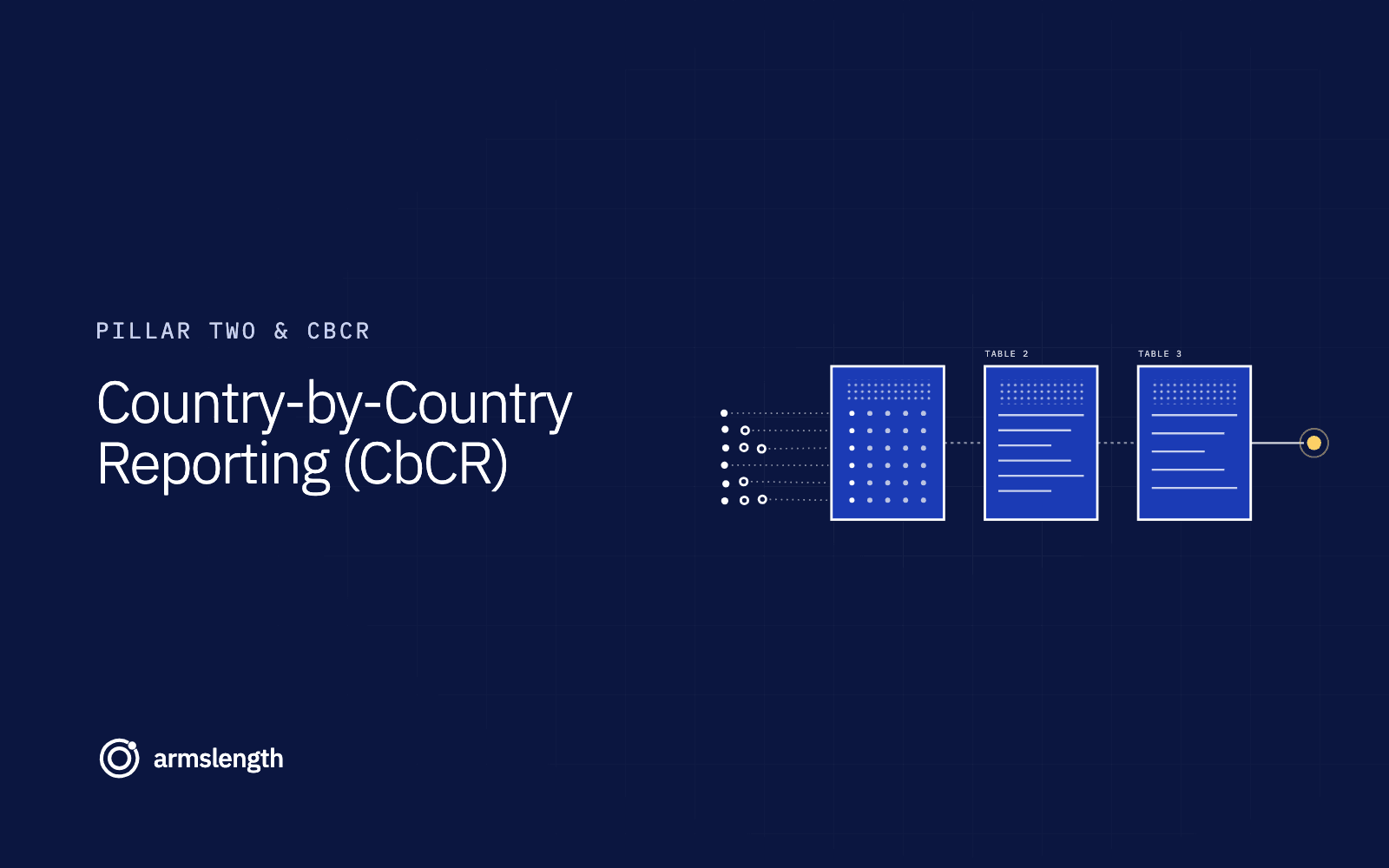
Mapping to OECD CbCR tables (why this matters for global consistency)
OECD Action 13 table
Form 8975 element
What it captures
Table 1 (jurisdictional summary)
Schedule A, Part I
Revenue split, PBT, cash tax paid, current tax accrued, employees, tangible assets, etc.
Table 2 (entity list + activities)
Schedule A, Part II
Entity roster and business activity codes (CBC501–CBC513)
Table 3 (additional info)
Schedule A, Part III and Form 8975 Part II
Narrative explanations and data source descriptions
If you maintain a global CbCR process (e.g., a non-U.S. secondary filing elsewhere), align definitions and mapping rules to avoid jurisdictional mismatches in exchanged reports.
Form 8975 Schedule A Part I: line-by-line guidance (what goes where)
Schedule A Part I is the heart of the report: it aggregates metrics for all constituent entities listed in Part II for that jurisdiction (Instructions for Form 8975). That “population integrity” rule is the single most important control.
The Part I lines (with common technical traps)
Line
Metric
What to report
High-risk interpretation points
1a
Revenues — unrelated
Revenue from transactions with non-constituent entities
Revenue is broader than “sales”: may include services, royalties, interest, premiums; excludes dividends from other constituent entities (Instructions for Form 8975).
1b
Revenues — related
Revenue from constituent-entity transactions
Ensure intercompany eliminations are handled consistently with your chosen source (consolidation vs management accounts).
1c
Total revenues
1a + 1b
Must be mechanically consistent with 1a/1b.
2
Profit (loss) before income tax
Aggregate PBT for the jurisdiction
Avoid including excluded “dividend-like” items if excluded from revenue on your methodology (Instructions for Form 8975).
3
Income tax paid (cash)
Cash taxes paid (including withholding taxes on payments to the entities)
Withholding taxes can be overlooked because they’re often booked outside the recipient entity (Instructions for Form 8975).
4
Income tax accrued — current year
Current year income tax expense accrued
Exclude deferred and typically exclude uncertain tax liabilities as described in instructions (Instructions for Form 8975).
5
Stated capital
Aggregate stated capital
Watch permanent establishments (PEs): stated capital generally belongs to the legal entity owner’s jurisdiction (Instructions for Form 8975).
6
Accumulated earnings
Aggregate retained earnings
Similar PE allocation logic to stated capital (Instructions for Form 8975).
7
Number of employees (FTE)
Employees on a consistent FTE basis
Choose average vs year-end and apply consistently; rounding is permitted if it doesn’t distort distribution (Instructions for Form 8975).
8
Tangible assets (net book)
Net book value of tangible assets other than cash
Excludes cash/cash equivalents, intangibles, financial assets; PE assets reported where the PE is located (Instructions for Form 8975).
The instructions include specific PE allocation concepts. Commonly:
Assets associated with a PE are reported in the PE jurisdiction (Schedule A Part I, line 8 logic).
Certain equity-like items (stated capital, accumulated earnings) are often reported in the legal entity owner jurisdiction, unless there is a defined capital requirement in the PE jurisdiction (Instructions for Form 8975).
Taxes can split based on where they are paid/accrued (owner jurisdiction vs PE jurisdiction) depending on the fact pattern (Instructions for Form 8975).
If your group has branch structures, document the PE rule you applied—and keep it stable year over year unless facts change.
Form 8975 Schedule A Part II: entity list, role codes, and business activities
Schedule A Part II is where you list each constituent entity resident in the tax jurisdiction for the Schedule A, and assign business activity code(s) (Instructions for Form 8975).
The Part II fields you must get right
Field
What the IRS expects
Practical control
Constituent entity legal name
Full legal name and legal form; PE naming convention “Legal Entity – (PE)”
Maintain a controlled entity registry (legal name + local registration form).
Control objective: exactly one UPE in the group, coded CBC801 or CBC803 as applicable. If the reporting entity is different from the UPE, ensure the reporting entity is properly coded CBC802.
TIN
Use local jurisdiction TIN; if none, enter “NOTIN”
Track missing TINs with a remediation queue (who owns it, target date).
Jurisdiction of incorporation
Only if different from tax residence jurisdiction
Frequently missed for entities resident in one country but organized in another.
Main business activity code(s)
CBC501–CBC513; “Other” requires description
Build a mapping policy so business activity selection is consistent.
Business activity codes (CBC501–CBC513) and how to choose them
The IRS codes align closely to the OECD CbCR activity headings (Instructions for Form 8975; OECD BEPS Action 13 Annex III).
Code
Activity (plain English)
Typical examples
CBC501
Research & Development
Product engineering center; pharma R&D lab
CBC502
Holding/Managing IP
IP owner/licensor entity
CBC503
Purchasing/Procurement
Global procurement hub
CBC504
Manufacturing/Production
Plant entity; contract manufacturing principal
CBC505
Sales/Marketing/Distribution
Local distributor; principal sales company
CBC506
Administrative/Management/Support
Shared services center; HQ functions
CBC507
Services to unrelated parties
Third-party service provider subsidiary
CBC508
Internal group finance
Treasury center; internal lender
CBC509
Regulated financial services
Bank; broker-dealer
CBC510
Insurance
Insurer; reinsurer
CBC511
Holding shares/equity instruments
Pure holding company
CBC512
Dormant
Inactive entity
CBC513
Other
Anything not reasonably covered above (must describe)
Tip
Pick business activity codes based on the entity’s primary value driver, not its legal label. A company called “HoldCo” that actively runs treasury is better coded as CBC508 than CBC511 if treasury is the main function.
Data sourcing, currency, and documentation: how to build a defensible Form 8975 process
Pick a consistent source hierarchy (and say it in Part III)
The IRS does not require a formal reconciliation of Form 8975 to the tax return or consolidated financial statements, but you do need to be able to support the reported numbers (Treas. Reg. §1.6038-4; Instructions for Form 8975). Part III is your opportunity to disclose:
whether you used consolidated reporting packages, statutory accounts, or management reporting,
how you treated eliminations and intra-group flows,
what changed year over year (reorganizations, acquisitions, accounting policy shifts).
A workable source hierarchy many tax teams adopt:
Consolidation system (group reporting packages) for revenue and PBT by entity
Tax provisioning system for current tax accrued (or a controlled extraction)
Cash tax tracker / treasury ledger for cash taxes paid and withholding taxes
HR system for FTE methodology
Fixed asset system for net tangible asset book values
Country codes and “OECD exchange-valid” coding
IRS instructions note that not all codes that appear in some IRS lists are valid for OECD exchange, and special handling may be needed in edge cases (Instructions for Form 8975). In practice:
maintain a jurisdiction code reference file used across Form 8975 and other global reporting,
flag non-standard territories early,
require a narrative explanation when “OC” or other exception handling is used.
Appropriate use (and why you should care even if you’re the filer)
OECD BEPS Action 13 states CbCR is for high-level risk assessment and is not a substitute for a full transfer pricing analysis (OECD BEPS Action 13, 2015 Final Report, paragraph 59). Practically, that means:
you should expect questions when CbCR suggests misalignment (e.g., high profits with low headcount),
you should have a story ready (e.g., IP ownership, unique intangibles, central entrepreneurial risk),
you should not rely on CbCR alone to defend pricing—link it back to your local files/master file and intercompany agreements.
For end-to-end CbCR process design, see our deeper walkthrough in the CbCR Preparation Guide.
Penalties and enforcement: what happens if Form 8975 is missing or incomplete
The Form 8975 instructions indicate penalties under IRC §6038(b) may apply for failure to furnish information or for incomplete/incorrect information (Instructions for Form 8975; statutory authority in IRC §6038). Penalty outcomes depend on facts, including timeliness and whether the failure is corrected after IRS contact.
Special rule: specified national security contractors (Notice 2018-31)
A narrow but important exception exists for “specified national security contractors” (Notice 2018-31; IRS CbCR FAQs). In general terms, a U.S. MNE group can fall into this category if more than 50% of its prior reporting period annual revenue (determined under U.S. GAAP) is attributable to contracts with the U.S. Department of Defense or other U.S. government intelligence or security agencies.
For eligible groups, the IRS has described a modified reporting approach that (at a high level) involves:
completing Form 8975 with an identifying statement in the Additional Information section,
filing a US Schedule A with aggregated financial and employee information for the entire U.S. MNE group in Part I, but listing only the UPE in Part II, and
filing a stateless (X5) Schedule A with zeros in Part I and listing only the UPE in Part II, with no other Schedules A required under that approach.
If you think this may apply, treat it as a counsel-led determination: it can affect both what you file and what is exchanged.
Warning
A common confusion in practice is mixing Form 8975 penalties with Form 5472/IRC §6038A penalties. Form 8975 is filed under §6038 reporting authority and has its own penalty framework and compliance expectations (Instructions for Form 8975).
Mitigation is mostly operational:
file on time (or on a valid extension with the return),
keep jurisdiction mapping memos and data lineage,
correct errors promptly via amended returns when required.
Common Form 8975 errors (and how to prevent them)
Common Pitfalls to Avoid
01Missing a U.S. Schedule A (or failing to use an X5 stateless Schedule A when your U.S. footprint is fiscally transparent).
02Using incorrect or non-exchange-valid country codes; not documenting exceptions like ‘OC’ where needed.
03Part I aggregates that don’t match the Part II entity population—especially after acquisitions, liquidations, or reorganizations.
04Including dividends from other constituent entities in revenue/PBT despite the instructions’ exclusion concept.
05Confusing cash taxes paid (Line 3) with current tax accrued (Line 4), or pulling deferred tax expense into Line 4.
06Inconsistent employee methodology (year-end vs average) that creates artificial volatility across jurisdictions.
A practical control set that works
A “lightweight but robust” control set many tax teams implement:
Entity registry lock date: freeze the constituent entity list for the reporting period (with documented post-close adjustments).
Jurisdiction mapping sign-off: tax owner approves each entity’s residence jurisdiction and incorporation jurisdiction differences.
Three-way tie: Part II entity count ↔ consolidation perimeter ↔ Part I aggregation dataset.
Variance analytics: year-over-year change thresholds (e.g., ±20% in PBT or ETR proxies) forcing commentary in Part III.
Schema pre-check: validate codes/field lengths before return assembly.
Practical examples (with numbers)
Example 1: Do you meet the Form 8975 threshold—and how many Schedule A filings do you need?
Facts
USP is a U.S. corporation and the group’s UPE.
Prior reporting period consolidated revenue: $1.20 billion
Current reporting period: calendar year 2025
Constituent entities resident in: United States and Germany
Step 1 — Threshold test
Because prior-period revenue is $1.20B ≥ $850M, USP is within scope (Treas. Reg. §1.6038-4; Instructions for Form 8975).
Step 2 — Filing mechanics and schedules
USP files Form 8975 attached to its U.S. return, due with the return including extensions (Instructions for Form 8975). It must prepare at least:
Schedule A (US)
Schedule A (DE)
Illustrative Schedule A (US) Part I (USD)
Line
Metric
Amount
1a
Unrelated revenue
700,000,000
1b
Related revenue
200,000,000
1c
Total revenue
900,000,000
2
PBT
120,000,000
3
Cash taxes paid
24,000,000
4
Current tax accrued
26,000,000
7
Employees (FTE)
2,000
8
Tangible assets
400,000,000
Control takeaway: The Part I numbers must reflect only the U.S.-resident constituent entities that you list in Schedule A (US) Part II (Instructions for Form 8975).
Example 2: Revenue definition trap—why dividends can silently overstate revenue and PBT
Facts (Jurisdiction: US)
A U.S. holding company receives:
Third-party service revenue: $60,000,000
Intercompany service revenue: $15,000,000
Dividend from a foreign constituent entity: $25,000,000
Incorrect approach (common mistake)
Some teams include the dividend in revenue and PBT, producing:
text
Unrelated revenue (1a): 60,000,000
Related revenue (1b):   40,000,000  (15,000,000 intercompany + 25,000,000 dividend)
Total revenue (1c):    100,000,000
Correct approach (instructions-driven concept)
Dividends received from other constituent entities are generally excluded from revenue for CbCR purposes (Instructions for Form 8975). Under that approach:
text
Unrelated revenue (1a): 60,000,000
Related revenue (1b):   15,000,000
Total revenue (1c):     75,000,000
Impact: Your jurisdictional “profitability per revenue” signal (and ETR-style analytics) can materially change based on this classification. Even if you disclose in Part III, inconsistent treatment across years can trigger risk flags in both IRS and foreign tax authority analytics.
Tip
If your consolidation system books “dividend income” inside revenue lines, build a CbCR-specific reclassification layer rather than trying to override the general ledger.
Example 3: Using Form 8975-style data to screen Pillar Two Transitional CbCR Safe Harbour (de minimis + simplified ETR)
While Form 8975 is not a Pillar Two return, many groups start Pillar Two screening with the same jurisdictional dataset.
Facts (Jurisdiction: Country X)
From CbCR-style metrics:
Total revenue: €9,000,000
Profit (loss) before income tax: €800,000
Test 1 — De minimis test (Transitional CbCR Safe Harbour)
Safe harbour de minimis applies if:
Revenue < €10m AND
PBT < €1m
(OECD Safe Harbours, Dec 2022)
Country X meets both thresholds, so it screens in as de minimis.
Now assume a different year for the same jurisdiction:
Total revenue: €120,000,000
PBT: €20,000,000
Simplified Covered Taxes: €3,600,000
What “Simplified Covered Taxes” means (why this is not “current tax”)
Under the OECD Transitional CbCR Safe Harbour, the numerator for the simplified ETR test is Simplified Covered Taxes, which is the jurisdiction’s income tax expense as reported on the MNE group’s Qualified Financial Statements, after eliminating (i) taxes that are not Covered Taxes and (ii) uncertain tax positions. The OECD framework also notes that the income tax expense used for the ETR test includes deferred items (subject to the specified removals above), so it is not accurate to describe this as a “current tax expense proxy” (OECD Safe Harbours, Dec 2022).
Transition rates and period (guardrails)
For the Transitional CbCR Safe Harbour, the OECD Safe Harbours paper defines the transition rates as:
15% for fiscal years beginning in 2023 and 2024
16% for fiscal years beginning in 2025
17% for fiscal years beginning in 2026
(OECD Safe Harbours, Dec 2022)
If the relevant transition rate is 16% for FY2025, then 18% ≥ 16%, so the jurisdiction screens in under the simplified ETR test (subject to “Qualified CbC Report” and other conditions).
Control takeaway: The safe harbour relies on a “Qualified CbC Report” concept. If your Form 8975 dataset is inconsistent (population, revenue definition drift, tax-line confusion), you can create Pillar Two rework—even when the Form 8975 filing itself is timely.
How Form 8975 data intersects with Pillar Two safe harbours (and what to do about it)
The OECD Transitional CbCR Safe Harbour uses jurisdictional revenue and profit (loss) before tax from a CbCR dataset to determine whether a jurisdiction can be treated as having zero top-up tax for a transition period (OECD Safe Harbours, Dec 2022). This has two implications for U.S. Form 8975 filers:
You need definitional governance: revenue, PBT, and (especially) income-tax-expense concepts must be stable and documented.
You need audit-ready lineage: if you later use CbCR data for Pillar Two, you’ll be asked “where did this number come from?” across tax, finance, and systems.
2024–2025 Pillar Two update context (why “Dec 2022” isn’t the end of the story)
The Transitional CbCR Safe Harbour design originated in the OECD’s December 2022 Safe Harbours paper, but the OECD has continued to publish Pillar Two materials—including multiple releases of Agreed Administrative Guidance (e.g., June 17, 2024 and January 15, 2025) and a Consolidated Commentary published May 9, 2025 that incorporates agreed guidance through March 2025 (OECD Pillar Two hub).
Practical takeaway: if you’re reusing Form 8975-style data for Pillar Two screening, build a process to track the latest OECD guidance that can affect:
the meaning and adjustments to the simplified ETR numerator (income tax expense / “Simplified Covered Taxes”),
how taxes and profits are treated in specific structures (PEs, hybrids, flow-throughs, etc.),
transition-period mechanics and safe harbour conditions.
Key point
Teams that treat Form 8975 as a controlled dataset (entity registry + jurisdiction mapping + documented source hierarchy) typically reduce both CbCR risk and Pillar Two implementation cost, because the same data is reused with fewer adjustments.
Form 8975 is the U.S. country-by-country report used to disclose high-level financial and operational metrics by tax jurisdiction for large U.S.-headed MNE groups (Instructions for Form 8975).
2) Who must file Form 8975?
A U.S. person that is the ultimate parent entity of a U.S. MNE group must file Form 8975 if the group’s prior reporting period revenue is at least $850 million (Treas. Reg. §1.6038-4; Instructions for Form 8975).
3) How is the $850M Form 8975 threshold tested?
The threshold is tested using the group’s annual revenue for the immediately preceding reporting period, not the current year (Treas. Reg. §1.6038-4; TD 9773).
4) When is Form 8975 due (and can it be extended)?
Form 8975 is due when the filer’s U.S. income tax return is due, including extensions, because it is filed as an attachment to the return (Instructions for Form 8975).
5) What is Form 8975 Schedule A and how many do you need?
Schedule A is the jurisdiction-level schedule. You generally file one Schedule A per tax jurisdiction where the group has resident constituent entities (Instructions for Form 8975).
6) Do you need a U.S. Schedule A on Form 8975?
Generally, yes—most U.S.-headed filers include a Schedule A (US). In certain structures, U.S. entities may be reported in a “stateless” Schedule A (code X5), depending on residence treatment (IRS CbCR FAQs; Instructions for Form 8975).
7) What does “stateless” (X5) mean on Form 8975 Schedule A?
“Stateless” refers to constituent entities that do not have a tax jurisdiction of residence for these reporting purposes and are reported on a Schedule A using code X5 (Instructions for Form 8975).
8) What are the Form 8975 business activity codes (CBC501–CBC513)?
They are standardized activity categories used in Schedule A Part II (e.g., R&D, IP holding, manufacturing, sales/distribution, services, internal finance, insurance, holding shares, dormant, other) (Instructions for Form 8975).
9) What are common Form 8975 preparation errors?
Common errors include missing US/X5 schedules, incorrect country codes, Part I totals not matching the Part II entity population, dividend inclusion issues in revenue/PBT, and mixing cash taxes paid (Line 3) with current tax accrued (Line 4) (Instructions for Form 8975; IRS CbCR FAQs).
10) What penalties apply if Form 8975 is not filed or is incomplete?
The IRS instructions indicate penalties under IRC §6038(b) may apply for failure to furnish required information or for incomplete/incorrect information (Instructions for Form 8975; IRC §6038).
11) How does Form 8975 relate to Pillar Two transitional CbCR safe harbours?
The OECD Transitional CbCR Safe Harbour uses jurisdictional revenue and profit (loss) before tax from a “Qualified CbC Report” to screen for zero top-up tax during the transition period. For the simplified ETR test, the numerator is Simplified Covered Taxes (income tax expense from Qualified Financial Statements, adjusted for non-covered taxes and uncertain tax positions). Many groups use the same underlying dataset used for Form 8975 as the starting point, so data quality and definitional consistency directly affect Pillar Two readiness (OECD Safe Harbours, Dec 2022).
12) If you need to amend Form 8975, can you file only the changed schedules?
Generally no. IRS guidance indicates you typically must file an amended Form 8975 and all Schedules A (including unchanged ones), and you should file the amended submission using the same method (e-file vs paper) as the original (IRS CbCR FAQs).
13) If you file Form 8975 on paper, is there an extra mailing step?
Yes. IRS guidance requests that paper filers also mail a copy of page 1 of Form 8975 to the Ogden mailbox to notify the IRS that the CbCR attachment was paper-filed (IRS CbCR FAQs; Instructions for Form 8975).
 Borys UlanenkoCEO of ArmsLength AI