Preparing Transfer Pricing Functional Analysis with ChatGPT (2025)Preparing Transfer Pricing Functional Analysis with ChatGPT (2025)
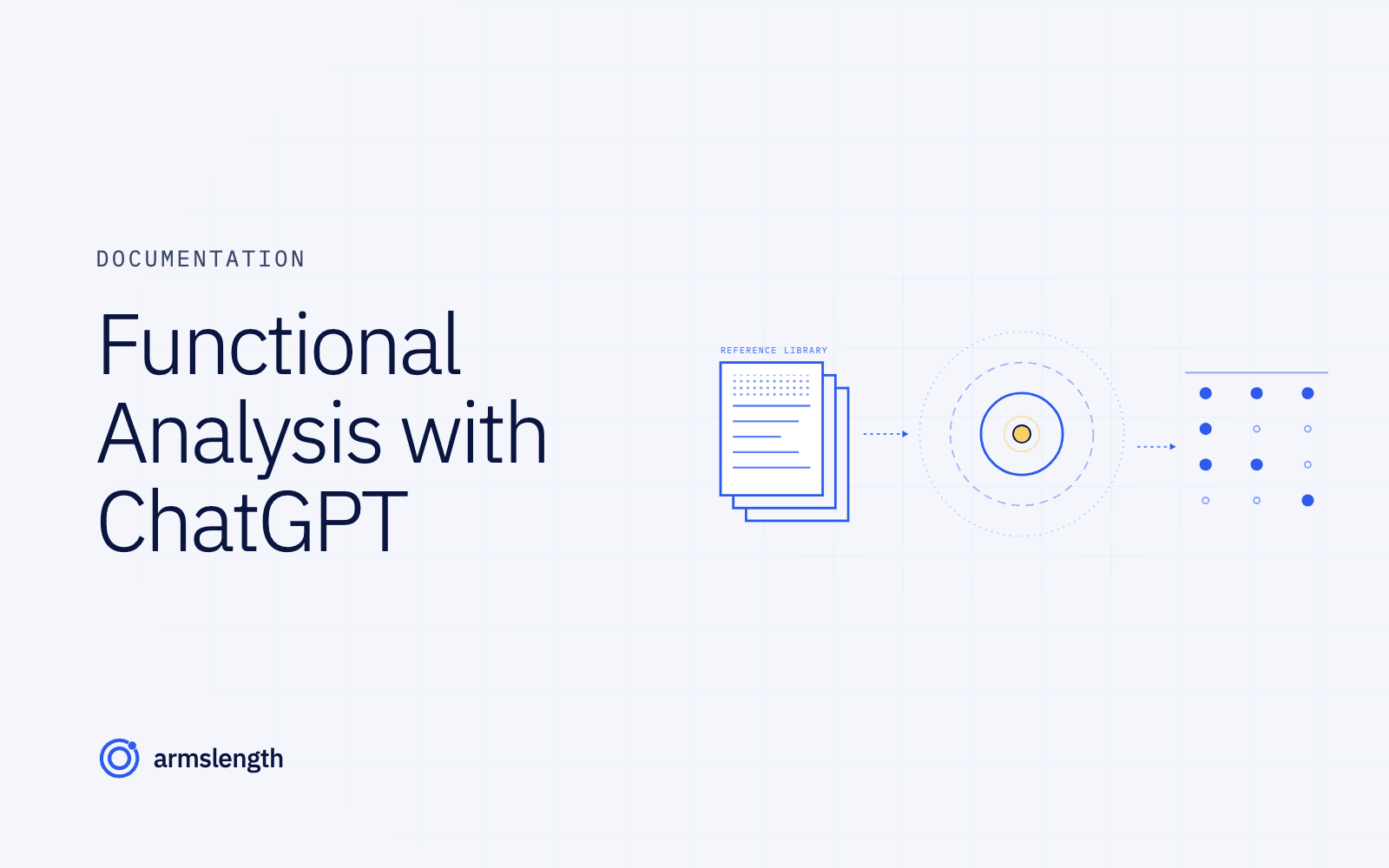
Learn how to leverage ChatGPT Projects to create standardized, high-quality functional analyses with remarkable efficiency while maintaining professional transfer pricing standards.
Borys UlanenkoCEO of ArmsLength AI
10min read
Contents↓
Contents
TL;DR key takeaways
AI-assisted functional analysis creates consistent structure and comprehensive coverage across all your transfer pricing documentation.
Setting up custom instructions with detailed templates ensures ChatGPT produces functional analyses that meet professional standards.
Reference libraries for functions, assets, risks, and entity characterizations are essential for quality AI-generated content.
Human review and professional judgment remain critical for ensuring accuracy and appropriateness of AI outputs.
Business restructurings trigger intensive transfer pricing scrutiny. Learn what documentation you need before, during, and after a restructuring—including exit charge calculations, valuation requirements, and how to avoid common pitfalls that invite audit adjustments.
Strong intangibles documentation, consistent with OECD Chapter VI (intangibles) and Chapter V (documentation), requires identifying all relevant IP, distinguishing legal ownership from entitlement to returns using the DEMPE framework, and ensuring arm's length compensation for each contributor. This guide covers DEMPE analysis, valuation approaches, hard-to-value intangibles, CCAs, and common documentation gaps.
More resources for your next workflow stepMore resources for your next workflow step
Browse the full resource library or contact us if you want recommendations for your specific use case.
Transfer pricing functional analysis is a critical component of any comprehensive transfer pricing documentation. It helps establish the economic substance behind intercompany transactions and determines appropriate transfer pricing methods. Traditionally, this process has been manual, time-consuming, and repetitive—exactly the kind of task that's ripe for AI assistance.
In this guide, I'll walk you through how to leverage ChatGPT Projects to create standardized, high-quality functional analyses with remarkable efficiency. Based on insights from industry experts, I'll show you how to set up a reusable workflow that maintains the quality standards expected in professional transfer pricing work.
1. Why Use AI for Functional Analysis?
Before diving into the technical setup, let's understand why AI-assisted functional analysis makes sense:
Standardization: Creates consistent structure across all analyses
Efficiency: Reduces time spent on repetitive documentation
Comprehensiveness: Ensures all relevant functions, assets, and risks are considered
Quality control: Applies a systematic approach to entity characterization
Note
However, as with any AI application in professional settings, the output requires human review and expertise to ensure accuracy and appropriateness.
2. Setting Up Your ChatGPT Project for Functional Analysis
Step 1: Create a New Project
Log into ChatGPT (ensure you're using a paid subscription with access to Projects)
Click on "New Project" in the sidebar
Name your project (e.g., "Functional Analysis Prep")
Click "Create"
Step 2: Add Custom Instructions
Custom instructions are crucial for guiding ChatGPT to produce functional analyses that meet professional standards. Here's a template based on industry best practices:
Text
You are a transfer pricing functional analysis writer.

You will be provided with:
1. A library of possible functions, assets, and risks to consider in your analysis
2. A library of entity characterizations/functional profiles
3. Information about a transaction (such as intercompany agreements, interviews, or other documentation)

In your functional analysis:
- Use functions, assets, risks, and entity characterizations only from the provided lists; do not create your own
- Include only functions, assets, and risks that are relevant for either side of the transaction
- Analyze both sides of the transaction (Entity A and Entity B)

Format your output as follows:

ENTITY A: [Replace with actual entity name]

FUNCTIONS:
- Function A: [Description of how Entity A performs this function]
- Function B: [Description of how Entity A performs this function]
[Continue for all relevant functions]

ASSETS:
- Asset A: [Description of how Entity A uses/owns this asset]
- Asset B: [Description of how Entity A uses/owns this asset]
[Continue for all relevant assets]

RISKS:
- Risk A: [Description of how Entity A bears/manages this risk]
- Risk B: [Description of how Entity A bears/manages this risk]
[Continue for all relevant risks]

ENTITY B: [Replace with actual entity name]

[Repeat the same structure for Entity B]

CONCLUSION ON ENTITY CHARACTERIZATION:
Based on the analysis above, Entity A can be characterized as [select from provided profiles].
Based on the analysis above, Entity B can be characterized as [select from provided profiles].
If no profile matches exactly, clearly explain why.

ASSUMPTIONS AND FOLLOW-UP QUESTIONS:
[List any assumptions made in this analysis]
[Suggest follow-up questions for further clarification]
Save these instructions in your project settings.
Step 3: Upload Reference Documents
For truly effective functional analysis, you need to provide ChatGPT with the reference materials it needs to understand transfer pricing standards. You should upload:
Functions, Assets, and Risks Library: A document listing standard functions, assets, and risks commonly analyzed in transfer pricing
Entity Characterizations/Functional Profiles Library: A document describing common entity types (e.g., limited-risk distributor, fully-fledged manufacturer, etc.)
Warning
Without proper reference libraries, ChatGPT may create its own functions, assets, risks, or entity characterizations that don't align with standard transfer pricing practice.
3. Reference Libraries
Sample Functions, Assets, and Risks Library
Here's a starting point for your library, which you can customize based on your practice:
Text
# Risks

(Choose only relevant ones for the analyzed transaction, do not include the rest)

1. Market risk: Market risk can occur when a company faces unfavorable sales conditions due to increased competition, inability to develop the market, or failure to reach target customers. Key considerations include the definition of market risk, who bears it, and its overall significance.
2. Inventory risk: This risk pertains to potential losses associated with carrying finished product inventory. Questions that need answering include whether inventory becomes obsolete, who bears the cost of obsolete inventory, who provides warranties in relation to finished goods, who bears the cost of returns/repairs under warranty, and how significant the inventory risk is.
3. Customer credit risk: When a company supplies products or services to a customer before receiving payment, it faces the risk that the customer will fail to pay. This risk is known as customer credit risk. Important factors include the credit terms given and received, who bears the cost of bad debts, and the overall significance of the customer credit risk.
4. Product technology risk: This risk relates to the potential consequences of changes in a particular market. The risk of obsolescence or stranded assets due to behavioral or technological change is a form of product risk.
5. Foreign exchange risk: This risk relates to the potential variability of profits that can arise due to changes in foreign exchange rates.
6. Warranty product liability risk: This arises when a product fails to perform at the accepted or advertised standard.
7. Scheduling/production risk: This risk relates to the uncertainty involved in scheduling production in response to unpredictable fluctuations in demand or production flow.
8. Operational risks: These relate to the physical performance of the assets operated and managed by the business, and the potential for them to be affected by events beyond a business's control.
9. Financial risks: These relate to the relationship between a firm's revenue and its financing costs.
10. Volume risk: This risk is a function of the way in which companies generate their revenue. It can lead to forecasting risk, which relates to the predictions of costs and revenues.
11. Asset redundancy risk: A firm's assets might become obsolete or redundant in response to a shift in customer demand.
12. Infrastructure failure risk: This risk pertains to a company's own assets that might not be covered by insurance. It may be possible to predict the expected costs associated with infrastructure failure risk for inclusion in the cash flows.
13. Service incentive scheme risk: This risk is associated with the operation of service incentive schemes (e.g., reliability and service performance), particularly when their actual performance might be influenced by factors outside their control.
14. Foreign investment risk: This is the risk associated with investing in one country, but with shareholders in another. It might be possible to estimate the likely costs associated with this risk for inclusion in the cash flows due to the size of the foreign exchange market.
15. Inflation risk: This risk pertains to the possibility that expected inflation might differ from actual inflation. It's possible to predict the expected loss of managing this risk, or develop an approach to regulation that directly compensates the business for bearing this risk.
16. Real interest rate risk: This risk is associated with the assumption of locking in the interest-free rate. It may be challenging to definitively predict the expected costs associated with this risk for inclusion in the cash flows, but market evidence might assist in this process.
17. Personnel risk: This risk is associated with the attrition of skilled/trained personnel, which can result in time and cost overruns to replace.
18. Capacity utilization risk: This risk arises when the installed capacity for a manufacturer or service provider is not optimally utilized and the companies have to bear fixed costs associated with excess capacity.
19. Compliance risk: The risk of financial or reputational loss that can occur from not complying with laws or regulations. This could involve both domestic and international regulations.
20. Political and regulatory risks: These risks relate to potential losses due to changes in government policies, trade restrictions, tax laws, and political instability.
21. Environmental risk: This pertains to potential losses due to environmental damage and the associated costs of repairs, fines, or a decrease in brand value.

# Functions

(Choose only relevant ones for the analyzed transaction, do not include the rest)

1. Research and Development (R&D): This function is involved in the development of new products or processes.
2. Design and Engineering: This involves designing the product, creating specifications, and improving product efficiency.
3. Sourcing and Procurement: This function is responsible for acquiring the raw materials and other resources needed to manufacture the product.
4. Manufacturing and Production: This involves the physical production of the products.
5. Quality Control: This function ensures that the products meet the necessary standards and specifications.
6. Distribution: This involves storing and transporting the goods to the customers or retail outlets.
7. Marketing and Advertising: This function is responsible for promoting the products and creating brand awareness.
8. Sales: This function includes activities related to selling the products to customers.
9. Customer Service: This involves post-sale services, such as handling customer complaints and providing product support.
10. Finance: This function manages the company's financial resources.
11. Human Resources: This function manages the company's workforce, including hiring, training, and managing employee benefits.
12. Information Technology (IT): This function manages the company's IT infrastructure and ensures that the company's technology needs are met.
13. Legal: This function manages legal risk, ensures compliance with laws and regulations, and provides legal advice to the company.
14. Accounting: maintains financial records, and ensures compliance with tax and other regulatory requirements
15. Business Strategy and strategic management: This involves the planning and execution of the company's strategic objectives. May include determination of pricing policy, production strategy, and the sale of goods (work, services), volumes of sales and assortment of goods (work, services), their consumer qualities, as well as operational management.
16. Risk Management: This involves identifying, assessing, and managing risks that could impact the company's operations or profitability.
17. Inventory and logistics management: This function is responsible for overseeing the flow of goods from manufacturers to warehouses and from these facilities to point of sale
18. Insurance: This function manages the company's risk exposure by transferring potential losses to an insurance provider. It involves the procurement of insurance policies that cover potential losses or damages to the company's assets, personnel, or operations.
19. Product Maintenance and Warranty Services: This function handles the upkeep, repair, and warranty obligations of the products sold. It involves the provision of services such as product repairs, replacements, or adjustments as needed to ensure the product's performance and longevity. Additionally, under the product warranty terms, it entails fulfilling commitments made by the manufacturer or seller to fix or replace products free of charge within a specified period or under certain conditions.

# Assets

(Choose only relevant ones for the analyzed transaction, do not include the rest)

Intangible Assets:

1. Patents: The right granted to anyone who invents any new, useful, and non-obvious process, machine, article of manufacture, or composition of matter.
2. Trademarks: These serve to identify a particular business as the source of goods or services.
3. Brand Names: These help customers identify and differentiate one product from another.
4. Licenses: Official or legal permission to do or own a specified thing.
5. Copyrights: Copyright owners have the right to control the reproduction of their work, including the right to receive payment for that reproduction.
6. Unpatented Technical Know-How: Specialized knowledge or expertise not protected by a patent.
7. Customer Lists and Relationships: The value derived from a company's established customer base and the relationships they maintain.
8. Software: Proprietary software or applications developed by the company.
9. Trade Secrets: Information that provides a company with a competitive advantage and is treated as confidential.
10. Goodwill: The value derived from a company's reputation, customer relationships, and other intangible assets that are not separately identifiable.
11. Franchises: A right granted by a government or company to an individual or group, enabling them to carry out specified commercial activities.
12. Contracts: The value associated with favorable contracts, such as supply contracts, service contracts, or lease agreements.

Tangible Assets:

1. Land and Buildings: Physical properties owned by the company.
2. Furniture and Fixtures: Movable furniture, fixtures, or other equipment that have no permanent connection to the structure of a building.
3. Computers: Servers, desktops, laptops, and related hardware.
4. Plant and Machinery: Industrial units or machines that are used for manufacturing or other industrial purposes.
5. Vehicles: Company-owned cars, trucks, or other modes of transportation.
6. Inventory: Goods available for sale or raw materials used to produce goods.
7. Office Equipment: Fax machines, printers, photocopiers, telephone systems, etc.
8. Leasehold Improvements: Enhancements paid for by a tenant to leased property.
Sample Entity Characterizations Library
Text
A (commission) agent does not usually purchase products and resell to the customer, but instead operates as a sales representative and receives a commission on the sales to customers (the commission is often calculated as a percentage of the price paid by the customer). An agent is responsible for interaction with the customers and facilitates sales, but the terms of the sale and the contract for sale itself are agreed upon and concluded by the principal. An agent does not take title to the products and therefore incurs minimal risks. While a distributor reports revenue as the amount of the product sold to customers, an agent generally reports income as the amount of commission received from the supplier, which is often a small fraction of the third-party sales.

A Limited-Risk Distributor (LRD) is an entity that buys goods and markets them to customers. The arrangement between the distributor and principal significantly limits LRD risks. Risks relating to inventory and debtors will be effectively controlled and covered by the principal. For example, the obsolete stock will be bought back, bad debts will be reimbursed, etc. The market risk will also be limited for the LRD. Such a distributor typically does not develop significant marketing intangibles. The material difference between an agent and the LRD is that the LRD takes the title of the product, which leads to more significant functions and risks compared with an agent. However, these functions and risks are still limited.

A Fully-Fledged Distributor (FFD) undertakes all of the sales and distribution functions and bears all of the material risks relevant to these functions. It buys, holds, and sells products, develops necessary intangibles, and has significant downside risks, as well as receiving upside results of positive outcomes of its activity. The FFD usually incurs material costs to execute its functions and is often entitled to residual profit.

A toll manufacturer is an entity that processes raw materials or semi-finished goods for another company. Essentially, a toll manufacturer provides the service to the principal without taking title to the raw materials or final products. As a result, a toll manufacturer does not bear inventory and selling risks. It is not responsible for the procurement of raw materials, executes very limited quality control or logistics management, and does not utilise any significant intangibles.

a contract manufacturer executes manufacturing functions for a principal. However, contrary to a toll manufacturer, a contract manufacturer takes title to the raw materials and finished products. Provided it meets specified quality and quantity, a principal will guarantee to buy all the goods manufactured. This means the contract manufacturer does not have risks associated with holding finished products or selling them. A contract manufacturer will, however, still buy the raw materials (and bear the associated stock risk).

A fully-fledged manufacturer executes all important manufacturing functions and bears associated risks. It usually engages in production planning, sourcing and procuring inputs, R&D activities, design and engineering, quality control, and logistics. A fully-fledged manufacturer assumes the market risk, inventory risk, R&D risk, product liability risk, and other risks depending on the MNE structure. It usually earns a residual profit (i.e., all profit remaining after it compensates other, less risky parties).

A principal, or entrepreneur, in the context of transfer pricing and multinational enterprise (MNE) structures, is an entity that performs key functions, bears significant risks, and often employs important intangible assets. This entity holds ownership or control of the production of goods or services, and it's involved in strategic decision-making processes. It typically sources raw materials, controls production or service execution, and handles the sale of the finished products or services, thus being responsible for the end-to-end supply chain. Principals often undertake considerable risks related to the business operations, including market, credit, and operational risks. In essence, the principal is the main driving force behind the value creation in an MNE. Furthermore, the principal is often characterized by a higher degree of control over intangible assets, such as patents, trademarks, or trade secrets, which can be crucial for a company's competitive advantage. These intangible assets drive profit generation. As a result of taking on considerable risks and controlling key assets, the principal is typically entitled to the residual profit (i.e., the profit remaining after all other parties have been compensated) in the MNE group. This profit reflects both the return on the functions performed and the risks assumed by the principal entity. The characterization of an entity as a principal is critical in transfer pricing as it guides the allocation of profits within the MNE group.

A service provider in the context of transfer pricing and multinational enterprise (MNE) structures is an entity that provides specific services to other entities within the MNE group. The types of services provided can be diverse and may include IT services, human resources, finance, legal support, among others. The service provider does not typically own key intangible assets or bear significant risks.

Procurement entity: This entity handles the procurement of raw materials or goods for other entities within a multinational group. The procurement entity doesn't usually own the goods and bears limited risks.

A Service Recipient in the context of transfer pricing and multinational enterprise (MNE) structures is an entity that receives services from other units within the MNE, such as IT, HR, or legal services. This entity pays a fee to the service provider, usually calculated on a cost-plus basis or as a fixed or variable service fee. The service recipient does not typically bear significant operational risks related to these services; those are usually assumed by the service provider. However, the recipient may face performance risk, as the quality of services received can impact its operational effectiveness.

A licensor is an entity that owns specific intangible assets, such as patents, trademarks, copyrights, or technology, and provides rights to use these assets to another entity (licensee) typically within the same MNE group. The licensor bears risks associated with the development, maintenance, protection, and enhancement of these intangible assets. In return for granting the license, the licensor receives a royalty or licensing fee, which is often calculated based on a percentage of revenues generated from the licensee's use of the intangible assets, or alternatively, may be a fixed fee. The licensor is not typically engaged in the production, marketing, or delivery of products or services that utilize the licensed intangible assets but may play a role in ensuring compliance with license terms and maintaining the quality and reputation of the licensed items.

A licensee is an entity that has been granted rights by a licensor to use certain intangible assets such as trademarks, patents, or technology, often for the production, marketing, and sale of goods or services. The licensee typically compensates the licensor through payment of royalty fees or licensing fees, which may be based on a proportion of sales revenue generated using the intangible assets, or a fixed fee, as agreed upon in the licensing agreement. While a licensee may bear certain risks related to the exploitation of the licensed intangibles, such as market or operational risks, it does not bear the risks related to the development, enhancement, maintenance, and protection of the intangible assets themselves. The licensee utilizes the intangible assets to enhance its own value creation in its operational activities, and its profit potential is influenced by its ability to effectively exploit the licensed intangibles.

A borrower is an entity that obtains funds from another entity (lender) with an agreement to repay the principal amount along with interest or fees associated with the borrowing. Borrowers may utilize the funds to finance various aspects of their operations, such as working capital needs, capital expenditures, or acquisitions. The borrower bears the risks associated with the utilization of borrowed funds and is obligated to adhere to the terms of the loan agreement, which may include covenants, repayment schedules, and interest payments.

A lender is an entity that provides funds to another entity (borrower) with the expectation of repayment of the principal along with compensation in the form of interest or fees. The lender typically evaluates the creditworthiness of the borrower and other risk factors before disbursing funds and agrees upon the terms and conditions of the loan, which are documented in a loan agreement. The lender bears the risk of default by the borrower and should consequently be compensated with an appropriate return that reflects this risk.
4. Using Your Project for Functional Analysis
Once your project is set up, using it is straightforward:
Start a new chat within your project
Upload or paste the relevant transaction information (intercompany agreements, interview notes, etc.)
Ask ChatGPT to "Please prepare a functional analysis for this transaction"
Example Request
Text
Please prepare a functional analysis based on the attached intercompany agreement between Company X and Company Y.
5. Tips for Getting Better Results
Provide sufficient context: The more information you provide about the transaction, the better the analysis will be
Use multimodal abilities: You can upload PDFs of agreements, screenshots of organizational charts, etc.
Request follow-up output: Ask for a summary table showing functions, assets, and risks for each entity side-by-side
Iterate as needed: If the first analysis isn't satisfactory, ask for revisions based on specific feedback
Tip
When providing transaction information, include legal agreements, business context, organizational charts, and relevant industry-specific information.
6. Post-Processing and Quality Control
Remember that AI-generated functional analysis is a starting point, not the final product. Always:
Review for factual accuracy
Ensure the entity characterization makes sense given the functions, assets, and risks
Consider jurisdictional nuances that may not be reflected in the analysis
Use the follow-up questions to gather additional information
Customize the analysis to reflect the specific circumstances of your client
7. Summary Table Example
Once your functional analysis is complete, it's helpful to create a summary table. You can ask ChatGPT:
Text
Please take the provided functional analysis and create a summary table with the following columns:
- Function/Asset/Risk
- Entity A (indicate level: High/Medium/Low)
- Entity B (indicate level: High/Medium/Low)
This might produce a table like:
Function/Asset/Risk of the entity
Entity A (Manufacturer)
Entity B (Distributor)
R&D and Design
High
Low
Manufacturing
High
None
Distribution
Low
High
Marketing
Low
High
IP Ownership
High
Low
Inventory Risk
Medium
High
Market Risk
Low
High
Credit Risk
Low
High
This visual summary makes it easier to verify that your functional analysis aligns with the intended entity characterizations.
Key point
The summary table is particularly helpful for quick reviews and for ensuring consistency in your characterization approach across multiple entities in a value chain.
8. Advantages and Limitations
Advantages
Significantly reduces time spent on drafting initial functional analyses
Ensures consistent structure and comprehensive coverage
Helps identify areas where more information is needed
Creates a standardized approach across your practice
Limitations
Not a replacement for professional judgment
Requires quality inputs to produce quality outputs
May not account for all jurisdictional nuances
Cannot independently conduct interviews or gather data
9. Beyond Basic Functional Analysis
Once you're comfortable with the basic setup, consider expanding your project to include:
Templates for different transaction types (services, tangible goods, intangibles)
Industry-specific functions, assets, and risks
Jurisdiction-specific considerations
Integration with other transfer pricing documentation
AI tools like ChatGPT Projects are transforming transfer pricing practice, allowing professionals to focus on value-added analysis rather than routine documentation. A well-structured functional analysis project improves efficiency while maintaining quality standards.
The key to success is providing the AI with clear instructions, comprehensive reference materials, and applying your professional judgment to the output. As with any tool, the quality of what you get depends on how well you use it.
I'd love to hear your experiences with using AI for functional analysis. What challenges have you faced? What techniques have you found most effective? Share your thoughts in the comments below.
Frequently Asked Questions
How much time can I save using AI for functional analysis?
There is no reliable universal percentage. Time saved depends on source quality, transaction complexity, review controls, and how much reusable material already exists. Measure the same workflow before and after adoption, including setup, fact checking, revision, and approval time, rather than comparing draft-generation time alone.
Does using AI for functional analysis create compliance risks?
Yes. Relevant risks include inaccurate or invented statements, loss of source provenance, inconsistent treatment of confidential information, and over-reliance on a draft that has not been reconciled to evidence. Use an approved environment, apply the organisation's data-handling rules, retain sources, and require a qualified reviewer to verify the final analysis.
How do I ensure my AI-generated functional analysis meets OECD standards?
Incorporate OECD language and principles into your custom instructions and reference libraries. Regularly update these as OECD guidance evolves. Always review the final output against current OECD guidelines.
Can AI help with industry-specific functional analyses?
Yes, but you'll need to build industry-specific libraries of functions, assets, and risks. For specialized industries (pharmaceuticals, digital services, etc.), create custom reference documents that capture industry-specific terminologies and business models.
How do I handle confidential information when using ChatGPT?
Only use enterprise versions with appropriate data security measures, or redact sensitive information before uploading. Alternatively, provide anonymized or generalized transaction information and add specific details back in during your review.
Can ChatGPT help with entity characterization disputes?
While ChatGPT can provide consistency in applying characterization criteria, resolving disputes requires human expertise. AI can help identify areas where a characterization might be questioned by simulating alternative interpretations of the same functional profile.
How do I keep my AI-generated functional analyses up-to-date?
Set up a regular review cycle for your reference libraries and custom instructions to incorporate new OECD guidance, case law, and industry developments. Consider setting calendar reminders to update your ChatGPT Projects annually.
How detailed should the transaction information be for optimal results?
More detail generally yields better results. At minimum, provide: (1) intercompany agreement details, (2) basic entity information, (3) transaction flow description, and (4) industry context. If available, also include organizational charts and any interview notes with key personnel.
 Borys UlanenkoCEO of ArmsLength AI