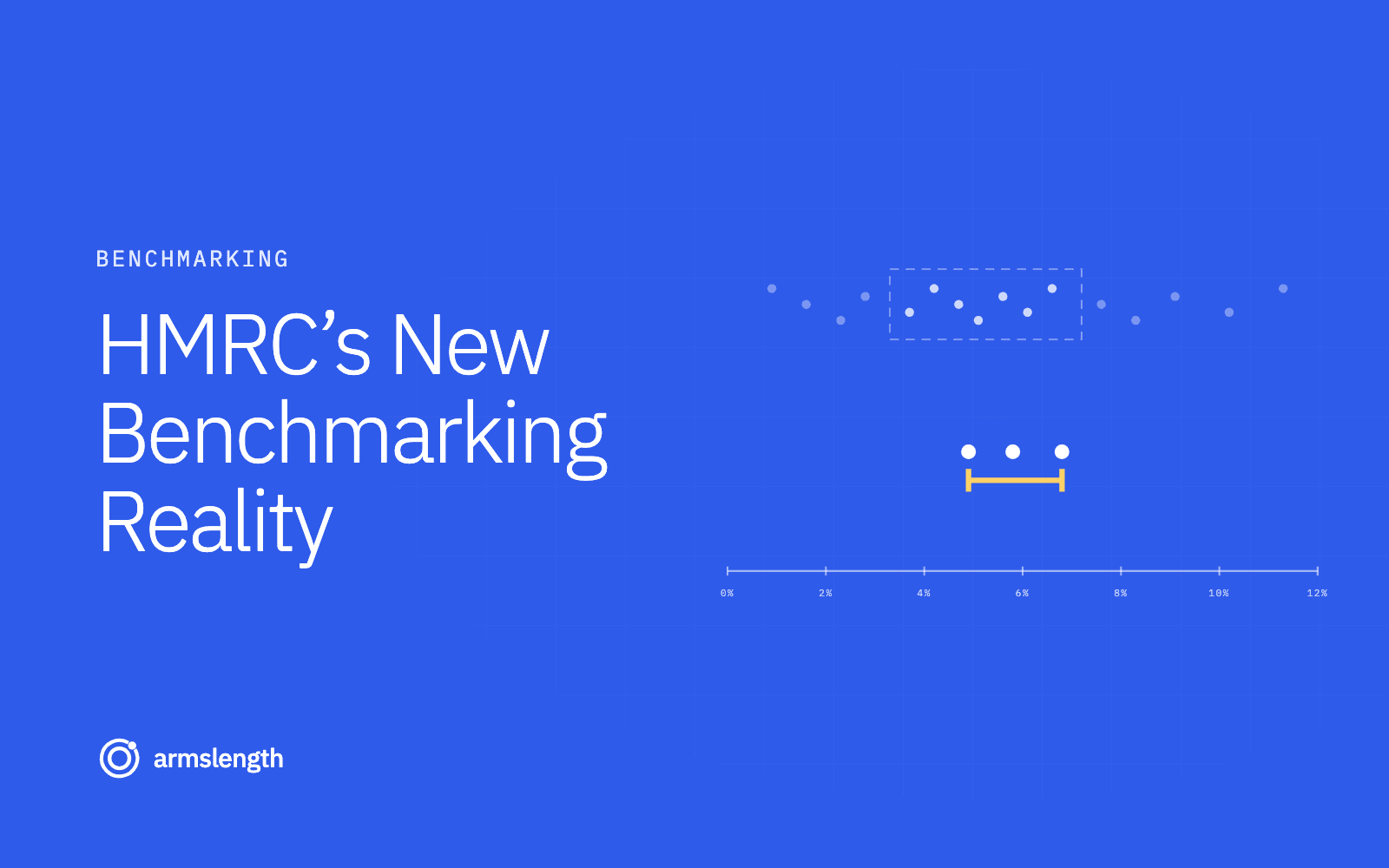
HMRC’s New Benchmarking Reality: Why the IQR Is No Longer AutomaticHMRC’s New Benchmarking Reality: Why the IQR Is No Longer Automatic
On November 10, 2025, HMRC updated INTM485120 with critical details on searching for comparables. The key takeaway? The Interquartile Range is not a default right - and relying on it blindly carries a median-sized risk.
Borys UlanenkoCEO of ArmsLength AI
8min read
Contents↓
Contents
TL;DR key takeaways
HMRC updated INTM485120 on Nov 10, 2025, explicitly challenging the 'automatic' use of the Interquartile Range (IQR).
The guidance prioritises quality over quantity: a small, precise subset is preferred over a large, statistical bucket.
The 'Median Trap' is confirmed: falling outside the range likely triggers an adjustment to the median, not the nearest edge.
Manual verification is now effectively mandatory - relying on database descriptions alone is no longer sufficient.
We tested three AI configurations on 10 transfer pricing questions. ChatGPT with web search scored 83%, but models without web access fabricated most quotes. Here's what we learned.
The Berry Ratio (gross profit ÷ operating expenses) is a specialized PLI for low-risk distributors and agents. Learn when it's appropriate, when to avoid it, and how to defend your analysis—with calculation examples and jurisdictional guidance.
We asked experienced transfer pricing practitioners how they actually build benchmarking sets, define ranges, treat loss-makers, and apply capital adjustments. The results reveal a clear core toolkit - and interesting divergence at the edges.
More resources for your next workflow stepMore resources for your next workflow step
Browse the full resource library or contact us if you want recommendations for your specific use case.
For years, the transfer pricing profession has operated on a comfortable default: run a search, export a large set of "broadly comparable" companies, apply an Interquartile Range (IQR), and call it a day.
But on November 10, 2025, HMRC quietly updated its internal manual, specifically INTM485120, with new operational guidance on "Searching for comparables." If you read the text closely, it looks like a direct challenge to the "scrape and smooth" approach that dominates so much of the industry.
The updated guidance makes it clear that the IQR is not an automatic right. It also codified a preference for small, high-quality datasets over large statistical ones, and reaffirmed the financial risks of getting it wrong.
Here is what the update says, and what it means for the way we build benchmarks.
Note
This post analyses the Nov 10, 2025 update to INTM485120. The guidance explicitly clarifies that the IQR is a tool for "enhancing reliability" in specific circumstances, not a mandatory default for every study.
1. The IQR is a patch, not a policy
The most striking point in the updated text is how HMRC frames the Interquartile Range.
In many firms, the IQR is treated as the definition of the arm's length range. But HMRC explicitly reminds its case teams that neither UK Law (TIOPA10) nor the OECD Guidelines mandate the use of an interquartile range.
Instead, the guidance positions the IQR as a statistical tool to be used only when:
Comparability defects remain: You’ve done your best, but the companies aren't perfect.
There is a "sizeable" number of observations: You have enough data to make statistics meaningful.
The practical implication
If you have a small, pristine set of comparables—say, five companies that perform exactly the same functions as your tested party—the full range (min to max) might be the appropriate arm's length range.
You don't need to artificially narrow it. In fact, applying an IQR to a perfect set might be technically incorrect because it discards valid market evidence. The IQR is there to clean up noise; if there's no noise, you don't need the filter.
2. Quality beats quantity (The "Subset" Preference)
There is a long-standing belief in transfer pricing that there is "safety in numbers." A set of 20 comparables feels safer than a set of 5.
The updated INTM485120 challenges this directly. HMRC encourages case teams to narrow the range by focusing on a precise subset of companies, rather than expanding the pool to make the statistics look better.
The Software R&D Example
The guidance uses a telling example:
Imagine a report with 16 companies doing generic "computer R&D"—hardware, OS, software, etc.
But inside that list, 3 companies do specifically software R&D, matching the tested party.
HMRC’s view: Discard the 13 generic companies. Use the 3 specific ones.
This is a clear signal that HMRC prefers a "perfect 3" over a "noisy 16." They would rather see a small, highly comparable dataset than a large one that requires the IQR to wash out the differences.
Tip
Action point: Don't be afraid of small final sets. If you have to choose between adding "okay" companies to reach a sample size of 10, or sticking with 4 "perfect" companies, the new guidance supports the latter.
3. The "Median Trap"
This is the point that carries the real financial sting.
The guidance reiterates that if your results fall within the arm's length range, no adjustment is made. That’s standard.
But if your results fall outside the range, HMRC officers are instructed not to adjust you to the nearest edge (e.g., the lower quartile). Instead, they will likely adjust you to the Median.
Why this matters
HMRC views the median as the "most defensible position" for Mutual Agreement Procedures (MAP). It’s the hardest number for another tax authority to argue against.
But for taxpayers, this creates a "cliff edge" risk.
Scenario: The Lower Quartile is 3%. The Median is 6%.
Your Result: You achieve 2.9%.
The Consequence: You don't get bumped up to 3%. You get bumped all the way to 6%.
That tiny miss (0.1%) triggers a massive adjustment. This "Median Trap" means that aiming for the bottom edge of the range is a high-risk strategy.
4. "Trust but Verify" is dead
Finally, the update emphasizes manual verification. HMRC instructs case teams not to rely solely on database descriptions.
We all know that database descriptions can be generic ("provision of business services") or outdated. HMRC now expects its officers—and by extension, taxpayers—to:
Visit company websites.
Check annual reports.
Confirm what the company actually does.
If an HMRC officer clicks through to a comparable’s website and finds they sell hardware instead of software, that company is out. If that company was anchoring your lower quartile, your entire range shifts, and you might fall into the Median Trap.
5. How to adapt your benchmarking workflow
This update doesn't mean you have to throw out your existing studies, but it should shift your focus for new ones.
If you want to align with INTM485120, here is the playbook:
Don't auto-pilot the IQR. If you have a high-quality set, consider if the full range is more appropriate. If you use the IQR, be ready to explain why (e.g., "used to address residual comparability defects").
Curate ruthlessly. Don't keep "filler" companies just to pad the numbers. A smaller, cleaner set is now explicitly preferred.
Review the websites. This is non-negotiable. If you haven't manually verified the business activities of your comparables, you are leaving an open goal for an auditor.
Mind the gap. Given the median adjustment risk, targeting the absolute floor of the range is dangerous. Leave yourself a buffer.
HMRC has signaled that they are looking at the substance of the comparables, not just the statistics. Our documentation needs to reflect that reality.
Frequently Asked Questions
Is the Interquartile Range (IQR) mandatory in the UK?
No. INTM485120 confirms that neither UK law nor the OECD Guidelines mandate the IQR. It is a statistical tool to be used when you need to improve the reliability of a dataset that still has some comparability defects.
What was the key change in the Nov 10, 2025 update?
The update provided specific operational instructions on "Searching for comparables," emphasizing that case teams should look for specific subsets of high-quality comparables rather than accepting broad, generic lists.
Can I use a dataset with only 3 or 4 companies?
Yes, if they are highly comparable. The guidance explicitly prefers a "subset" of high-quality comparables (e.g., 3 specific software R&D firms) over a larger group of less comparable ones (e.g., 16 general IT firms).
What is the "Median Trap"?
It refers to the risk that if your transfer pricing results fall just outside the arm's length range (even by a small amount), HMRC will likely adjust your profits to the median of the range, rather than the nearest quartile. This maximizes the tax adjustment.
Do I really need to check company websites?
Yes. The guidance instructs HMRC officers not to rely on database descriptions alone. If they are checking websites to disqualify your comparables, you need to check them first to ensure they are robust.
Related OECD Guidance
The OECD Transfer Pricing Guidelines provide the foundation for HMRC's approach:
 Borys UlanenkoCEO of ArmsLength AI