Published August 5, 2025Updated March 6, 202612 min read
Income Inclusion Rule: How Pillar Two IIR Top-up Tax Works in Practice (2026)Income Inclusion Rule: How Pillar Two IIR Top-up Tax Works in Practice (2026)
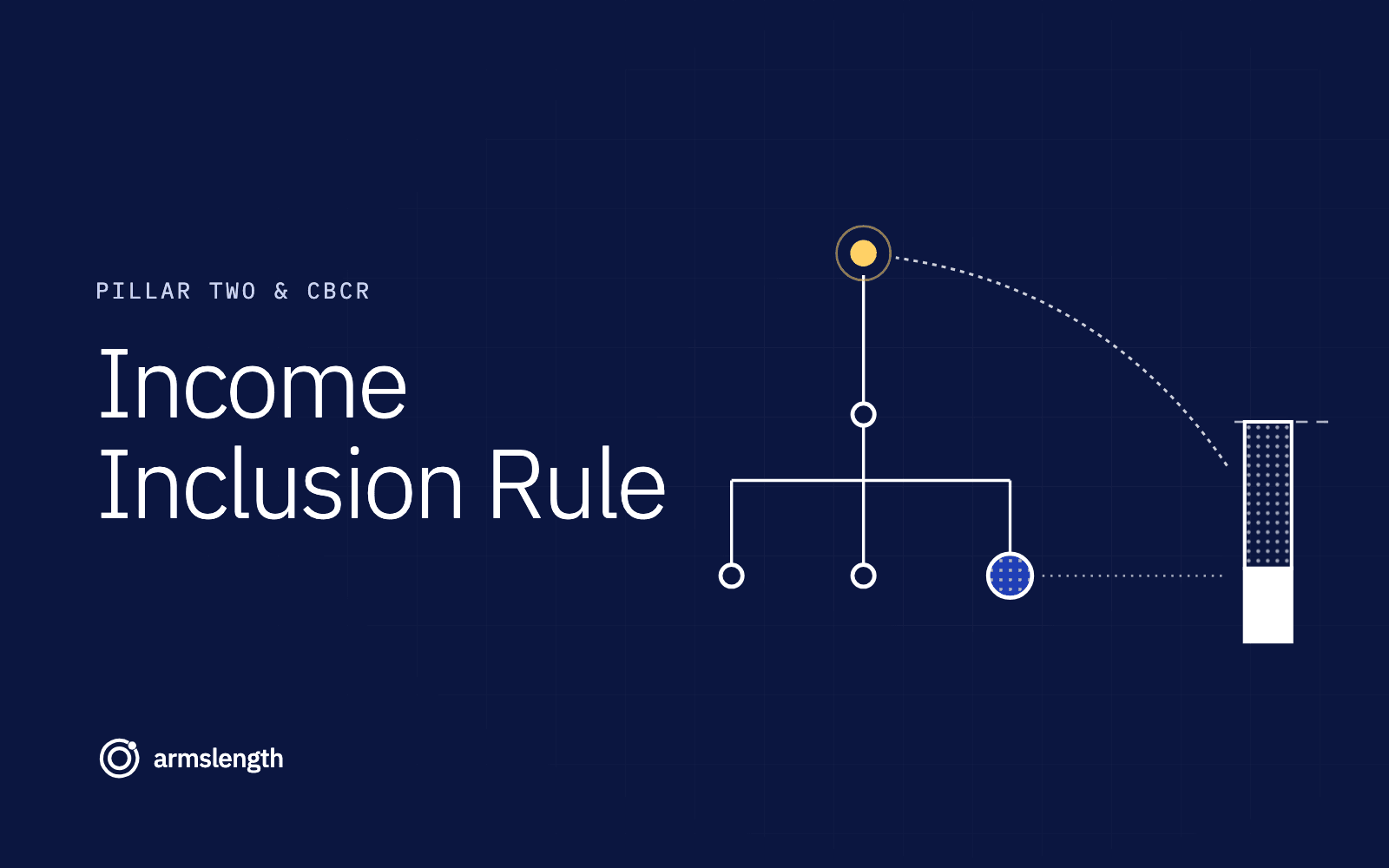
The income inclusion rule (IIR) charges a parent entity top-up tax when a jurisdiction’s GloBE ETR falls below 15% under Pillar Two.
Borys UlanenkoCEO of ArmsLength AI
12min read
Contents↓
Contents
TL;DR key takeaways
IIR is Pillar Two’s primary charging rule: it collects top-up tax at the parent level when jurisdictional GloBE ETR is below 15%.
Core math: Top-up Tax ≈ (15% − ETR) × (GloBE income − SBIE), reduced by any qualified QDMTT.
Liability is generally top-down at the UPE, but can shift to intermediate parents (or a POPE) based on ordering and split-ownership.
Model IIR, QDMTT, and UTPR together—getting the ordering wrong is a common (and expensive) implementation failure.
EU Public CbCR requires large groups to publish income-tax KPIs by jurisdiction. Most calendar-year groups first report FY2025 and publish by 31 Dec 2026.
The income inclusion rule (IIR) is Pillar Two’s primary mechanism for enforcing the 15% global minimum tax by charging top-up tax at the parent level when a group’s jurisdictional GloBE ETR falls below 15%. In practice, you compute top-up tax jurisdiction-by-jurisdiction using financial-accounting-based GloBE income and covered taxes, then allocate and charge it top-down to the Ultimate Parent Entity (or, in some cases, an intermediate parent or a partially-owned parent). IIR generally takes priority over the UTPR backstop, and it is typically reduced (sometimes to zero) where a jurisdiction has a qualified domestic minimum top-up tax (QDMTT).
In 2025, “IIR in practice” also means building around the OECD’s evolving compliance architecture (including updated Administrative Guidance and GloBE Information Return (GIR) materials released in January 2025). (oecd.org)
Income inclusion rule in Pillar Two: what it is and where it sits
The income inclusion rule is designed to move minimum-tax enforcement to the parent jurisdiction, rather than relying only on source-country adjustments. Under the OECD/G20 GloBE rules, the IIR charges a parent entity a top-up tax for the parent’s share of low-taxed profits earned by low-taxed constituent entities. (OECD GloBE Model Rules (2021), Chapter 2)
The ordering rule practitioners must internalize
Pillar Two is not “one calculation.” It’s an ordering system that coordinates multiple mechanisms:
Mechanism
What it does
Practical consequence
QDMTT
Allows the source jurisdiction to collect top-up tax domestically (if “qualified”)
Often reduces or eliminates IIR exposure for that jurisdiction
IIR (income inclusion rule)
Collects remaining top-up tax at the parent level (top-down)
Primary charging rule; drives most group-level compliance
UTPR
Backstop allocation of remaining top-up tax to other jurisdictions
Kicks in when IIR doesn’t fully collect (see /resources/utpr-guide)
This ordering is fundamental to forecasting where the cash tax cost lands, where returns are filed, and which entities need Pillar Two-grade data controls. (OECD GloBE Model Rules (2021), Chapter 2; OECD Consolidated Commentary (2025))
Note
If you need a Pillar Two refresher before diving into the IIR mechanics, start with /resources/pillar-two-guide and the hub /resources/pillar-two-cbcr-guide (many groups reuse CbCR pipelines, but the data requirements are stricter for GloBE).
Scope, thresholds, and the entities that can be “on the hook” under IIR
Revenue threshold and exclusions (who is in scope)
Groups are generally in scope when consolidated revenue meets the EUR 750m threshold in at least two of the four Fiscal Years immediately preceding the tested Fiscal Year (aligned conceptually with CbCR scope, but not identical in mechanics). (oecd.org)
The rules also carve out certain excluded entities (e.g., government entities, pension funds, certain investment funds as UPE), plus certain chains predominantly owned by excluded entities. (OECD GloBE Model Rules (2021), Chapters 1–2)
Practical note: domestic implementations often translate “EUR 750m” into local currency using a specified FX approach, which can matter in edge cases and forecasts.
Key IIR terms (the minimum vocabulary for implementation teams)
Term
Meaning (practitioner view)
Why it matters for IIR
Constituent Entity (CE)
Entity included in the GloBE computation perimeter
Determines which entities feed the jurisdictional ETR and allocation
UPE
Ultimate Parent Entity that prepares (or would prepare) consolidated financials
Usually the primary IIR taxpayer if its jurisdiction has a qualified IIR
Intermediate Parent Entity (IPE)
Parent entity below the UPE
Can become the IIR taxpayer if the UPE jurisdiction doesn’t apply a qualified IIR
POPE (Partially-Owned Parent Entity)
Parent with >20% of its ownership interests in profits held (directly/indirectly) by persons that are not constituent entities of the MNE group
Can be required to apply IIR in split-ownership structures (oecd.org)
Inclusion Ratio
Limits the IIR charge to the parent’s ownership-based share of the low-taxed income
Prevents “taxing other people’s profits” where there are outside owners
Certain minority-owned entities/subgroups are computed as if they were a separate MNE group (and excluded from the remainder group’s jurisdictional blending)
Prevents “blending away” low-tax outcomes (or diluting top-up) through broader group aggregation (oecd.org)
There isn’t a single universal “IIR ownership percentage.” Instead:
Who must apply IIR is driven by parent status in the ownership chain (aligned to consolidation/control concepts), plus ordering rules.
How much top-up tax is charged is limited by the Inclusion Ratio (ownership-based allocation).
Split-ownership / POPE mechanics become relevant where outside ownership is significant (the Model Rules’ POPE definition uses a >20% outside-ownership threshold). (oecd.org)
Warning
A common implementation error is treating IIR as “UPE-only.” In reality, liability can shift to intermediate parents (or a POPE) depending on (i) whether the UPE jurisdiction has a qualified IIR in effect and (ii) the group’s ownership and minority investor profile.
Income inclusion rule calculation: how IIR top-up tax is computed
At a high level, the IIR doesn’t create a separate tax base. It charges top-up tax based on the jurisdictional ETR computed under GloBE rules, which rely on financial accounting income with standardized adjustments. (OECD GloBE Model Rules (2021), Chapters 3–5)
The “mental model” formula (what you’re actually doing)
In simplified form (ignoring certain adjustments), for each jurisdiction:
text
ETR = Adjusted Covered Taxes / Net GloBE Income

Top-up % = max(0, 15% − ETR)

Excess Profit = Net GloBE Income − SBIE

Jurisdictional Top-up Tax ≈ Top-up % × Excess Profit
Then: reduce for any qualified QDMTT, allocate to entities, and charge via IIR inclusion ratios.
The key practical point: statutory rate ≠ GloBE ETR. Credits, incentives, timing differences, and deferred tax mechanics can drive GloBE ETR below 15% even in “high-tax” countries. Administrative Guidance has continued to refine practical treatment in several areas (including transition and compliance mechanics). (oecd.org)
Step-by-step workflow (what your model and your data pipeline must support)
Step 1: Build GloBE income (or loss) per entity
Start from financial accounting net income/loss and apply standardized adjustments. This is why many groups anchor Pillar Two to the consolidation trial balance—then layer adjustments in a controlled mapping. (OECD GloBE Model Rules (2021), Chapter 3)
Covered taxes are not “whatever is in the tax provision.” They are defined and adjusted under GloBE, including specific constraints around deferred tax treatment (a recurring focus of Administrative Guidance and implementation choices). (OECD GloBE Model Rules (2021), Chapter 4; OECD Administrative Guidance (June 2024; January 2025)) (oecd.org)
Step 3: Compute jurisdictional ETR
Aggregate covered taxes and GloBE income across all constituent entities in the jurisdiction to compute the jurisdictional effective tax rate. (OECD GloBE Model Rules (2021), Chapter 5)
Step 4: Apply the Substance-based Income Exclusion (SBIE)
SBIE reduces the base subjected to top-up tax using a carve-out for payroll and tangible assets. Many regimes follow transitional rates that decline over time.
Important timing detail (easy to get wrong): under the EU Minimum Tax Directive, the “year labels” in the SBIE transitional tables map to fiscal years beginning from 31 December of the listed calendar year (i.e., the row you use depends on your fiscal-year start date, not the fiscal-year end date). (eur-lex.europa.eu)
Example transitional rates (EU Directive illustration; selected rows):
Step 5: Account for QDMTT (critical for “where tax is paid”)
Where a jurisdiction has a qualified QDMTT, it generally reduces the residual top-up tax that would otherwise be collected under IIR. This is why a purely parent-country IIR model is incomplete: you need QDMTT eligibility and “qualified status” tracking jurisdiction-by-jurisdiction. (OECD GloBE Model Rules (2021), Chapter 5; OECD Administrative Guidance; OECD Central Record)
Tip
Treat QDMTT qualification as a “master data” problem, not a spreadsheet note. Many groups maintain a controlled table keyed by jurisdiction and fiscal year: (i) QDMTT in force? (ii) transitional qualified status per the OECD Central Record? (iii) effective dates and local filing requirements?
Step 6: Allocate and charge through IIR
After computing top-up tax at the jurisdiction level, it is allocated to constituent entities and then charged to parent entities through IIR using ownership-based limitations (Inclusion Ratio) and ordering rules. (OECD GloBE Model Rules (2021), Chapter 2; OECD Consolidated Commentary (2025))
Who pays the income inclusion rule tax? Top-down charging and split-ownership
The IIR is designed to operate top-down: if the UPE is in a jurisdiction that applies a qualified IIR, the UPE generally bears the group’s IIR charge (subject to inclusion ratios and other ordering mechanics). If not, the charge can shift down the chain.
Typical charging outcomes (simplified)
Fact pattern
Which entity applies IIR?
What you must model
UPE jurisdiction has a qualified IIR in effect
UPE
Consolidated GloBE calc + jurisdiction rollups + UPE filing/payment
UPE jurisdiction does not apply a qualified IIR
Intermediate parent in a jurisdiction with IIR (to its share)
Ownership chain, inclusion ratios, and which parents are “activated”
POPE identification + minority ownership tracking + double-charge prevention logic
(OECD GloBE Model Rules (2021), Chapter 2)
Why POPE exists (the intuition)
In split-ownership cases, charging everything at the UPE can misalign the tax burden relative to minority investors. POPE rules are intended to ensure that top-up tax can be charged at a level where the economics are shared appropriately among shareholders, while coordinating to avoid double charging. (OECD Consolidated Commentary (2025))
Don’t miss the separate “Minority-Owned CE/Subgroup” computation rule
POPE addresses who is charged under IIR in certain ownership structures. Separately, the Model Rules also require special computation for Minority-Owned Constituent Entities and Minority-Owned Subgroups—in effect, treating them as if they were a separate MNE group and excluding them from the remainder group’s jurisdictional blending. This can materially change jurisdictional ETRs and top-up tax outcomes in models that otherwise “just roll up by country.” (oecd.org)
IIR priority over UTPR: what changes in planning and controversy risk
The UTPR is explicitly designed as a backstop. In well-coordinated outcomes, top-up tax is collected first via QDMTT (if qualified), then via IIR; UTPR applies only to residual amounts not collected. (OECD GloBE Model Rules (2021), Chapter 2; OECD Consolidated Commentary (2025))
Note
If you are designing your first end-to-end Pillar Two model, build the UTPR logic early—even if you “don’t expect UTPR.” UTPR exposure often appears due to qualification gaps, effective date mismatches, or data quality issues rather than intentional low-tax planning. See /resources/utpr-guide.
Practical impact: you need “rule ordering” controls, not just tax calculations
Teams that succeed treat IIR/UTPR as a coordinated rules engine:
Qualification tracking (IIR/QDMTT transitional qualified status, effective dates) using the OECD Central Record as an input (while validating with local law).
Quarterly forecasting to understand provisioning and cash tax impacts.
Audit-ready lineage from consolidation reporting packages to GloBE adjustments to covered tax classification.
For related documentation practices, see /resources/transfer-pricing-documentation-guide (many controls and evidence patterns translate well).
Where IIR is implemented in 2025 (and why “implemented” needs a definition)
“Implemented” can mean (i) law enacted, (ii) effective for fiscal years beginning, and/or (iii) OECD transitional qualified status. For IIR planning, you typically need all three.
The OECD also notes that the 2025 Consolidated Commentary incorporates Agreed Administrative Guidance released up to March 2025, which matters when you are aligning calculations and positions across jurisdictions. (oecd.org)
IIR generally applies for FYs beginning on/after 31 Dec 2023, with optional deferrals for some Member States (Directive Article 50); UTPR generally from FYs beginning on/after 31 Dec 2024
“Multinational Top-up Tax” (IIR-equivalent) for periods beginning on/after 31 Dec 2023; UTPR from periods beginning on/after 31 Dec 2024
GOV.UK Pillar Two guidance
Japan
IIR effective for consolidated accounting years beginning on/after 1 April 2024 (Japan also links scope to the “two-of-four prior years” EUR 750m test); Japan’s QDMTT and UTPR apply from 1 April 2026 under the cited summary
IIR generally effective for fiscal years beginning on/after 1 Jan 2024; UTPR delayed by 12 months to fiscal years beginning on/after 1 Jan 2025 (per enacted reforms described in the cited alert)
Switzerland applied QDMTT from 1 Jan 2024; the Swiss Federal Council announced application of IIR effective from 1 Jan 2025; UTPR delayed indefinitely (per cited alert)
The U.S. has not implemented Pillar Two IIR/UTPR into domestic law as of 28 Dec 2025; separately, the U.S. Treasury’s June 28, 2025 statement describes a proposed “side-by-side” concept under which U.S.-parented groups would be exempt from other countries’ IIR/UTPR, subject to further Inclusive Framework work
Do not treat the OECD Central Record as your only source of truth. It is essential for transitional qualification reliance, but “not listed” is not the same as “not qualified,” and local law effective dates can differ from OECD registry updates.
Income inclusion rule vs CFC rules (including U.S. GILTI/NCTI): what’s similar, what isn’t
IIR will feel familiar to anyone who has worked with controlled foreign company (CFC) regimes—but the similarities can be misleading.
Core comparison (practice-oriented)
Dimension
IIR (Pillar Two)
Typical CFC regimes
Tax base
Financial-accounting-based GloBE income with standardized adjustments
Domestic tax base and categories (often anti-deferral concepts)
Blending
Primarily jurisdictional blending
Can be entity, jurisdictional, or global blending depending on regime
Rate objective
Uniform 15% minimum via top-up
Varies by country; not designed around a single global minimum
Coordination
Built-in ordering (QDMTT → IIR → UTPR) and allocation mechanics
High, but typically anchored in domestic tax computations
(OECD GloBE Model Rules (2021), Chapters 2–5; OECD Administrative Guidance)
U.S. position (2025): why it matters even for non-U.S. groups
As of 28 Dec 2025, the U.S. has not enacted Pillar Two IIR/UTPR into domestic law. The U.S. Treasury’s June 28, 2025 statement describes a proposed “side-by-side” approach under which U.S.-parented groups would be exempt from IIR/UTPR in recognition of existing U.S. minimum tax rules, subject to further Inclusive Framework work. (home.treasury.gov)
Even if you are not U.S.-parented, this stance can affect counterparty expectations, cross-border dispute dynamics, and transitional UTPR risk assessments.
Practical examples: income inclusion rule calculations with numbers
The examples below are simplified to illustrate mechanics. Real computations must layer in additional GloBE adjustments, deferred tax rules, and local implementation details. (OECD GloBE Model Rules (2021); OECD Administrative Guidance)
Facts (calendar-year FY 2025, beginning 1 Jan 2025):
UPE in Country A; Country A has a qualified IIR in effect.
One subsidiary in Country B.
Country B (GloBE basis):
Net GloBE income: 100
Adjusted covered taxes: 5
Payroll: 20
Tangible assets: 30
SBIE transitional rates: because the EU Directive’s transitional SBIE percentages apply for fiscal years beginning from 31 December of the listed calendar year, a calendar-year FY 2025 (beginning 1 Jan 2025) aligns to the 2024 row: payroll 9.8%, tangible 7.8% (illustrative EU Directive schedule). (eur-lex.europa.eu)
IIR charge
UPE owns 100% → Inclusion Ratio ~100% → UPE pays 9.57 under IIR.
Example 2: Same facts, but a qualified QDMTT reduces (often to zero) the IIR top-up
Assume Example 1, but Country B has a qualified QDMTT, and the domestic minimum tax computation produces qualified domestic top-up tax due for FY 2025.
Qualified domestic top-up tax due in Country B: assume 9.57
Residual top-up for IIR purposes (simplified): 0.00
Result: Country A’s UPE has no IIR payment for Country B to the extent the qualified domestic top-up tax is due (and properly computed/aligned). The EU Directive frames this as reducing IIR top-up tax “up to zero” by the qualified domestic top-up tax due. (eur-lex.europa.eu)
Key point
From a controversy and cash-tax perspective, qualified QDMTTs often “localize” top-up tax and reduce cross-border allocation disputes—provided your qualification and computation positions are supportable.
Example 3: Split-ownership / POPE concept (why top-down can be overridden)
Facts:
UPE (Country A) owns 60% of HoldCo P (Country C); outside investors own 40% of P (so the POPE concept can be relevant).
Assume Country C has a qualified IIR in effect and the POPE rule is triggered.
P owns 100% of SubCo S (Country D).
Country D (GloBE basis):
Net GloBE income: 200
Adjusted covered taxes: 10 → ETR = 10 / 200 = 5%
Ignore SBIE for simplicity.
Top-up computation (Country D):
Top-up % = 15% − 5% = 10%
Top-up tax = 10% × 200 = 20
POPE outcome (conceptual):
Under split-ownership mechanics, HoldCo P can be required to apply IIR, meaning P is charged on the 20 (subject to the detailed ordering/offset mechanics that prevent double charging up the chain).
Economics then follow shareholding: UPE bears 12 (60% × 20) and minority investors bear 8 (40% × 20). (oecd.org)
Implementation checklist: data, controls, and pitfalls to avoid
Key Takeaways
→Model the full ordering: QDMTT first, then IIR, then UTPR—most “surprises” come from getting this wrong.
→Build jurisdictional ETRs from financial-accounting data with controlled GloBE adjustments; statutory rates are not a proxy.
→Treat ownership, inclusion ratios, split-ownership (POPE), and minority-owned subgroup rules as first-class inputs, not legal-entity footnotes.
What “good” looks like in an IIR-ready operating model
Repeatable close process (quarterly estimates + year-end true-up) for provisioning discipline.
Audit trail consistent with how you support other cross-border reporting, such as CbCR (/resources/cbcr-preparation-guide) and transfer pricing files (/resources/transfer-pricing-documentation-guide).
Tip
If your group already runs a structured benchmarking and margin-testing process (/resources/benchmarking-study-guide), reuse the governance patterns: version control, sign-offs, and “single source of truth” inputs. Pillar Two fails most often as a data governance project, not a tax theory project.
Safe harbors and compliance shortcuts to evaluate in 2025 (don’t skip these)
Pillar Two includes (and has continued to develop) compliance simplifications—some elective, some transitional. At a minimum, implementation teams should map:
Safe harbors under the Model Rules’ administrative framework (conceptually allowing top-up tax for an eligible jurisdiction to be deemed zero for a fiscal year, subject to conditions and elections). (oecd.org)
Transitional relief items that affect early years (including transition and filing mechanics—areas specifically addressed in January 2025 Administrative Guidance on Articles 9.1 and 8.1.4/8.1.5). (oecd.org)
GloBE Information Return (GIR) operations: in January 2025, the OECD released an updated GIR, plus tooling to support administration (including an XML schema and a multilateral competent authority agreement for central filing and exchange). (oecd.org)
The practical takeaway: even if your tax math is right, your filing/exchange design can still fail if you don’t align to the GIR architecture that relevant jurisdictions expect.
Common pitfalls (and why they happen)
Common Pitfalls to Avoid
01Assuming “statutory rate ≥ 15%” means no IIR exposure (GloBE ETR is driven by covered taxes vs GloBE income, not the headline rate).
02Treating deferred tax as a black box—Administrative Guidance has refined deferred tax mechanics and transition items; your model must reflect current guidance and local adoption.
03Ignoring QDMTT qualification/effective dates and then discovering late that the IIR/UTPR outcome changes materially.
04Hardcoding “UPE pays everything” and missing intermediate parent / POPE activation, *and* missing minority-owned subgroup computation separation in structures with minority investors.
Decision criteria: when to prioritize IIR workstreams vs UTPR workstreams
Decision Criteria
01Prioritize IIR modeling first if your UPE (or key intermediate parents) are in jurisdictions with IIR effective from 2024/2025—this is usually the earliest cash-tax and filing impact.
02Prioritize UTPR scenario testing if your UPE jurisdiction does not have a qualified IIR in effect, or if you rely on transitional positions that could expire or change.
03Prioritize QDMTT analysis if you operate in jurisdictions implementing domestic minimum top-up taxes; QDMTT often determines where the tax is actually paid.
Related topics (next steps)
Pillar Two overview and context: /resources/pillar-two-guide
UTPR mechanics and backstop allocation: /resources/utpr-guide
Hub: Pillar Two + CbCR operationalization: /resources/pillar-two-cbcr-guide
Glossary definitions:
/glossary/income-inclusion-rule
/glossary/pillar-two
FAQ: Income Inclusion Rule (IIR)
1) What is the income inclusion rule (IIR) under Pillar Two?
The income inclusion rule is Pillar Two’s primary charging rule that imposes top-up tax on a parent entity when a jurisdiction’s GloBE ETR for group entities is below 15%. (OECD GloBE Model Rules (2021), Chapter 2)
2) How do you calculate IIR top-up tax in practice?
You compute jurisdictional GloBE income and adjusted covered taxes, calculate the jurisdictional ETR, apply the 15% minimum rate to determine a top-up percentage, reduce the base for SBIE, then net down (up to zero) for any qualified domestic top-up tax due before charging the residual through IIR. (eur-lex.europa.eu)
3) Is the income inclusion rule calculated country-by-country or globally?
Primarily country-by-country (jurisdictional blending). You compute an ETR per jurisdiction and determine top-up tax separately for each jurisdiction. (OECD GloBE Model Rules (2021), Chapter 5)
4) Which entity pays the IIR tax: the UPE or an intermediate parent?
Usually the UPE, if the UPE jurisdiction has a qualified IIR in effect. If not, the IIR can shift to an intermediate parent in a jurisdiction that applies IIR, and in split-ownership cases a POPE may be required to apply IIR. (OECD GloBE Model Rules (2021), Chapter 2)
5) What is the Inclusion Ratio in the IIR?
The Inclusion Ratio limits the parent entity’s IIR liability to the share of low-taxed income attributable to its ownership interest (so the parent doesn’t pay top-up tax on income economically owned by minority investors). (OECD GloBE Model Rules (2021), Chapter 2)
6) If a country’s statutory corporate rate is above 15%, can there still be IIR exposure?
Yes. The GloBE ETR is based on adjusted covered taxes divided by GloBE income, and it can fall below 15% due to incentives, credits, and timing differences (including deferred tax effects). (OECD GloBE Model Rules (2021), Chapters 3–5)
7) How does a QDMTT affect the income inclusion rule outcome?
A qualified QDMTT generally reduces (and can eliminate) the residual top-up tax that would otherwise be collected under IIR for that jurisdiction—shifting collection to the source jurisdiction—to the extent qualified domestic top-up tax is due under the domestic minimum tax computation. (eur-lex.europa.eu)
8) How does IIR interact with UTPR?
IIR generally applies before UTPR. UTPR is intended as a backstop that allocates residual top-up tax to other jurisdictions only when it isn’t collected under a qualified QDMTT and/or IIR. (OECD GloBE Model Rules (2021), Chapter 2)
9) Is the United States adopting the Pillar Two income inclusion rule?
As of December 28, 2025, the U.S. has not implemented Pillar Two IIR/UTPR into domestic law. Separately, the U.S. Treasury’s June 28, 2025 statement describes a proposed “side-by-side” approach under which U.S.-parented groups would be excluded from IIR/UTPR, subject to further work through the Inclusive Framework. (home.treasury.gov)
10) How is IIR different from traditional CFC rules?
Both can impose additional parent-level tax on low-taxed foreign income, but IIR uses a standardized GloBE base derived from financial accounts, targets a uniform 15% minimum, and is coordinated through ordering with QDMTT and UTPR—unlike most domestic CFC regimes. (OECD GloBE Model Rules (2021), Chapters 2–5)
 Borys UlanenkoCEO of ArmsLength AI