Published June 20, 2025Updated December 23, 202513 min read
IQR vs Full Range: When to Use Which in Transfer Pricing BenchmarkingIQR vs Full Range: When to Use Which in Transfer Pricing Benchmarking
The interquartile range is the default choice when comparability defects exist—but full range is acceptable when all comparables are equally reliable. This guide explains the decision criteria, practical examples, jurisdictional differences, and how to document your choice.
Borys UlanenkoCEO of ArmsLength AI
13min read
Contents↓
Contents
TL;DR key takeaways
Use IQR when comparability defects remain that can't be identified or quantified—this is the default for most benchmarking studies.
Use Full Range only when ALL comparables are 'equally reliable' with no material differences. This is rare and requires enhanced documentation.
Canada is the exception: CRA advises against using IQR and emphasizes qualitative comparability screening instead.
India, Malaysia, and Vietnam mandate narrower statutory ranges (35th-65th, 37.5th-62.5th, 35th-75th respectively).
Adjustment point varies by jurisdiction: US uses median for IQR; OECD allows median, mean, or weighted averages depending on facts.
We tested three AI configurations on 10 transfer pricing questions. ChatGPT with web search scored 83%, but models without web access fabricated most quotes. Here's what we learned.
The Berry Ratio (gross profit ÷ operating expenses) is a specialized PLI for low-risk distributors and agents. Learn when it's appropriate, when to avoid it, and how to defend your analysis—with calculation examples and jurisdictional guidance.
On November 10, 2025, HMRC updated INTM485120 with critical details on searching for comparables. The key takeaway? The Interquartile Range is not a default right - and relying on it blindly carries a median-sized risk.
More resources for your next workflow stepMore resources for your next workflow step
Browse the full resource library or contact us if you want recommendations for your specific use case.
The Interquartile Range (IQR) is the default choice for most benchmarking studies. Use it when comparability defects remain that can't be fully identified or quantified—which is the case in most TNMM analyses.
The Full Range (min–max) is acceptable only when you can demonstrate that ALL comparables are "equally reliable" with no material differences unaccounted for. This is rare and requires significantly more documentation.
Approach
Use when
What you need to document
IQR (25th–75th percentile)
Residual comparability defects remain (default)
What the defects are + why they couldn’t be reliably adjusted
Full range (min–max)
All results are “equally reliable”
Why each comparable is equally reliable + what adjustments eliminate material differences
Statutory narrower ranges
Local law mandates (e.g., India/Malaysia/Vietnam)
The statutory rule + calculation method + adjustment point
Decision Rule:
IQR → When any comparability defects exist (default)
Full Range → When all comparables pass the "equally reliable" test (rare)
Narrower Range → When jurisdiction mandates (India: 35th-65th, Malaysia: 37.5th-62.5th, Vietnam: 35th-75th)
Canada → IQR not recommended; emphasize qualitative comparability screening
When you benchmark a tested party using TNMM or CPM, you compare its profitability against multiple comparable companies. Those comparables produce a range of results—the arm's length range.
The question is: should that range include ALL comparable results (full range, min to max), or should it be narrowed statistically (typically to the interquartile range, 25th to 75th percentile)?
Range Type
Definition
When to Use
Full Range
Min to max of all comparables
When all comparables are "equally reliable"
Interquartile Range (IQR)
25th to 75th percentile
When comparability defects remain (default)
Narrower Statutory Range
35th-65th (India), 37.5th-62.5th (Malaysia), etc.
When local law mandates
Note
If your tested party's result falls within the arm's length range, no adjustment is required. If it falls outside, most jurisdictions will adjust to the median.
How to Calculate IQR (Quick Method)
In benchmarking, “IQR” is used in two closely related ways:
Interquartile range (spread): (IQR = Q3 - Q1)
Interquartile range (arm’s length range): the interval ([Q1, Q3])
Quick steps:
Sort your comparable results from low to high.
Calculate Q1 (25th percentile) and Q3 (75th percentile).
Your IQR-based arm’s length range is Q1 to Q3.
Tip
Quartile calculation methods vary (e.g., Excel QUARTILE.INC vs QUARTILE.EXC, and IRS rank-based rules). If you’re operating across multiple jurisdictions, document which method you used and why. For jurisdiction-by-jurisdiction calculation methods, see our IQR Calculation Methods guide.
The Interquartile Range: Default Choice
What OECD Says
(paraphrase):
Where comparability defects remain that cannot be identified and/or quantified, and therefore no adjustments can be made for them, it may be appropriate—especially where there is a sizeable number of observations—to use statistical tools that take account of central tendency to enhance reliability.
The IQR excludes the bottom 25% and top 25% of results, focusing on the middle 50%. This filters out potential outliers and comparables with unidentified defects.
When to Use IQR
Use IQR when:
Comparability defects exist — Differences in functions, assets, risks, geography, accounting, or business cycle that can't be fully adjusted
Large comparable set — With 10+ comparables, statistical trimming is more meaningful (practice heuristic)
Wide dispersion — A large gap between min and max often signals comparability issues (practice inference)
Jurisdiction expects it — US, UK, Germany, Australia, and most OECD-aligned countries
Risk-averse approach needed — IQR is generally safer for audit defense
What Are "Comparability Defects"?
Comparability defects are differences between your tested party and comparables that affect profitability but can't be identified, quantified, or adjusted. Examples:
Geographic market differences (emerging vs. developed)
Business cycle timing variations
Accounting policy differences (IFRS vs. local GAAP)
Product/service mix variations
Size or scale effects
Risk profile differences you can't quantify
Warning
If these defects exist—and they usually do in any TNMM analysis—use IQR. Full range requires demonstrating that NO such defects remain.
The Full Range: Conditions for Use
What OECD Says
:
"Where the range comprises results of relatively equal and high reliability, it could be argued that any point in the range satisfies the arm's length principle."
What US Regs Say
US Treasury Regulations §1.482-1(e)(2)(iii)(A):
The arm's length range consists of all results of uncontrolled comparables if the information on the comparables is "sufficiently complete that it is likely all material differences have been identified, each such difference has a definite and reasonably ascertainable effect, and an adjustment is made to eliminate the effect of each difference."
When Full Range May Be Acceptable
Full range requires meeting ALL of these conditions:
All comparables "equally reliable" — No material comparability defects remain
All differences identified and adjusted — Material differences have definite, reasonably ascertainable effects that have been eliminated
No significant outliers — The range is narrow and defensible
Enhanced documentation — You can articulate why EACH comparable is equally valid
Practical Indicators (Rules of Thumb)
Indicator
Description
Narrow spread
Full range width less than 3-4 percentage points (rule of thumb, not a legal test)
Similar business models
All comparables have the same FAR profile
Same industry/product
True industry peers
Comparable size
No large size disparities
Geographic alignment
Same market or no geographic premium/discount
Tip
The Reality Check: In practice, full range is most defensible for CUP analyses (where you're comparing prices, not profits) or when you have fewer than 5 highly comparable companies. For standard TNMM with 10+ comparables from a database search, IQR is almost always expected.
Decision Flowchart
Use this decision tree to select your range approach:
Step
Question
If Yes
If No
Q1
Does local law mandate a specific range?
Use mandated range (India: 35-65, Malaysia: 37.5-62.5, Vietnam: 35-75)
Continue to Q2
Q2
Is this Canada (CRA jurisdiction)?
IQR not recommended; focus on qualitative comparability
Continue to Q3
Q3
Do comparables have comparability defects that can't be identified or quantified?
Use IQR
Continue to Q4
Q4
Are ALL comparables "equally reliable" with no material differences?
Continue to Q5
Use IQR (safer approach)
Q5
Is the full range narrow? (Rule of thumb: less than 3-4 pp spread)
Full range MAY be acceptable
Use IQR (wide range suggests issues)
Always: Document your choice and rationale thoroughly.
Jurisdictional Differences
Tax authorities have different approaches to range selection. Understanding local expectations helps you anticipate audit questions.
Canada's CRA takes a different approach. Per the OECD Canada Country Profile (referencing TPM-16), CRA advises taxpayers not to use IQR to determine arm's length prices.
CRA's Philosophy:
Emphasis should be on selecting truly comparable transactions—not statistical manipulation
If you've done proper comparability analysis, the range is inherently meaningful
Statistical trimming might discard useful information
If the range is very wide, that's a selection problem—not something IQR should "fix"
Note
For Canada: Focus on rigorous qualitative screening. Justify why each comparable belongs. IQR is not recommended, but if you use it for multi-country consistency, document that CRA may look at the full range.
India: Narrower Statutory Range
India's Rule 10CA mandates a 35th-65th percentile range (not IQR) when you have ≥6 comparables. If fewer than 6, use arithmetic mean with a tolerance band.
This is narrower than the standard IQR and reflects India's policy to constrain the arm's length range. Median adjustment applies if outside the range.
China: Median Focus
Chinese practice favors IQR with strong emphasis on median. In certain contexts (e.g., APA renewals), authorities may challenge results below the median even if they're within IQR. Being in the lower quartile may attract scrutiny.
UK (HMRC): Recent Practical Shift
If you operate in the UK, it’s worth reading HMRC’s operational guidance alongside the “default IQR” narrative. HMRC has emphasized that the IQR is a tool to enhance reliability in the presence of defects—not an automatic entitlement—and that small, high-quality subsets can be preferable to large, noisy sets.
Note: Quartile calculations vary by jurisdiction and method (Excel QUARTILE.INC vs QUARTILE.EXC, IRS rank-based, etc.). Numbers below are illustrative.
Example A: Large Set, Wide Dispersion → Use IQR
Scenario: 12 comparables for a distribution affiliate
Full range (19pp) is huge—suggests comparability defects exist
The 1% and 20% extremes look like outliers
Using IQR, tested party (4%) is just inside the range
Decision: Use IQR. The wide variance signals comparability defects.
If tested party were 3%: Outside IQR → adjustment to median (8.5%) = +5.5pp adjustment.
Example B: Small, Tight Set → Full Range May Be Acceptable
Scenario: 4 highly similar comparables in a niche industry
Results: 5.0%, 5.5%, 6.1%, 6.5%
Metric
Value
Full Range
5.0% – 6.5% (1.5pp spread)
IQR
~5.25% – 6.3%
Median
~5.8%
Tested Party
5.2%
Analysis:
All comparables extremely close (1.5pp range)
No obvious outliers
Tested party (5.2%) is inside full range but slightly below IQR (5.25%)
With only 4 data points, IQR is less statistically meaningful
Decision: Full range may be defensible here. Document why all comparables are equally reliable.
Example C: Borderline Case → Gray Area
Scenario: 8 comparables for a service provider
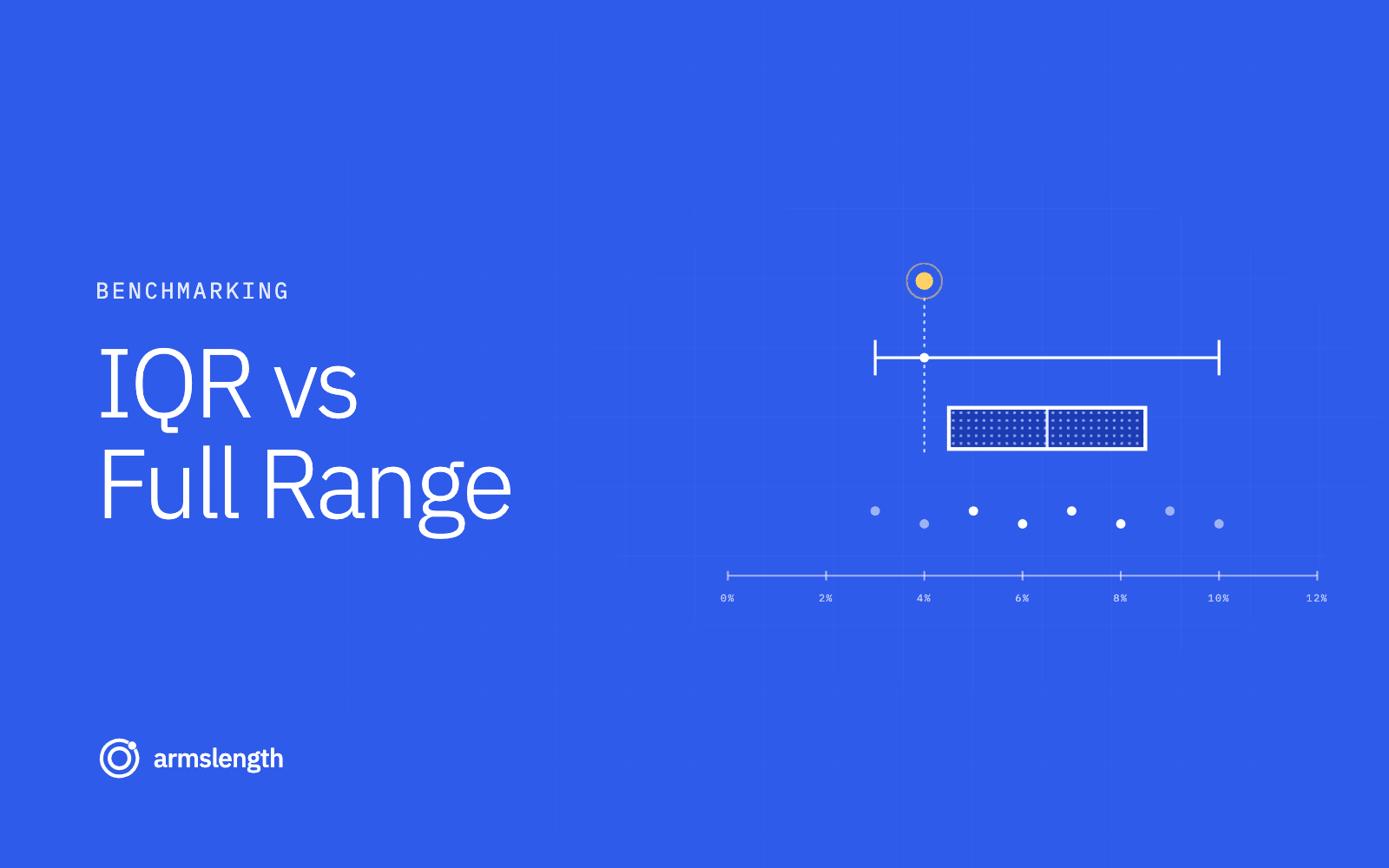
Results: 3%, 4%, 5%, 6%, 7%, 8%, 9%, 10%
Metric
Value
Full Range
3% – 10% (7pp spread)
IQR
~4.5% – 8.5%
Median
6.5%
Tested Party
4%
Analysis:
Under Full Range: 4% is inside (above 3%)
Under IQR: 4% is outside (below 4.5%) → adjustment to median (6.5%)
Decision:
If 3% comparable has identifiable defects → Use IQR
If all 8 are "equally reliable" → Full range possible but risky
Conservative approach: Use IQR, accept potential adjustment to median
Numerical Impact Summary
Example
Full Range Accepts?
IQR Accepts?
Adjustment if Outside IQR
A (4%)
Yes
Yes (barely)
n/a
B (5.2%)
Yes
No (barely outside)
+0.6pp to median
C (4%)
Yes
No
+2.5pp to median
Audit Defense: Documenting Your Choice
Documenting IQR Choice (Standard)
State the range approach: "The arm's length range has been determined as the interquartile range of [X%–Y%]."
Explain why: Reference or US §1.482-1(e)(2)(iii)(B). Example: "We applied the interquartile range to mitigate the influence of comparability defects, in line with OECD guidelines."
List comparability defects: "While all companies are broadly comparable, differences in geographic markets and accounting treatment could not be fully quantified. Using a statistical range is appropriate."
Show calculation: List results, show Q1, Q3, median.
Cite local guidance: Reference HMRC/ATO/BMF guidance as applicable.
Documenting Full Range Choice (Enhanced)
All of the above, PLUS:
Justify equal reliability: "All comparables were found to be of high reliability after adjustments because [specific reasons for each]."
Address why narrowing wasn't necessary: "We considered IQR but determined it unnecessary because no comparability deficiencies warrant narrowing."
Reference the narrow range: "The full range of [X%–Y%] is itself narrow, reflecting high comparability."
Cite authority: Reference US §1.482-1(e)(2)(iii)(A) or .
Warning
Full range requires more documentation. If you can't articulate why EACH comparable is equally reliable, use IQR.
Use the full range only when you're confident ALL comparables are of high quality and very closely comparable—meaning no material comparability defects remain. This typically means a small set of very similar comparables, a naturally narrow range (less than 3-4pp), and the ability to document why each comparable is equally reliable. In practice, full range is most defensible for CUP methods or when you have fewer than 5 highly comparable companies.
What exactly are "comparability defects" that trigger IQR?
Comparability defects are differences between the tested party and comparables that affect profitability but can't be identified, quantified, or adjusted. Examples include: geographic market differences, business cycle timing variations, accounting policy differences, product/service mix variations, size effects, and risk profile differences. If any of these exist and can't be adjusted—which is typical—use IQR.
Why does Canada discourage IQR while others use it?
Canada's CRA advises against using IQR to determine arm's length prices. The philosophy is that emphasis should be on selecting truly comparable transactions through rigorous qualitative screening—not on statistical manipulation. If you've done proper comparability analysis, the range is inherently meaningful. If the range is too wide, that's a selection problem to address, not something IQR should "fix."
What if my result is outside IQR but inside full range?
This is precarious. Most tax authorities will say being outside IQR means you're not arm's length—even if you're inside the full range. You can argue the result is still arm's length based on full range logic, but success requires demonstrating all comparables are equally reliable. The more common outcome: adjustment to median.
Can tax authorities require a narrower range than IQR?
Yes. India legally requires 35th-65th percentile. Malaysia uses 37.5th-62.5th. Vietnam uses 35th-75th. These are statutory requirements—not discretionary.
If outside the range, do I always adjust to median?
Not universally—it depends on jurisdiction:
US: Median if using IQR; arithmetic mean "in other cases"
UK: Median "most of the time" per HMRC 2025 guidance
Vietnam: Median per Decree 132
OECD: Allows median, mean, or weighted averages depending on facts
In practice, median is the most common adjustment point—but it's not a universal rule.
How does sample size affect range selection?
Sample size affects the reliability of statistical measures. With a very small sample (3-5 comparables), IQR is less statistically meaningful—you're discarding limited data. With larger samples (10+), IQR filtering is more robust. This is an argumentation point, not a legal rule.
What if my IQR excludes what I believe are valid comparables?
If Q1/Q3 excludes companies you think are comparable, this may indicate: (1) your screening criteria were too broad, (2) the excluded comparables have unidentified defects, or (3) you have a borderline case for full range. Don't "cherry-pick" by switching to full range just to include favorable outliers—document your reasoning either way.
 Borys UlanenkoCEO of ArmsLength AI