Italy vs. UFI Filters (April 2024): A Transfer Pricing Dispute Over Arm's Length MarkupsItaly vs. UFI Filters (April 2024): A Transfer Pricing Dispute Over Arm's Length Markups
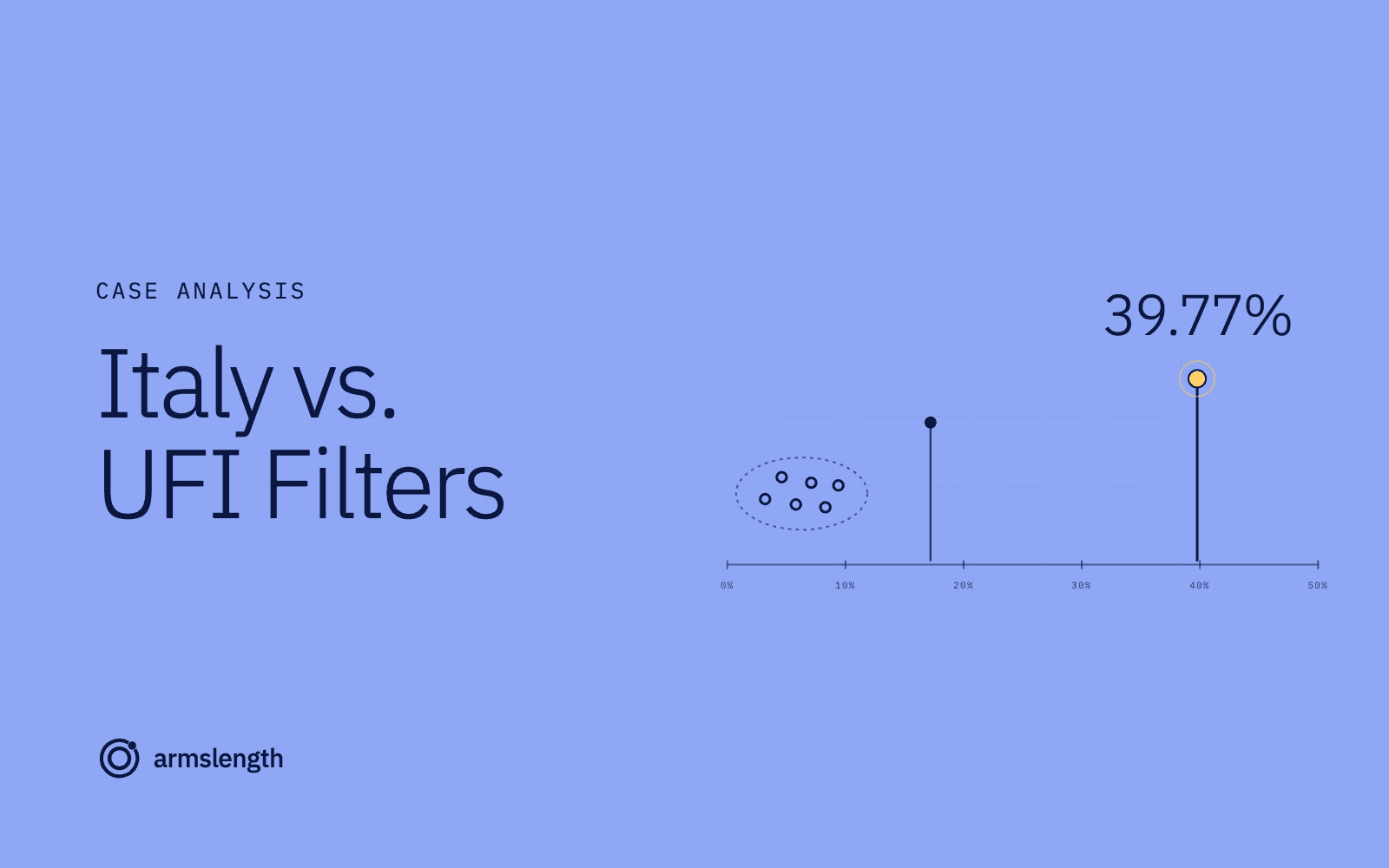
In this high-profile transfer pricing case, UFI Filters successfully defended its 39.77% intra-group markup against the Italian tax authority, highlighting the critical importance of proper comparability analysis.
Borys UlanenkoCEO of ArmsLength AI
15min read
Contents↓
Contents
TL;DR key takeaways
The Italian Supreme Court ruled in favor of UFI Filters, rejecting tax authorities' transfer pricing adjustment due to poor comparability analysis.
Proper selection of comparable companies is critical - tax authorities failed to establish comparability on product, geography, and functional profile.
Even without formal transfer pricing documentation, taxpayers can prevail if tax authorities don't meet their burden of proof with reliable benchmarking.
The case reinforces the importance of following [OECD Transfer Pricing Guidelines](/resources/oecd-guidelines) in Italian tax disputes.
In this landmark Kenyan transfer pricing case, the Tax Appeals Tribunal upheld the tax authority's rejection of the Resale Price Method in favor of TNMM, resulting in a significant tax adjustment for Avic's vehicle assembly operations.
In this Italian transfer pricing case, the Supreme Court addressed when loss-making comparables may be retained and why exclusions require case-specific support under OECD-aligned analysis.
In this landmark Danish transfer pricing dispute, the Eastern High Court ruled in favor of EET Group, rejecting a DKK 129 million adjustment and setting important precedents for method selection and range application.
More resources for your next workflow stepMore resources for your next workflow step
Browse the full resource library or contact us if you want recommendations for your specific use case.
In a high-profile transfer pricing battle, a 39.77% intra-group markup stood at the center of a dispute between Italy's tax authority and UFI Filters S.p.A., an Italian multinational with manufacturing affiliates in China. This case, resolved by the Italian Supreme Court in April 2024, provides key insights into transfer pricing methodology, comparability analysis, and the burden of proof in tax disputes.
1. Overview & Context
Case Background
In 2009, UFI Filters S.p.A. (a leading filtration technology company) purchased automotive filters from two Chinese subsidiaries – UFI Filters (Shanghai) Co. Ltd and Sofima Automotive Filter (Shanghai) Co. Ltd. The Italian parent deducted these purchase costs on its tax return, but Italy's Agenzia delle Entrate (Tax Authority) challenged the prices as not arm's length, suspecting that UFI was overpaying its Chinese affiliates to shift profits out of Italy.
UFI Filters Case Timeline: Key Events
2009
2013
2016
2019
2024
Hover over or click any point to see details about that stage of the UFI Filters case
The tax authority questioned the high profit margins earned by the Chinese subsidiaries, with markups of about 17.2% and 39.77% on cost. They believed these markups exceeded what independent manufacturers would charge, leading to an improper reduction of UFI's taxable income in Italy.
Financial and Policy Implications
The case carried significant financial stakes – had the tax authority prevailed, UFI faced a substantial increase in taxable income in Italy (with corresponding corporate taxes and regional IRAP tax due) and potential double taxation of income already taxed in China. The reputational risk was also high: a public court battle can draw unwanted attention to a company's tax practices.
Policymakers and multinationals alike closely watched this case because it tested Italy's enforcement of the arm's length principle under Article 110(7) of the Income Tax Code (TUIR) and the courts' willingness to embrace OECD Transfer Pricing Guidelines. The Italian Supreme Court's ultimate decision is seen as a landmark ruling that shows the importance of robust transfer pricing analysis and documentation in cross-border transactions.
2. Core Transfer Pricing Issues
Transfer Pricing Method Selection
The central transaction involved UFI's Chinese manufacturing affiliates selling filters to the Italian parent, a classic setup for applying the cost-plus method. UFI Filters had priced the transactions based on cost-plus, allowing the Chinese subsidiaries a gross profit markup of about 17.2% and 39.77% on cost.
Transaction Structure: UFI Filters Case
UFI Filters S.p.A.
🇮🇹
Italian Parent Company
Filtration Technology Company
Deducts Purchase Costs
Subject to IRES and IRAP tax
Items purchased from affiliates
Automotive Filters
Cost + 17.2% / 39.77%
Chinese Subsidiaries
🇨🇳
UFI & Sofima Shanghai
Manufacturing Operations
High-Tech Filter Production
Markups: 17.2% and 39.77% on cost
Taxed in China
Key Dispute Focus
The Italian Tax Authority claimed the high markups were not arm's length and shifted profits to China. The Supreme Court ruled in favor of UFI, finding the tax authority failed to establish proper comparability with its benchmark companies.
Note
The cost-plus method is one of the traditional OECD-approved methods for tangible goods, appropriate when the supplier is a contract manufacturer or producer.
Both UFI and the Italian Tax Authority agreed cost-plus was an acceptable method – the contention arose over its application. Specifically, did independent parties in comparable circumstances also earn such high mark-ups? Or were UFI's Chinese affiliates given excessively generous margins?
Comparability and Benchmark Selection
At the heart of the dispute was the selection of comparable companies for benchmarking the Chinese subsidiaries' profit markups. The tax authority's audit had relied on a set of six Chinese companies as comparables to determine the "normal" cost-plus mark-up range.
UFI Filters vehemently argued that these purported comparables were not truly comparable. There were clear mismatches in several areas:
Product differences – some comparables made items like cabins, tanks, or gearboxes, whereas UFI's affiliates produced high-technology filters
Geographic and market conditions – the comparables were located in inland/rural parts of China, operating under different economic conditions than UFI's subsidiaries in the Shanghai port region
Functional profile – there was little evidence that the chosen companies had similar functions, risks, and assets as UFI's affiliates (e.g., any involvement in R&D, complex manufacturing, or similar scale of operations)
These disparities meant the comparables' profit margins were not an apples-to-apples benchmark. The Italian Supreme Court highlighted that the Tax Authority failed to establish comparability on these key factors, and thus hadn't correctly identified the parameters for determining an arm's length "normal value".
Functional Analysis and Arm's Length Principle
Underpinning the comparability issue was a broader question of functional analysis – understanding the functions performed, assets used, and risks assumed by each party. UFI's position was that its Chinese subsidiaries' higher profit margins were justified by their functions and perhaps intangibles or efficiencies, whereas the Tax Authority treated them as if they were ordinary manufacturers.
Warning
The Supreme Court noted the absence of a detailed functional analysis in the Tax Authority's approach: they did not provide specific descriptions of functions, risks, or unique assets of either the Chinese affiliates or the purported comparables.
Without this, it was difficult to prove that the high mark-ups were unwarranted. Italy's transfer pricing rule (Art. 110(7) TUIR) requires that intercompany charges reflect the "normal value" of goods or services – essentially the arm's length price that unrelated parties would pay. Accurately determining that normal value requires aligning on functional profiles.
The Supreme Court explicitly invoked OECD Guidelines on comparability and pricing methods as an interpretative aid. Additionally, prior jurisprudence in Italy had established that if tax authorities want to adjust a taxpayer's transfer prices, they must do so by closely following OECD-compliant methods and demonstrating truly comparable scenarios.
3. Stakeholder Positions
Both the taxpayer (UFI Filters) and the Italian Tax Authority advanced contrasting arguments on the transfer pricing methodology and outcomes:
Key Positions in the UFI Filters Transfer Pricing Case
Taxpayer (UFI Filters)
Applied the cost-plus method to Chinese manufacturing affiliates, believing it appropriate given the subsidiaries' role as producers. The resulting mark-ups (17.2% and 39.77%) were seen as reflecting the affiliates' functions and costs.
Tax Authority (Agenzia delle Entrate)
Accepted the cost-plus method in principle but argued the implemented mark-ups were excessive. Emphasized that independent manufacturers would not command such high margins, indicating a potential profit shift away from Italy.
Supreme Court Reasoning
Agreed that cost-plus was an appropriate method for tangible goods transactions. However, the Court emphasized that proper application requires reliable comparable data, which the tax authority failed to provide.
4. Analysis & Court Decision
Strengths & Weaknesses of Each Side
Tax Authority's Case – Strengths
The prima facie numbers were troublesome for UFI: a 39.77% cost-plus margin is unusually high for contract manufacturing, which gave the Tax Authority a common-sense argument that something was amiss. Additionally, UFI's lack of contemporaneous documentation was a major weakness for the taxpayer – it suggested that UFI hadn't tried to benchmark or support its pricing at the time.
From a policy perspective, the Tax Authority's concern about profit shifting was not unfounded – it's a core reason transfer pricing rules exist, and here was a case of profits accumulating in a foreign affiliate rather than in Italy.
Tax Authority's Case – Weaknesses
The authority's execution of the transfer pricing analysis had clear weaknesses. The comparables selection was arguably poorly tailored – companies producing dissimilar products in different regions of China undermined the reliability of their calculated arm's length range.
Tip
In transfer pricing disputes, a robust analysis is essential – any analytical shortcuts (like using somewhat random comparables) can lead a court to side with the taxpayer, as happened here.
The failure to perform a nuanced functional analysis meant the authority could not demonstrate that the Chinese affiliates were truly operating like the lower-margin comparables. The Italian Supreme Court explicitly held that the tax authority "was not capable of providing appropriate evidence to justify the tax assessment" in this case.
UFI Filters' Case – Strengths
UFI's greatest advantage turned out to be the scrutiny applied to the Tax Authority's evidence. By effectively highlighting the mismatches in the authority's comparables and the lack of specific proof, UFI cast doubt on the reliability of the adjustment.
The company benefited from Italian jurisprudence that requires adjustments to be well-founded: since the authority's calculation of "normal value" was questionable, the benefit of doubt went to the taxpayer.
UFI's operations involved real, tangible manufacturing in China, not a paper restructure to a tax haven – the fact that the affiliates were in a bona fide production economy (China) and presumably paid local taxes made UFI's narrative of legitimate business arrangements more credible.
UFI Filters' Case – Weaknesses
Despite victory, UFI's position had notable weaknesses. The absence of a contemporaneous transfer pricing study or documentation meant UFI initially had little affirmative defense – it could only attack the authority's claims.
The sheer discrepancy in margins (especially the 39.77% markup) is difficult to defend on pure arm's length grounds; UFI was somewhat vulnerable to the argument that independent companies might not have agreed to pay such a high markup for the same product.
Court Decision & Ruling
The Italian Supreme Court ruled in favor of UFI Filters, concluding that the tax authority had failed to prove that the high markups were not arm's length. The Court emphasized several key points in its decision:
The tax authority had not adequately demonstrated that its selected comparables were truly comparable to UFI's Chinese subsidiaries
No proper functional analysis was conducted to show that the comparables had the same function and risk profiles as UFI's affiliates
The mere fact that the markups were high is not sufficient to justify an adjustment - proper comparability analysis is essential
The authority bears the burden of proving that its proposed adjustment is based on valid comparables, which it failed to meet
The Court's decision reinforced that Italian transfer pricing practices must align with OECD standards, particularly regarding proper comparability analysis and method application.
5. Key Takeaways
Documentation and Benchmarking Matter
The Italy vs. UFI Filters case provides a textbook example of why strong transfer pricing documentation and rigorous benchmarking matter. UFI's lack of a contemporaneous local file left it exposed; preparing a detailed transfer pricing study that justified the Chinese affiliates' margins with appropriate comparables could potentially have prevented the dispute or at least strengthened UFI's position from the outset.
Key point
Companies should ensure their documentation explains why a given method was chosen and includes a thorough search for comparables with adjustments for any differences.
The case shows that benchmarking quality matters – selecting truly comparable companies (similar products, functions, and markets) is the cornerstone of defending an intercompany price. Any significant deviations in profit indicators should be justified by genuine business differences and documented as such.
Enforcement Trends and Policy Shifts
This dispute reflects a broader enforcement trend: tax authorities are increasingly vigilant about cross-border profit allocations, even with trading partners that are not traditional "tax havens". Italy's tax authority in particular has shown willingness to scrutinize transactions with non-EU affiliates (like those in China), indicating a global reach in enforcement.
The Italian Supreme Court's firm stance on OECD Guidelines in this case signals a policy alignment with international standards. Notably, Italy's transfer pricing statute (Art. 110(7) TUIR) has evolved from a "normal value" concept to an explicit arm's length principle harmonized with OECD norms, and the courts are now actively applying OECD guidance on comparability, functional analysis, and burden of proof.
Managing Transfer Pricing Risk
Here are practical steps companies can take to manage transfer pricing risk based on the UFI Filters case:
Maintain Robust Documentation: Always prepare transfer pricing documentation (Master File and Local File) for significant intercompany transactions. In Italy, having OECD-compliant documentation in place (and notifying it on the annual tax return) helps defend your position and secures penalty protection.
Perform Quality Benchmarking & Periodic Reviews: The selection of comparables determines the strength of a transfer pricing analysis. Use databases and expert knowledge to identify independent companies that closely mirror the tested entity's situation. If your results yield an outlier, investigate and document the reasons.
Align Transfer Pricing with Business Reality: Transfer pricing policies should reflect the commercial reality of your operations. If one related entity is consistently far more profitable than others, there should be clear business drivers (unique functions, valuable intangibles, extra risks assumed, etc.) – and these should be articulated in your transfer pricing analysis.
Consider Proactive Risk Management: For high-risk transactions or complex supply chains, consider proactive measures such as negotiating an Advance Pricing Agreement (APA) with one or more tax authorities. While APAs require effort, the UFI dispute demonstrates that the cost and uncertainty of litigation can be far greater.
Final Thoughts
The Italy vs. UFI Filters case underlines that compliance is not just about avoiding penalties, but about aligning intercompany pricing with reality and being ready to defend it. In an era of heightened scrutiny, companies that invest in benchmarking accuracy, thorough documentation, and proactive strategies will be well positioned to withstand the challenges of transfer pricing audits and disputes.
While UFI Filters ultimately prevailed, the years of litigation and uncertainty could have been avoided with better upfront documentation. This case reminds us that transfer pricing is both an art and a science – requiring attention to detail, economic substance, and a thorough understanding of how tax authorities evaluate arm's length outcomes.
Frequently Asked Questions
What was the key issue in the UFI Filters transfer pricing case?
The main issue was whether the high markups (17.2% and 39.77%) that UFI's Italian entity paid to its Chinese manufacturing subsidiaries were arm's length. The Italian tax authority claimed these markups were excessive and shifted profits out of Italy, while UFI argued they reflected genuine business arrangements and appropriate compensation for the Chinese entities' functions.
Why did the tax authority's case fail despite the unusually high markups?
The tax authority's case failed because they didn't properly establish comparability. The six Chinese companies they used as benchmarks made different products, operated in different regions of China, and had different functional profiles than UFI's subsidiaries. The Supreme Court determined that without proper comparability, the tax authority couldn't prove that UFI's markups were not arm's length.
How important is functional analysis in transfer pricing disputes?
The UFI case demonstrates that functional analysis is essential. The tax authority's failure to conduct a detailed assessment of the functions, assets, and risks of both UFI's affiliates and the benchmark companies was a major weakness in their position. Courts expect tax authorities to establish why supposedly comparable companies are truly comparable in terms of their business operations, not just their industry or location.
What should companies do to avoid similar transfer pricing disputes?
Companies should: (1) Prepare contemporaneous documentation with detailed functional analysis; (2) Conduct rigorous benchmarking studies using truly comparable companies; (3) Justify significant profit divergences with clear business explanations; (4) Consider advance pricing agreements for high-risk transactions; and (5) Regularly review their transfer pricing outcomes to identify and address potential risks before an audit.
How does the burden of proof work in Italian transfer pricing cases?
The UFI case confirmed that while taxpayers should maintain documentation, the Italian tax authority bears the burden of proving that its proposed adjustments are based on valid comparables and sound methodology. Even without formal documentation, UFI prevailed because the tax authority failed to meet its burden of demonstrating that the pricing was not arm's length using appropriate comparable data.
Can high markups ever be justified as arm's length in transfer pricing?
Yes, high markups can be arm's length if justified by the functional profile and value creation of the entity. Factors that might support higher markups include: specialized manufacturing expertise, valuable intellectual property, assumption of significant business risks, unique market position, or extraordinary efficiency. However, such factors must be documented and supported by evidence of similar arrangements between independent parties.
 Borys UlanenkoCEO of ArmsLength AI