Hard Questions in TNMM BenchmarkingHard Questions in TNMM Benchmarking
Functional analysis, search design, and comparable selection: a practical webinar on the hard questions that decide whether a TNMM benchmark can survive review.
Borys UlanenkoCEO of ArmsLength AI
Sven van der HeideCPO of ArmsLength AI
55min webinar
Contents↓
Contents
TL;DR - Key Takeaways
AI is changing the audit baseline: tax authorities and reviewers can scrutinize benchmarking studies at much greater scale.
A TNMM benchmark is a chain of judgment calls, not a database exercise. Weaknesses usually start in the functional profile and search design.
Comparable selection should focus on value drivers: reject quickly, review real differences, and accept imperfect companies only when the differences are not material.
Range selection should reflect confidence in the comparables. A full range requires much stronger comparability than an interquartile range.
PLI selection is not just a formula. The cost base has to follow the tested party's functions, assets, risks, and accounting reality.
TNMM benchmarking rarely fails because someone forgot how to calculate a range. It fails because the file cannot explain the choices behind the range.
The hard questions come earlier: what exactly is being benchmarked, what kind of independent business should the search look for, which differences matter, and whether the selected PLI actually follows the economics of the tested party.
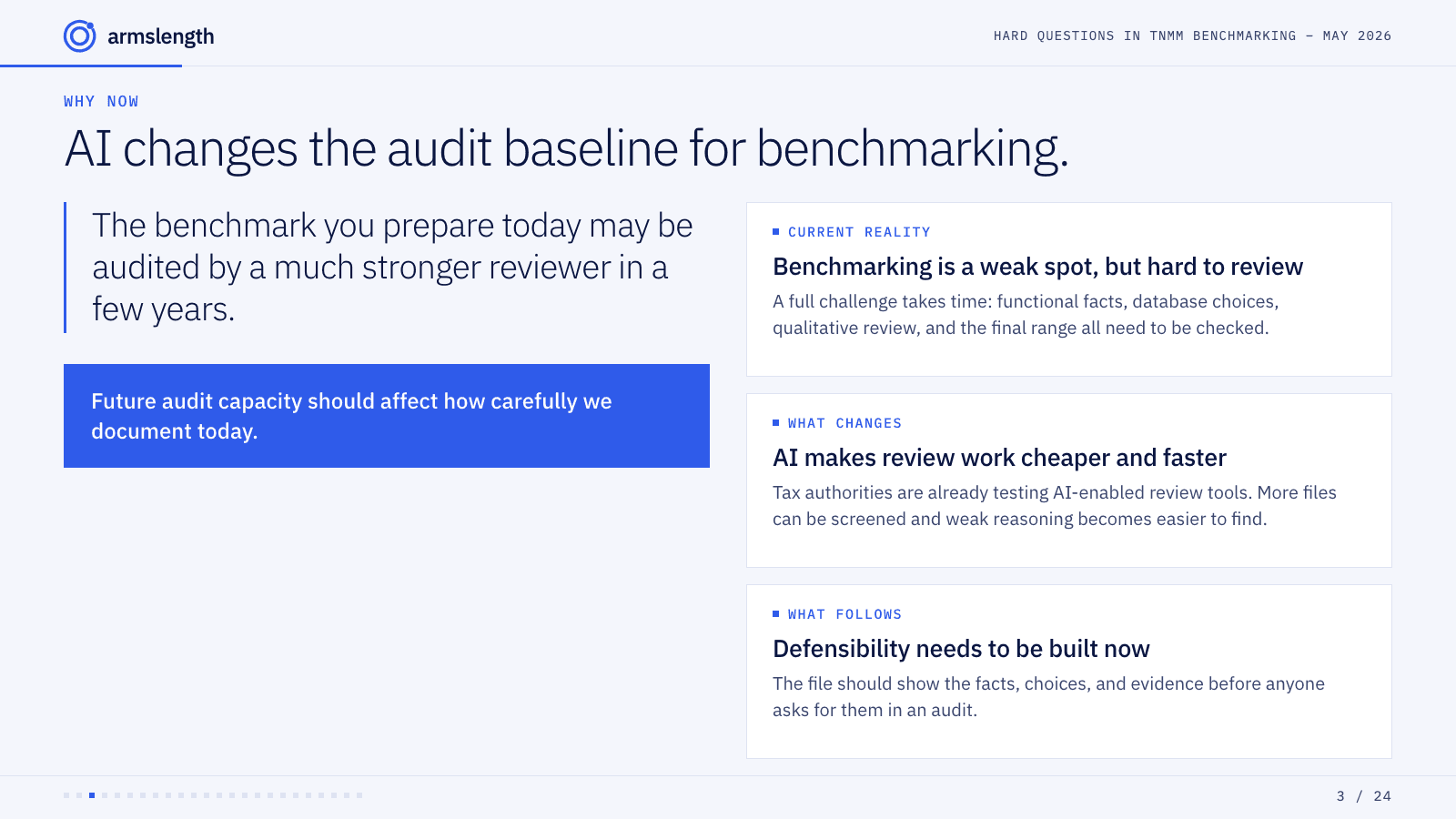
AI changes the audit baseline for benchmarking.
AI changes the audit baseline
For many years, benchmarking studies were a weak spot in transfer pricing files, but not always the highest-return target for tax authorities. A proper challenge meant replicating filters, reviewing hundreds of companies, reading websites, testing rejection reasons, and building an alternative range. That work takes time.
AI changes the economics.
The point is not that AI will make every tax authority right. The point is that AI lowers the cost of asking better questions. A reviewer can now test more benchmarks, identify inconsistencies faster, compare a taxpayer's search strategy against alternative strategies, and pressure weak documentation that previously might have gone untouched.
That means the old minimum standard is no longer enough. A benchmark needs to explain:
Why the tested party can be benchmarked with the chosen profile
What economic target the search is trying to find
Why each major filter is appropriate
Why accepted companies are comparable enough
Why rejected companies were excluded
Why the selected range and PLI match the underlying transaction
Note
The practical baseline is changing from "can we produce a benchmark?" to "can someone else retrace the benchmark and understand why each judgment call was made?"
The range is usually where the fight ends
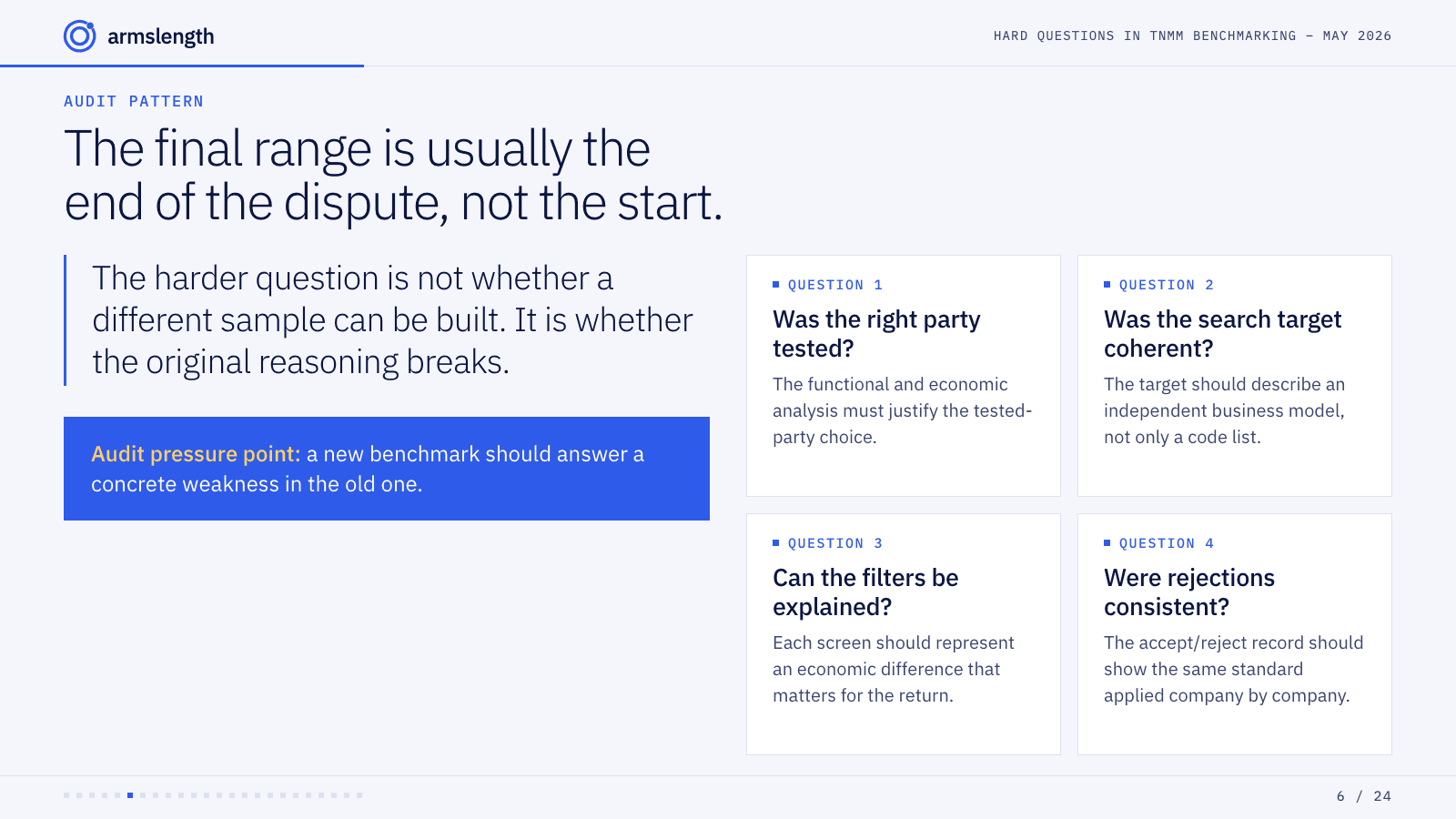
The final range is usually the end of the dispute, not the start.
The final range is usually where the dispute ends, not where it starts.
Tax authorities rarely win a benchmarking dispute by saying only that they prefer another number. They need to work backwards. A persuasive challenge usually has to show:
The original study has a real weakness
The weakness matters for comparability
The weakness affects the arm's length range
An alternative analysis is more reliable
The adjustment point is reasonable
Defensive benchmarking cannot stop at calculating an interquartile range. The file needs to preserve the logic behind the range.
If the file only contains a list of accepted companies and a final median, it is vulnerable. If it explains the tested party, search target, filters, accepted differences, rejected differences, and range policy, there is much less room for a reviewer to recast the analysis.
Functional profile comes before the benchmark
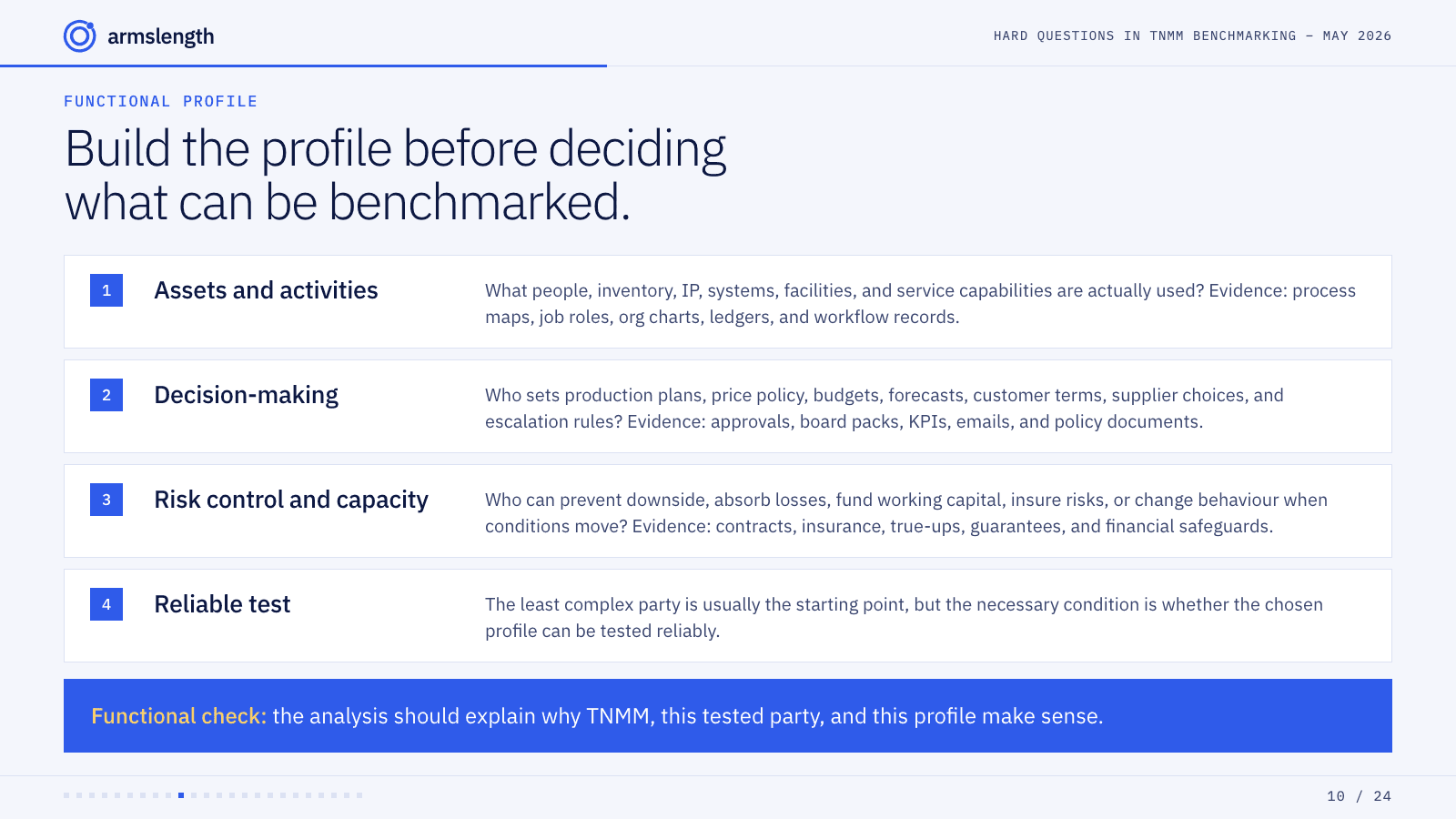
Build the profile before deciding what can be benchmarked.
Before opening a database, the team should know what business reality it is trying to benchmark.
That means more than writing "routine distributor" or "contract manufacturer." The functional profile should pin down:
Activities and workflows
Decision-making authority
Risk control and risk capacity
Assets used and intangibles involved
Accounting treatment that affects the PLI and cost base
The reliable test for whether a third-party company is close enough
This is where many benchmark disputes begin. If the functional profile is too generic, the search will be too generic. If the search is too generic, the comparable set will contain companies that are easy to challenge later.
Labels can mislead. A company that manufactures, stores, owns, and processes materials may not be comparable to a low-risk service provider just because both sit somewhere in a broad manufacturing category. Likewise, companies with different products may still be economically comparable if the relevant value drivers are similar, while companies with the same product category may be poor comparables if the functions and risks differ.
Tip
Do the functional profile before the search strategy. Otherwise the database filters start driving the economics, instead of the economics driving the database filters.
State the search target before opening the database
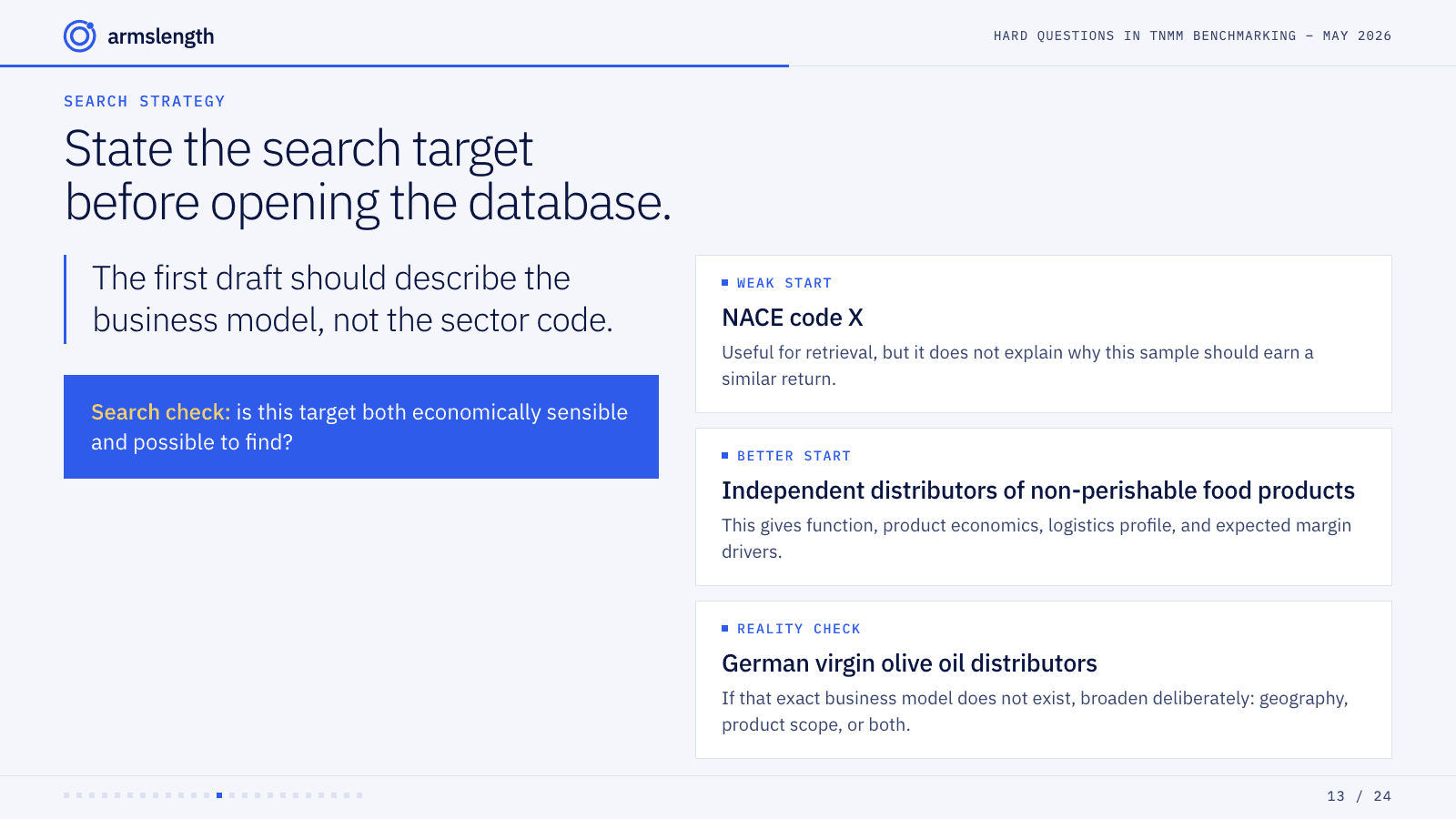
State the search target before opening the database.
The first draft of the search strategy should describe the business model, not the sector code.
A NACE code, SIC code, NAICS code, keyword, or database industry tag is a tool for finding candidates. It is not the search target itself. A good search target says what kind of independent company would be economically comparable to the tested party.
For example, "German oil distributors" is not the same thing as "independent distributors of petroleum products, chemical products, and adjacent industrial inputs with limited ownership of valuable intangibles." The second description gives the reviewer a test. It also gives the preparer a controlled way to expand the search if the first pass produces too few usable companies.
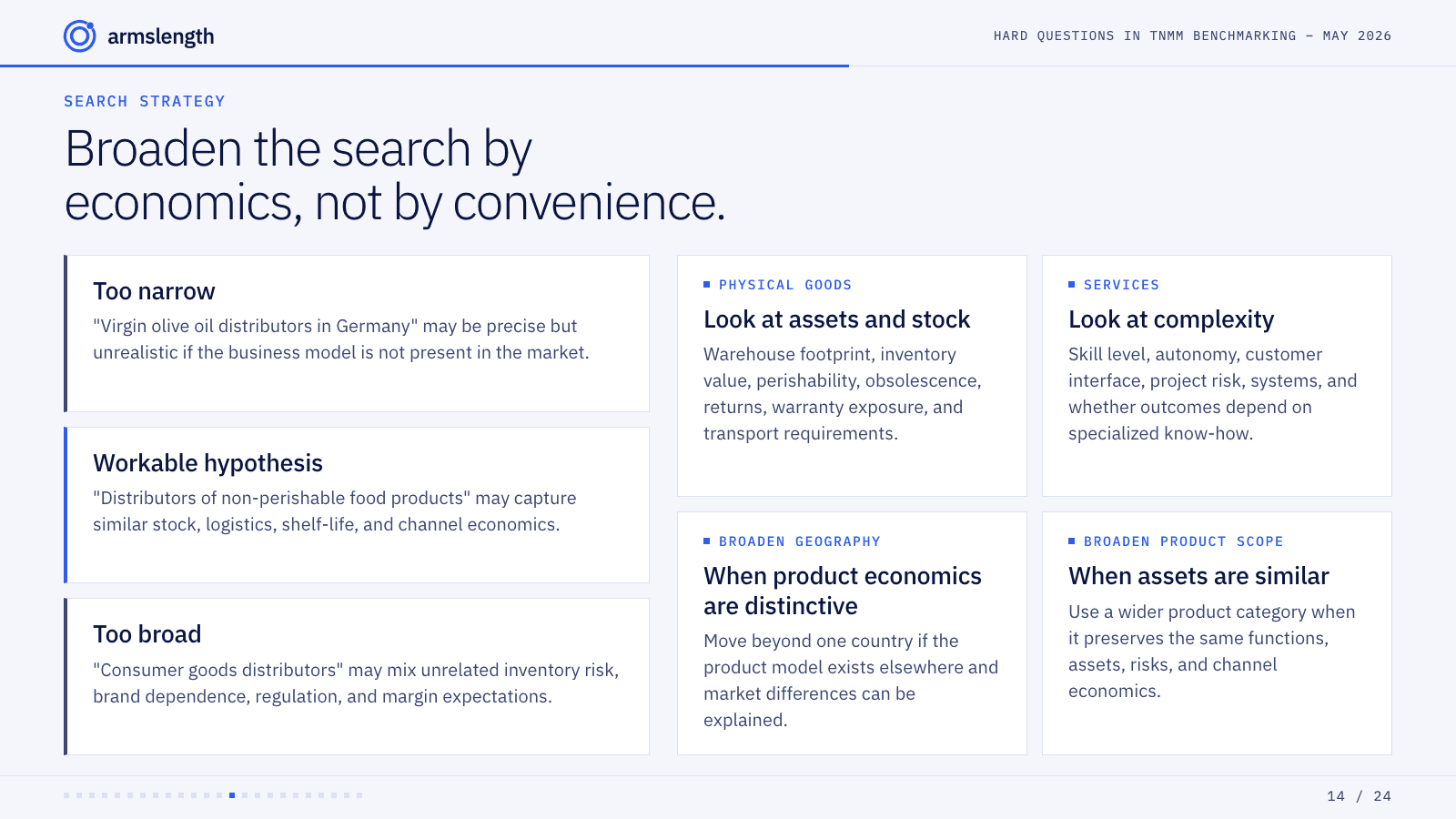
Broaden the search by economics, not by convenience.
Search expansion is often where files become weak. The defensible question is not "what gets us enough comparables?" It is "which adjacent business models remain economically comparable to the tested party?"
A stronger search file explains the expansion path:
Start narrow with the closest expected target
Test whether the result set is workable
Expand by products, services, functions, geography, or complexity only when the rationale is documented
Explain why the expanded group remains economically comparable
Preserve the order of decisions so the reviewer can follow the logic
Warning
A broader search is not automatically wrong. An unexplained broader search is the problem.
Comparable selection is about value drivers
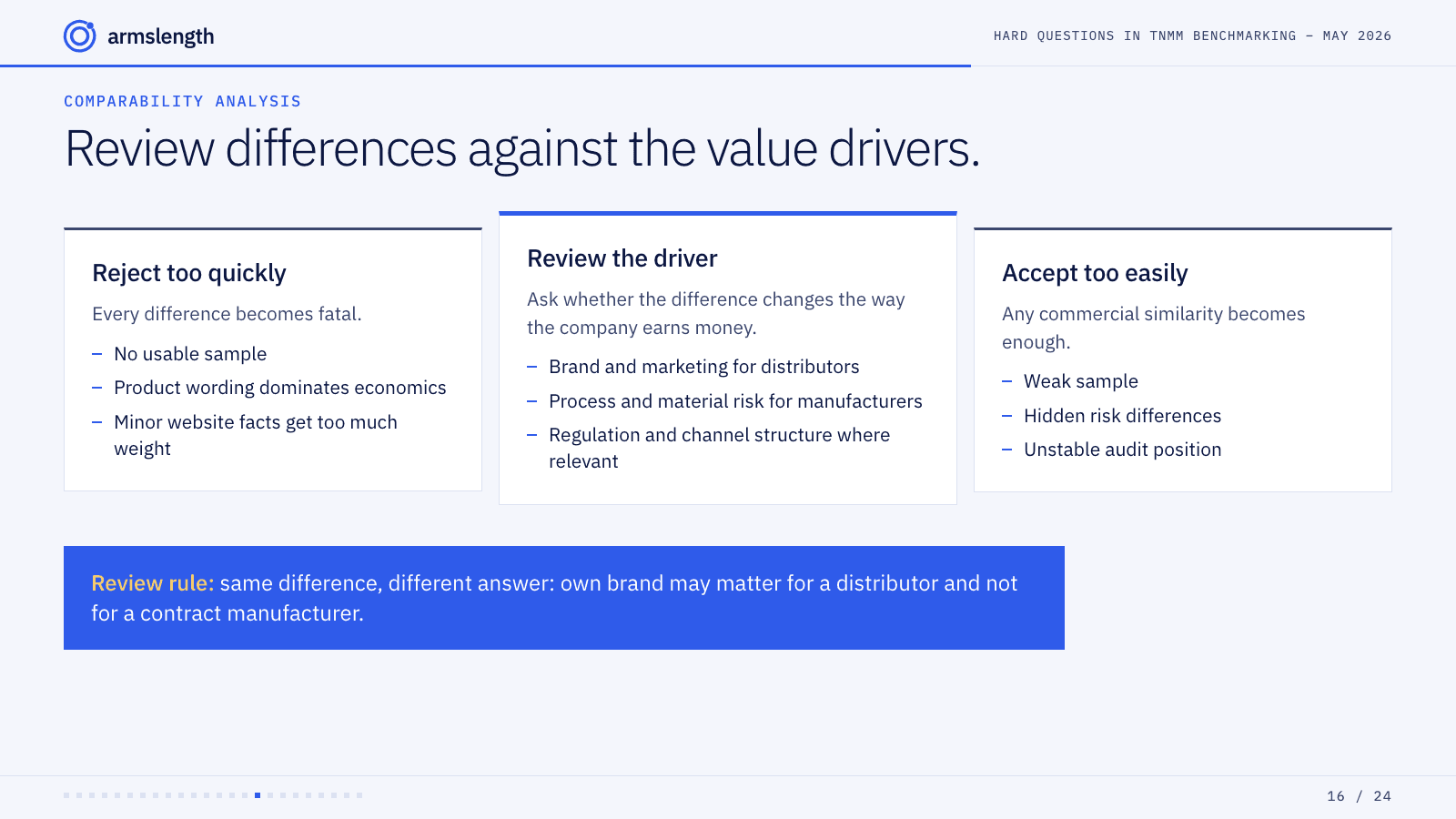
Review differences against the value drivers.
No benchmark is made of perfect clones. The question is whether the differences matter.
Comparable review usually falls into three practical buckets:
Reject too quickly: Product or function differences exist, but the file does not explain why they materially affect profitability.
Review the difference: The company has a relevant difference, such as broader products, additional services, manufacturing activity, foreign operations, or brand exposure. The reviewer needs to decide whether that difference changes the economics.
Accept too easily: The company looks close enough at first glance, but owns valuable intangibles, performs additional functions, bears different risks, or fails independence checks.
The middle bucket matters most. A strong benchmark does not pretend every accepted company is perfect. It explains why some differences are tolerable and others are material.
That distinction shows up repeatedly in disputes. Sometimes tax authorities challenge comparables because product differences are poorly explained. In other cases, the problem is not the existence of differences, but the missing link between those differences and the taxpayer's proposed range.
Range selection should reflect confidence
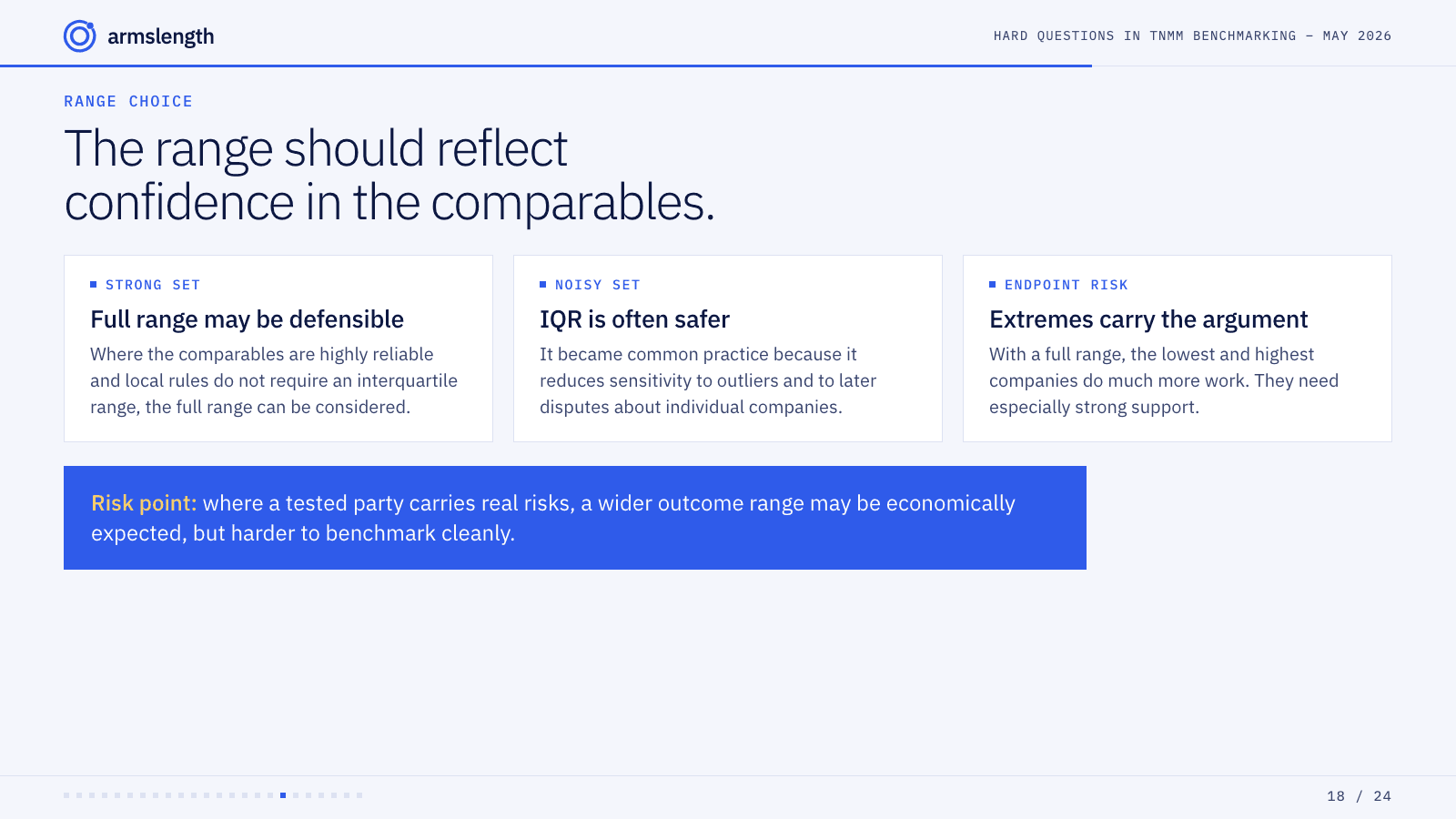
The range should reflect confidence in the comparables.
The full range versus interquartile range question often gets treated as a mechanical jurisdictional preference. It should not be.
The range should reflect confidence in the comparables.
If the set contains a small number of very strong comparables, a full range may be easier to defend. If the set contains a larger group with residual comparability defects, the interquartile range may better reflect uncertainty. If the set is weak enough that the range itself is unstable, the answer is not to hide behind the math. The answer is to revisit the search and comparable review.
Full-range policies can also create practical risk. When the accepted set is small, every company matters more. The lowest and highest observations become critical. If one edge comparable is successfully challenged, the range can move materially.
Note
Range policy is not a substitute for comparable quality. It is a way to express how much confidence you have in the set after the comparability work is done.
PLI selection is a benchmark question too
PLI selection should follow the functions, risks, and cost categories that drive the tested return.
PLI selection has its own trap: treating the PLI as a formula detached from the facts.
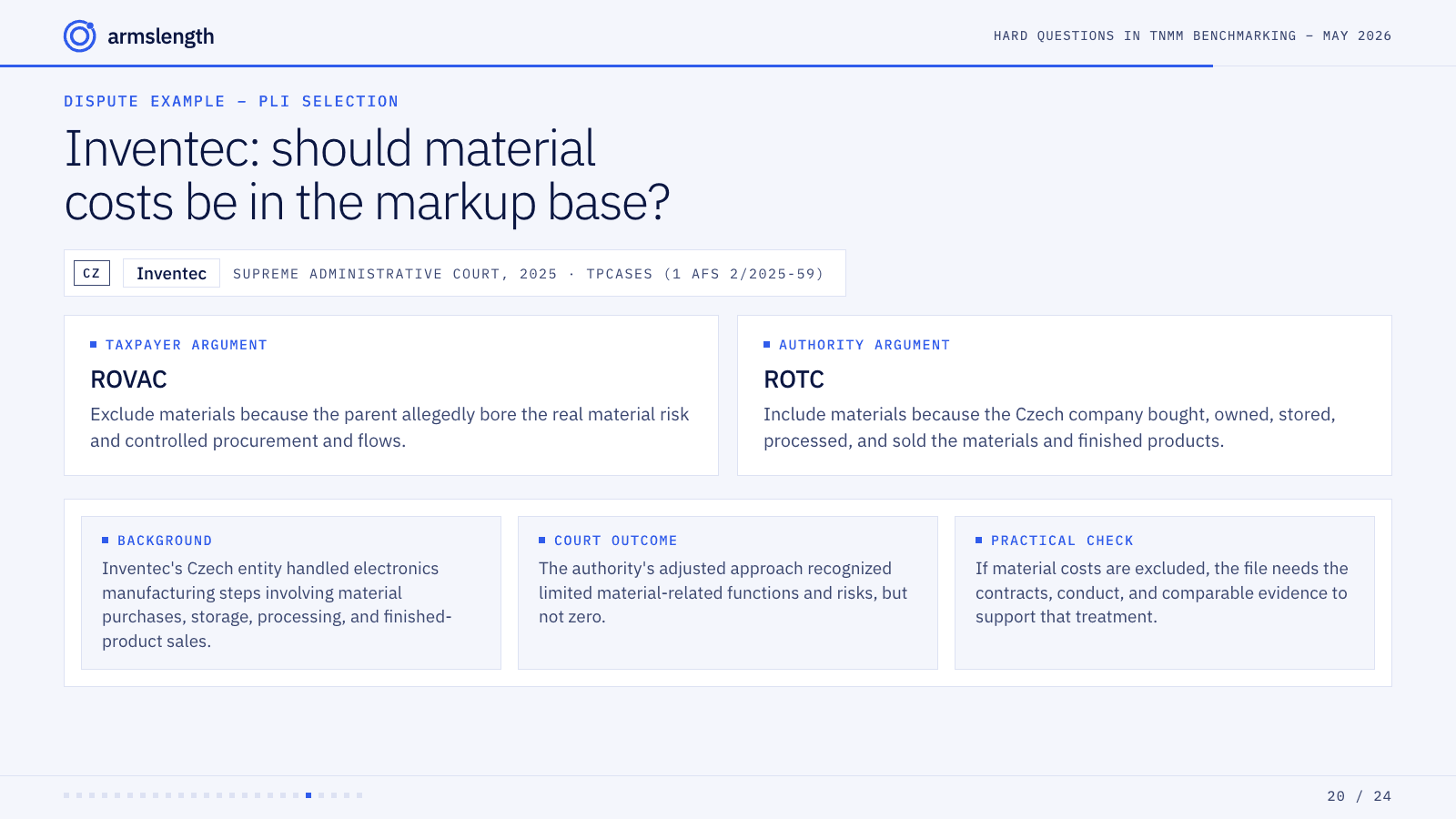
For TNMM, the selected PLI and the cost base need to follow the tested party's activity. If the tested party buys, owns, stores, and processes materials, it is difficult to say that material costs never matter to the return. If the company simply passes through third-party costs without risk or value creation, a different treatment may be appropriate. The answer depends on the functional and risk analysis.
Some disputes turn on how the benchmarked markup is applied, not only on which companies are included in the set.
Practical questions to document:
What costs are included in the denominator?
Are material costs part of the value-creating activity?
Does the tested party take inventory, processing, quality, or procurement risk?
Can comparable company data support the same cost-base treatment?
If different cost categories require different returns, is that supported by reliable data?
Warning
Exotic markup mechanics can be difficult to defend if the file does not explain why the excluded cost categories are economically different from the costs that receive a markup.
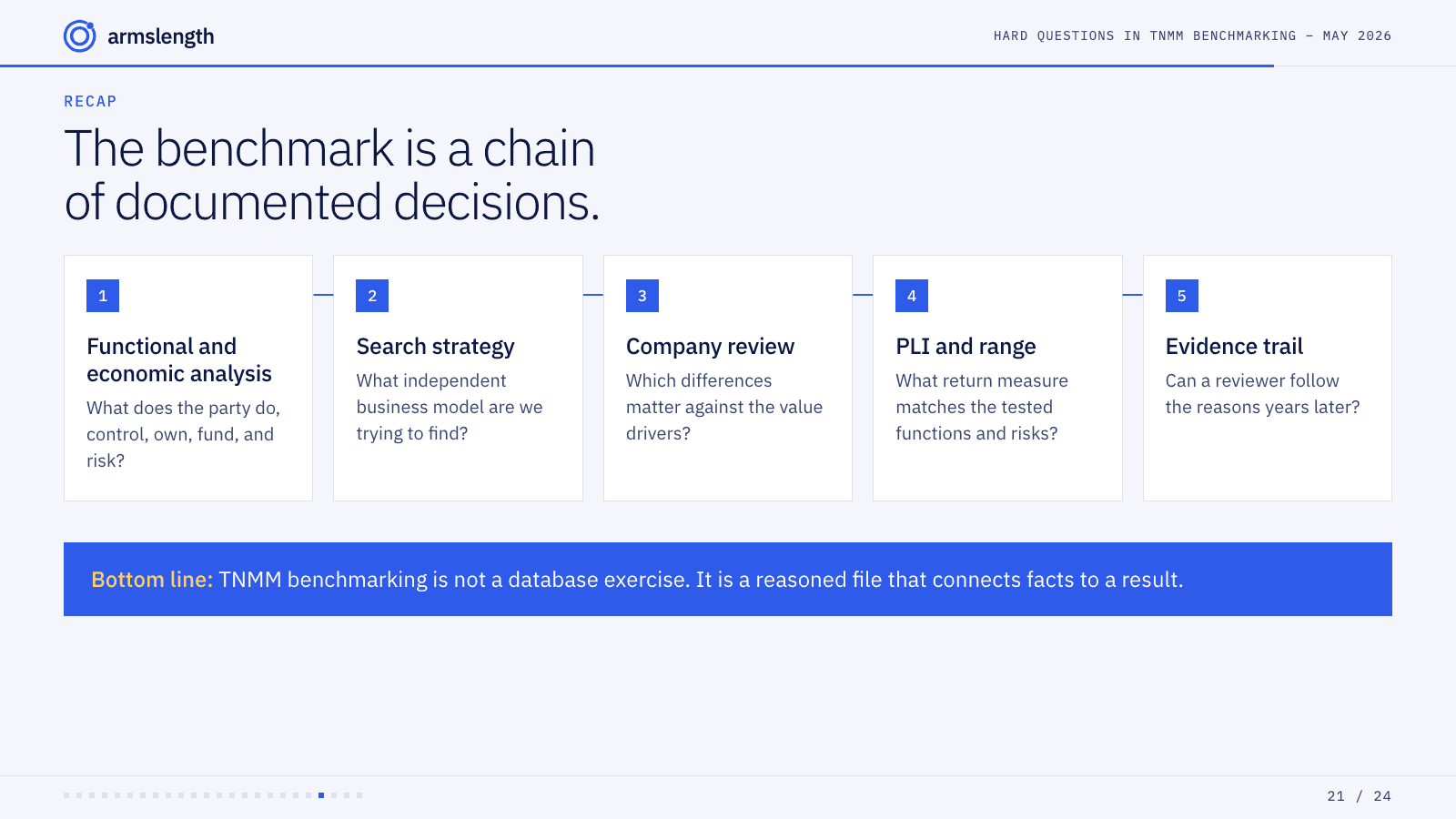
The benchmark is a chain of documented decisions
The benchmark is a chain of documented decisions.
A benchmark is not a database export plus a final report. It is a chain of decisions:
Functional and economic analysis
Search strategy
Company review
PLI and range
Evidence trail
Each step depends on the one before it. A weak functional profile leads to a weak search target. A weak search target leads to a noisy set. A noisy set makes comparable selection more subjective. Subjective comparable selection makes the range easier to challenge. A poor evidence trail makes the whole exercise harder to defend years later.
A modern benchmark file should preserve the reasoning, not only the result.
How ArmsLength AI supports the file
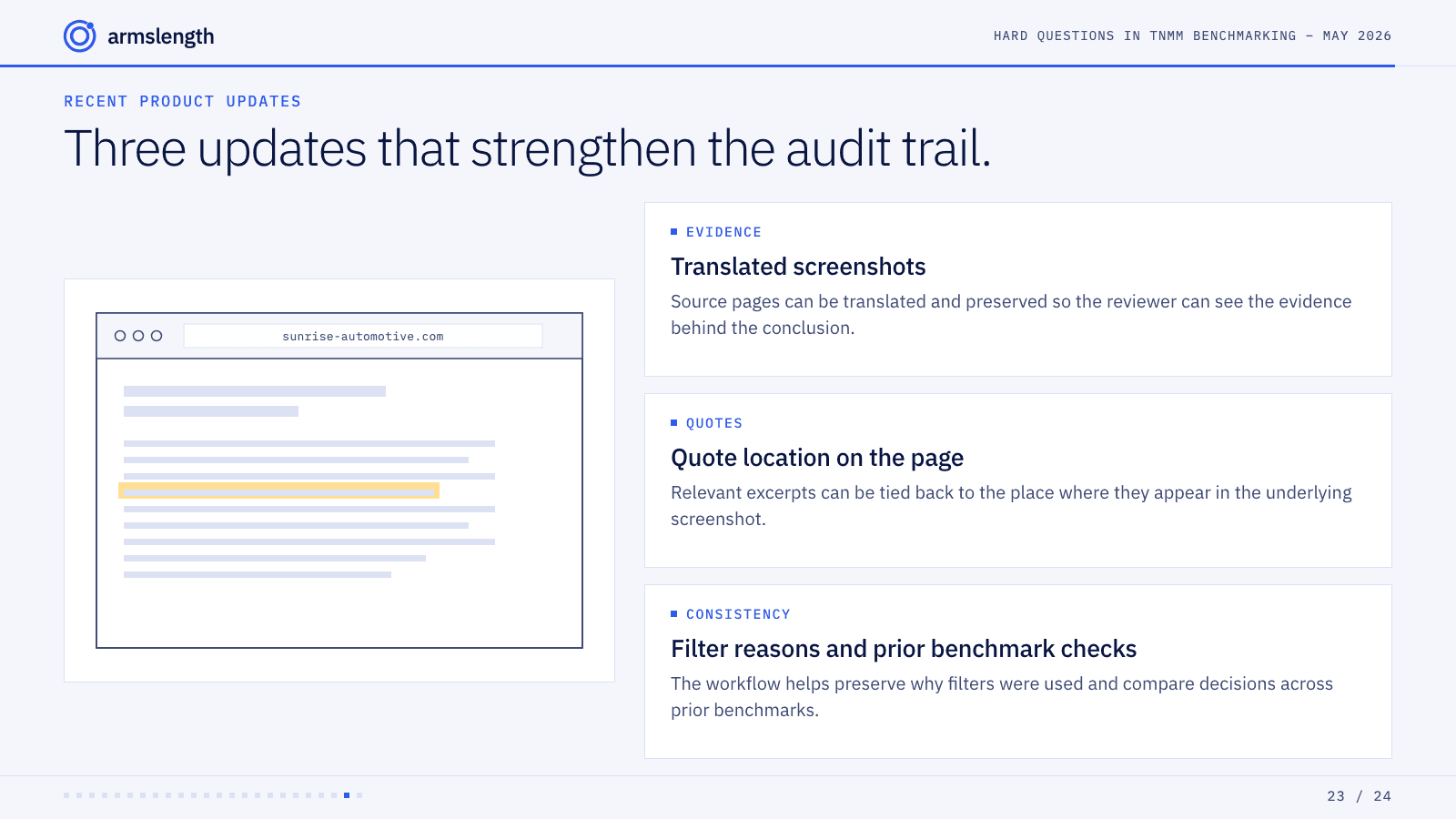
Three updates that strengthen the audit trail.
The platform does not remove the need for judgment. It changes where practitioners spend their time. Instead of manually copying website text, screenshots, and rejection reasons into a file, the tool helps collect and structure the evidence so the reviewer can focus on the hard calls.
In practice, that means:
Importing the dataset from a database export
Applying and documenting filters
Finding and validating company websites
Generating business, product, function, and structure descriptions
Reviewing AI-suggested accept and reject decisions
Seeing the range impact of review decisions
Exporting the analysis to Excel or a branded report
Preserving screenshots, source locations, and filter reasons for audit support
Benchmarking is becoming faster to prepare and faster to review. The file has to be ready for both.
Main takeaway
Hard TNMM benchmarking questions are rarely solved at the end of the file. They are solved when the functional profile is written, when the search target is defined, when the first expansion decision is documented, when accepted differences are explained, and when the PLI is tied back to the business model.
The recording goes through those decisions with dispute examples and a practical view of a stronger benchmarking workflow.
 Borys UlanenkoCEO of ArmsLength AI
 Sven van der HeideCPO of ArmsLength AI