Published April 10, 2025Updated April 30, 202615 min read
Global Minimum Tax: How the 15% Floor Works and How to Model Top‑Up Tax (2026)Global Minimum Tax: How the 15% Floor Works and How to Model Top‑Up Tax (2026)
The global minimum tax (Pillar Two) enforces a 15% jurisdictional ETR for large MNEs—shortfalls create top-up tax via QDMTT, IIR, or UTPR.
Borys UlanenkoCEO of ArmsLength AI
15min read
Contents↓
Contents
TL;DR key takeaways
Pillar Two applies mainly to MNE groups with EUR 750m+ consolidated revenue and tests ETR per jurisdiction—not statutory rates.
If ETR < 15%, top-up tax is computed on excess profits (after the substance-based carve-out) and collected in order: QDMTT → IIR → UTPR.
Tax incentives (holidays, non-refundable credits, accelerated depreciation) can trigger Pillar Two exposure unless redesigned or offset by a qualified QDMTT.
Most implementation risk is data and mechanics: mapping financial accounts to GloBE income, covered taxes (incl. deferred tax rules), and safe harbours.
EU Public CbCR requires large groups to publish income-tax KPIs by jurisdiction. Most calendar-year groups first report FY2025 and publish by 31 Dec 2026.
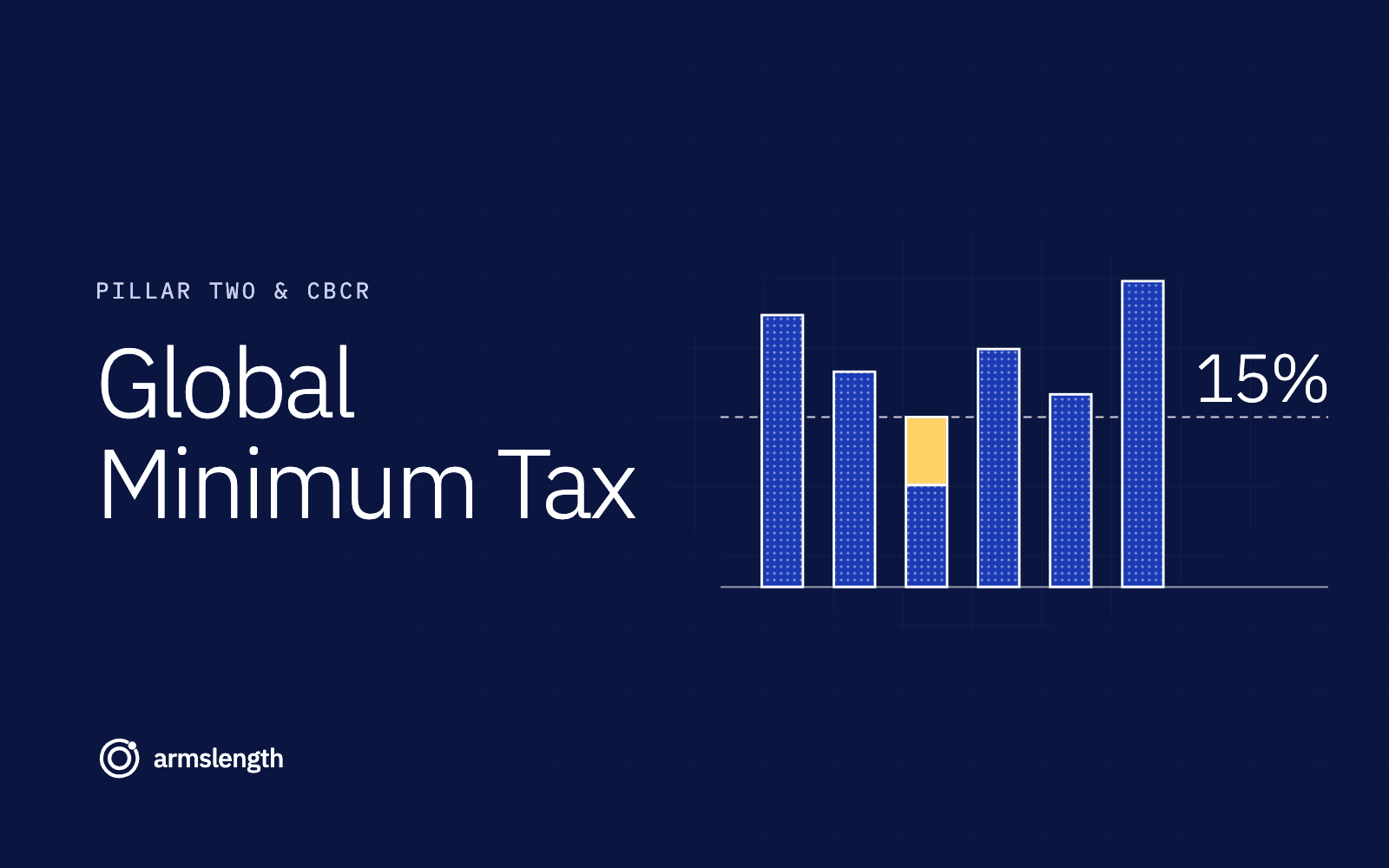
The global minimum tax (OECD/G20 Pillar Two, or GloBE) is a coordinated framework that ensures large multinational groups pay at least a 15% effective tax rate (ETR) in each jurisdiction. If a jurisdiction’s Pillar Two ETR is below 15%, the rules compute a top‑up tax. In common shorthand, top‑up is “collected” in the order QDMTT → IIR → UTPR—but it helps to remember the mechanics: a qualified domestic minimum top-up tax (QDMTT) is reflected as “Domestic Top-up Tax” in the jurisdictional top-up computation, reducing the residual amount (if any) that is then charged under the Income Inclusion Rule (IIR) and finally the Undertaxed Profits Rule (UTPR) backstop. The practical work is less about statutory rates and more about financial-accounting-based ETR modeling, safe harbour eligibility, and how incentives and deferred taxes flow through the GloBE mechanics. (See OECD GloBE Model Rules (2021) and OECD Consolidated Commentary (2025).)
Key Takeaways
→Pillar Two is a jurisdictional ETR system: Adjusted Covered Taxes ÷ Net GloBE Income—statutory rates are not determinative.
→If ETR < 15%, top-up tax is computed on Excess Profits (after the substance-based income exclusion) and collected via QDMTT → IIR → UTPR (with QDMTT reducing the jurisdictional top-up as “Domestic Top-up Tax”).
→Many traditional incentives can “leak” into top-up tax unless redesigned (e.g., credit design), protected by SBIE, or absorbed by a qualified QDMTT.
→The biggest implementation risk is data: mapping consolidated financials, current/deferred tax, and entity-jurisdiction attributes into the GIR reporting model.
What the global minimum tax is (and what it is not)
The global minimum tax is the market shorthand for the OECD/G20 Pillar Two rules—formally the Global Anti-Base Erosion (GloBE) Model Rules—which impose a minimum 15% jurisdictional effective tax rate on large multinational enterprise (MNE) groups. The system is designed as a “common approach”: jurisdictions are not forced to adopt it, but if they do, they are expected to implement it in a coordinated way so other countries accept the outcomes. (See OECD GloBE Model Rules (2021) and OECD Administrative Guidance (Jan 2025) on administration.)
What it targets
Pillar Two targets low-tax outcomes, not specific legal structures. It measures tax using a standardized approach based on financial accounting income, with specific adjustments, then compares the resulting jurisdictional ETR to the 15% floor. If the ETR is below 15%, Pillar Two calculates a top-up tax to bring the outcome up to the minimum. (See OECD GloBE Model Rules (2021).)
What it is not
It is not:
A single global tax levied by the OECD (tax is imposed under domestic law).
A “15% statutory corporate tax rate” requirement.
A per-entity test; ETR is computed per jurisdiction, aggregating constituent entities (with specific rules for permanent establishments and allocation). (See OECD GloBE Model Rules (2021).)
Who is in scope: thresholds, exclusions, and why “jurisdictional” matters
For most groups, the first modeling step is deciding whether Pillar Two applies at all and, if it does, in which jurisdictions the computations will be material.
The core scope threshold (EUR 750m)
In general, the GloBE Rules apply to constituent entities that are members of an MNE group whose Ultimate Parent Entity (UPE) has annual revenue of EUR 750 million or more in the UPE’s consolidated financial statements in at least 2 of the 4 fiscal years immediately preceding the tested fiscal year. If one or more of those fiscal years is not 12 months, the EUR 750m threshold is adjusted proportionally to match the length of the relevant fiscal year. (See OECD GloBE Model Rules (2021).)
NoteKey 2025 modeling inputs (quick reference)
Scope threshold: EUR 750m is a 2-of-4 prior fiscal years test, with proportional adjustment for non-12‑month years. (See OECD Model Rules, Article 1.1.)
Transitional CbCR Safe Harbour period: fiscal years beginning on/before 31 Dec 2026, but not including a fiscal year that ends after 30 Jun 2028. (See OECD Safe Harbours & Penalty Relief (2022).)
SBIE transitional rates for FY beginning in 2025:9.6% of eligible payroll and 7.6% of eligible tangible assets (unless local implementation deviates). (See OECD Model Rules, Article 9.2.)
Common exclusions and simplifications practitioners check early
Filter
What it does (high level)
Why it matters in practice
Group revenue threshold (EUR 750m)
Determines whether the group is in scope (2-of-4 years test; pro-rated for short years)
Drives whether to build a full GloBE data model
Jurisdictional de minimis exclusion
At election, deems jurisdictional top-up tax to be zero if Average GloBE Revenue < EUR 10m and Average GloBE Income/Loss is a loss or < EUR 1m (average is computed over the current and two preceding fiscal years, with special rules)
Prevents spending disproportionate effort on immaterial jurisdictions
Substance-based income exclusion (SBIE)
Carves out a routine return based on payroll and tangible assets
Can materially reduce “excess profits” subject to top-up
Transitional safe harbours
Allows simplified outcomes (often using CbCR-based data) for early years (within the OECD-defined transition period)
Key for early-year compliance and provisioning
The jurisdictional aggregation feature is the most counterintuitive shift for many tax teams: a “high-tax” entity can be blended with a “low-tax” entity in the same country, and vice versa. That is why Pillar Two provisioning often requires a jurisdiction-by-jurisdiction model, not an entity-based one. (See OECD GloBE Model Rules (2021).)
Warning
A common early mistake is using statutory tax rates (or cash taxes) as a proxy for Pillar Two ETR. The GloBE ETR uses Adjusted Covered Taxes and Net GloBE Income—and those can move in different directions than cash tax because of deferred tax rules, credit treatment, and accounting-to-tax adjustments.
How the 15% global minimum tax ETR is calculated
At the center of Pillar Two is a standardized calculation of a jurisdiction’s effective tax rate. Conceptually it is simple; operationally it requires careful data mapping.
The core ETR formula (simplified)
text
Jurisdictional ETR = Adjusted Covered Taxes / Net GloBE Income
Net GloBE Income is derived from financial accounting income, with Pillar Two adjustments, aggregated across all constituent entities in the jurisdiction.
This is why early-year Pillar Two work frequently begins with a “tax provisioning lens” (tax expense accounts, deferred tax movements, uncertain tax positions) rather than a transfer pricing lens—although the two intersect through profitability, incentives, and substance.
Statutory rate vs. cash tax vs. Pillar Two ETR
Metric
What it measures
Useful for
Not reliable for
Statutory corporate rate
Headline rate in local law
High-level screening
Determining Pillar Two exposure
Cash taxes paid
Cash outflows to authorities
Treasury / cash forecasts
Pillar Two ETR (timing differences)
Accounting ETR
Tax expense ÷ accounting profit
Financial reporting
Pillar Two ETR (definition differences)
Pillar Two ETR
Adjusted Covered Taxes ÷ Net GloBE Income
Top-up tax computation
Quick proxies without data mapping
What happens when a jurisdiction’s ETR is below 15%
When a jurisdiction’s ETR is below 15%, the rules compute a top-up tax to bring the outcome to the minimum—after excluding a routine return through the substance-based income exclusion (SBIE).
In the full Model Rules computation, the jurisdictional top-up amount is then adjusted for items such as Additional Current Top-up Tax and reduced by Domestic Top-up Tax (i.e., QDMTT payable) to arrive at the Jurisdictional Top-up Tax charged under IIR/UTPR. (See OECD GloBE Model Rules (2021).)
This is the mechanical reason many “old” planning tools (statutory rate reductions, tax holidays, certain credits) can stop producing a group-wide benefit: they may simply convert into top-up tax somewhere else.
Note
“Top-up tax” is a defined Pillar Two concept. For a plain-language definition and how it appears in Pillar Two reporting, see /glossary/top-up-tax.
Who collects the top-up tax: QDMTT → IIR → UTPR (practical order)
In practice, collection is commonly summarized as a clear hierarchy:
QDMTT (domestic top-up in the low-tax jurisdiction, if it is “qualified”)
IIR (parent jurisdiction(s) impose top-up tax on low-taxed foreign profits)
UTPR (backstop allocation to other jurisdictions when IIR does not fully apply)
One nuance that matters for legal mechanics and modeling: the Model Rules compute jurisdictional top-up tax by subtracting “Domestic Top-up Tax” (QDMTT payable) at the jurisdiction level, and only the residual amount (if any) is then charged under the IIR and/or allocated under the UTPR. (See OECD GloBE Model Rules (2021).)
This ordering is why groups are tracking which jurisdictions have a qualified QDMTT and/or IIR in force, not just whether a jurisdiction has “implemented Pillar Two” generally. (See OECD Consolidated Commentary (2025).)
Decision Criteria
01If the low-tax jurisdiction has a Qualified Domestic Minimum Top-up Tax (QDMTT), expect the top-up to be absorbed locally first (reducing residual IIR/UTPR).
02If there is no qualified QDMTT, model collection under the parent’s IIR (including intermediate parent structures).
03If the group has low-tax outcomes not picked up under IIR (or the parent is in a non-IIR jurisdiction), assess UTPR exposure in operating jurisdictions.
04In early years, test transitional safe harbours (CbCR safe harbour, transitional UTPR safe harbour) before building full GloBE computations for every jurisdiction.
Tip
From a workflow perspective, most tax teams get faster and more accurate results by modeling in this order: safe harbour eligibility → QDMTT impact → residual IIR → residual UTPR. It mirrors how top-up tax is often ultimately collected.
Substance-based income exclusion (SBIE): the carve-out that changes the base
The Substance-Based Income Exclusion (SBIE) removes a formulaic “routine” return on substantive activities from the top-up tax base. It is computed from:
materially reduce top-up tax in manufacturing and service hubs with payroll and tangible assets;
make “low ETR” jurisdictions less exposed if profits are aligned with substance; and
create planning pressure to align profitability with real functions/assets, especially where incentives drive statutory rate reductions.
SBIE is not a substitute for transfer pricing
Transfer pricing still determines where profit lands. SBIE determines how much of that profit is treated as “excess” for Pillar Two purposes. In other words: TP drives the denominator; SBIE adjusts the top-up base.
If you’re revisiting profitability allocations, it’s worth cross-checking your transfer pricing documentation workflows (master file/local file) because Pillar Two models often raise similar data questions. See our documentation hub: /resources/transfer-pricing-documentation-guide.
Safe harbours and transitional relief: where most 2024–2026 effort goes
For many groups, the fastest path to compliant outcomes is to use safe harbours where available, and reserve full GloBE computations for the jurisdictions that fail safe harbour tests.
Transition Period definition (formal): applies to fiscal years beginning on or before 31 December 2026, but not including a fiscal year that ends after 30 June 2028. (For calendar-year groups, that typically means FY 2024–2026.)
Simplified ETR test “Transition Rates”:15% for fiscal years beginning in 2023 and 2024, 16% for fiscal years beginning in 2025, and 17% for fiscal years beginning in 2026.
Most practitioners analyze three tests (high-level labels used in practice):
De minimis test (very small footprint jurisdictions),
Simplified ETR test (CbCR-based ETR meets the Transition Rate), and/or
Routine profits test (profit is not above a routine return proxy).
Exact mechanics and thresholds depend on the OECD materials and local implementation, and the tests need careful data hygiene—especially for CbCR consistency.
A QDMTT is only protective if it is designed and recognized as “qualified” for Pillar Two purposes. OECD materials include a central record approach to track transitional qualified status for IIR/QDMTT/UTPR. (See OECD Consolidated Commentary (2025) and OECD Central Record web page.)
If you’re designing or evaluating domestic rules, read our dedicated guide: /resources/qdmtt-guide.
Transitional UTPR relief (why US-parented groups care)
The UTPR is the backstop. The OECD’s Transitional UTPR Safe Harbour is set out in the July 2023 Administrative Guidance (and incorporated into the Consolidated Commentary). At a high level, it is designed to provide short, early-year relief in the UPE jurisdiction by deeming the UTPR Top-up Tax Amount for the UPE jurisdiction to be zero for fiscal years (i) that run no longer than 12 months, (ii) begin on or before 31 December 2025, and (iii) end before 31 December 2026, subject to conditions (including a nominal 20% rate test framework referenced in the Guidance). (See OECD Administrative Guidance (July 2023) and OECD Consolidated Commentary (2025).)
For operational planning, this translates into a simple rule: model UTPR, but do not assume it applies at full force in every early-year scenario—check transitional relief and local law.
Common incentive patterns and their Pillar Two effect
Incentive type
What it does locally
Typical Pillar Two effect
Practical mitigation to evaluate
Tax holiday / rate reduction
Lowers current tax
Lowers Adjusted Covered Taxes → ETR may drop below 15% → top-up tax
QDMTT design; shift to non-tax subsidy; align with SBIE
Non-refundable credit
Reduces tax payable
Often reduces covered taxes → can depress ETR
Consider credit redesign (subject to rules), or alternative support mechanisms
Refundable / “qualified refundable” style credit
Cash-like support
Can be treated more like income support than a tax reduction (fact-specific)
Validate classification under OECD guidance and local implementation
Accelerated depreciation
Timing benefit
Deferred tax mechanics and recapture can change whether “low ETR” persists
Model deferred tax attributes and recapture; avoid relying on timing alone
Warning
Do not assume an incentive “still works” because the statutory rate is above 15%. Pillar Two can still generate top-up tax if covered taxes are reduced by credits, exemptions, losses, or timing differences—especially in the transition years.
Where Pillar Two is implemented (and how to track “qualified” status)
By 2025, many jurisdictions have enacted Pillar Two rules, but practitioners need a more precise question:
Is the jurisdiction’s IIR/QDMTT/UTPR recognized as “qualified” (transitionally), and for which periods?
The OECD Consolidated Commentary (2025) includes an Annex B central record current as at 31 March 2025, and the OECD maintains an online Central Record updated beyond that cutoff. As of the OECD’s published status, the Central Record page is marked “current as at 18 August 2025”—so for a 2025 close you should still confirm whether any later update has been released and retain dated evidence for your provision/audit file. (See OECD Consolidated Commentary (2025) and OECD Central Record.)
Examples of jurisdictions listed in the OECD record (snapshot-style)
The Annex B record (current as at 31 March 2025) lists numerous jurisdictions with transitional qualified status for IIR and/or QDMTT, including many EU Member States and others such as Canada, Japan, Korea, Norway, Switzerland, Türkiye, the United Kingdom, and Viet Nam (among others). (See OECD Consolidated Commentary (2025).)
Determines whether local top-up reduces IIR/UTPR exposure
Effective dates and transition
Local law + OECD record
Impacts year-1 provisioning and safe harbour availability
Tip
For audit trails, save a dated export/screenshot of the OECD Central Record entry you relied on when finalizing provisions and GIR positions. “Qualified” status is time-bound and can be updated.
The US position: why US-parented groups often face UTPR and structure questions
The OECD materials explicitly contemplated coexistence issues with US GILTI, noting that Pillar Two operates on a jurisdictional basis. (See OECD GloBE Model Rules (2021).)
From a practical planning perspective, US-parented groups typically model three pathways for low-tax outcomes:
Local QDMTT: does the source jurisdiction collect the top-up domestically (and is it qualified)?
Intermediate parent IIR: if there is an intermediate holding entity in an IIR jurisdiction, does the IIR collect top-up even if the ultimate parent is in a non-IIR jurisdiction?
UTPR exposure: if top-up is not fully collected via QDMTT/IIR, do operating jurisdictions impose UTPR allocations—and does any transitional relief apply (including the OECD’s Transitional UTPR Safe Harbour framework)? (See OECD Administrative Guidance (July 2023).)
Because early-year UTPR outcomes can be highly sensitive to transitional relief and local implementation, US-parented groups often prioritize:
establishing defensible safe-harbour positions;
confirming intermediate holding structures and ownership chains; and
building jurisdictional data models for the most material low-tax jurisdictions first.
Compliance and reporting: what you actually need to file (and how teams organize it)
Pillar Two compliance is ultimately a data engineering problem with tax law rules on top.
The GIR (GloBE Information Return) as the reporting backbone
Jurisdiction mapping: entity-to-jurisdiction and PE allocation logic
Financial inputs: profit/(loss) before tax, adjusting items, consolidation eliminations (as relevant for GloBE)
Tax inputs:
current tax expense/payable,
deferred tax expense/movements,
tax credits (by type),
withholding/CFC taxes and allocation data
SBIE inputs: eligible payroll and tangible assets by jurisdiction
Safe harbour inputs: CbCR revenue/profit/tax and reconciliation support
Audit trail: source system references, controls, approvals, and time-stamped qualified-status evidence
Key point
Teams that build a single governed Pillar Two dataset (used for provision, compliance, and planning) typically reduce rework dramatically—especially when the first GIR filing cycle begins and local add-ons emerge.
Common Pitfalls to Avoid
01Treating Pillar Two as a one-off calculation instead of an annual reporting process with controls, audit trails, and repeatable data pipelines.
02Building a model that cannot reconcile to consolidated financial statements (creating provision/audit friction).
03Ignoring deferred tax mechanics until late in the process—often the largest swing factor in ETR/top-up outcomes.
04Assuming incentives are Pillar Two-neutral; many reduce covered taxes and convert to top-up unless redesigned or absorbed by QDMTT.
05Not documenting safe harbour positions with CbCR data governance and reconciliation support (including Transition Rate changes in 2025/2026).
06Failing to track “qualified” status changes for QDMTT/IIR and effective dates, leading to stale assumptions in provisioning.
Practical examples: calculating global minimum tax exposure with numbers
The examples below are simplified to show the mechanics. In real filings, you must apply the specific definitions, timing rules, and local implementation details under the GloBE Model Rules, Commentary, and Administrative Guidance.
Example 1: IIR top-up tax with SBIE (no QDMTT)
Facts (Jurisdiction L):
Net GloBE Income: 100
Adjusted Covered Taxes: 8
Eligible payroll base: 40
Eligible tangible asset base: 60
For illustration only, assume SBIE = 5% of payroll + 5% of tangible assets (actual rates are determined under the rules for the relevant year)
Step 1 — ETR
text
ETR = 8 / 100 = 8.0%
Step 2 — Top-up percentage
text
Top-up % = 15% – 8% = 7%
Step 3 — SBIE
text
SBIE = (5% × 40) + (5% × 60) = 2 + 3 = 5
2025 note (rates): For fiscal years beginning in 2025, the Model Rules’ transitional SBIE rates are 9.6% (payroll) and 7.6% (tangible assets). On the same inputs, SBIE would be (9.6% × 40) + (7.6% × 60) = 3.84 + 4.56 = 8.40. (See OECD GloBE Model Rules (2021).)
Step 4 — Excess profits
text
Excess Profits = 100 – 5 = 95
Step 5 — Top-up tax
text
Top-up Tax = 7% × 95 = 6.65
Result: If Jurisdiction L does not have a qualified QDMTT that absorbs the shortfall, the residual top-up tax is generally collected under an IIR at the parent (or intermediate parent) level, subject to ownership mechanics. (See OECD GloBE Model Rules (2021).)
Example 2: QDMTT “soaks up” the top-up (minimizing IIR/UTPR)
Facts (Jurisdiction M):
Net GloBE Income: 200
Adjusted Covered Taxes: 20 → ETR = 10%
SBIE (already computed under applicable rates): 10
Excess Profits = 190
Top-up % = 15% – 10% = 5%
Gross top-up = 5% × 190 = 9.5
Assume Jurisdiction M has a Qualified Domestic Minimum Top-up Tax (QDMTT) and the group accrues QDMTT payable of 9.5.
Result: Under the Pillar Two mechanics, QDMTT payable is treated as Domestic Top-up Tax in the jurisdictional computation—so the domestic amount generally reduces the jurisdiction’s residual GloBE top-up requirement under IIR/UTPR, often to zero (with no “refund” if domestic top-up exceeds the computed GloBE top-up). (See OECD GloBE Model Rules (2021) and OECD Consolidated Commentary (2025).)
Example 3: A non-refundable credit reduces ETR and creates top-up tax (incentive leakage)
Facts (Jurisdiction N):
Net GloBE Income: 50
Pre-credit current tax expense: 9 (18% of income)
A non-refundable tax credit of 5 reduces current tax payable to 4
Assume deferred tax adjustments are not material for this illustration
Assume SBIE = 0 (or immaterial)
Step 1 — ETR using Adjusted Covered Taxes
If the credit reduces covered taxes for Pillar Two purposes (a common outcome for non-refundable credits, depending on design and guidance):
A practical year-end checklist for global minimum tax readiness (2025 close)
Use this as a “do we have the right moving parts?” review for provision and compliance planning:
Scope
Confirm EUR 750m threshold using the 2-of-4 prior fiscal years test (and pro-rate for non‑12‑month years)
Confirm in-scope entity population (incl. PEs) and ownership-chain snapshot dates
Identify jurisdictions likely to fail safe harbours
Qualified status tracking
Confirm which jurisdictions have qualified QDMTT/IIR (save evidence; note the OECD Central Record page is stated as “current as at 18 Aug 2025” and may change later)
Identify potential UTPR jurisdictions relevant to the group footprint (and check any transitional relief)
Data
Lock the entity-jurisdiction mapping (including ownership chain snapshots)
Reconcile Net GloBE Income inputs to consolidation
Build a covered taxes roll-forward (current + deferred, with allocation flags)
Incentives and credits
Inventory material incentives by jurisdiction and classify likely treatment
Model alternative designs (where feasible) and QDMTT interactions
SBIE
Validate payroll and tangible asset data sources and eligibility logic
Confirm rates used for the fiscal year (including transitional SBIE rates where applicable)
Reporting readiness
Map required data fields to the GIR model and local add-ons (if known)
Document controls and review sign-offs for audit readiness
Related topics (guides and glossary)
If you’re working on global minimum tax planning or compliance, these are the most useful next reads:
The global minimum tax is the OECD/G20 Pillar Two (GloBE) framework that ensures large MNE groups pay at least a 15% effective tax rate in each jurisdiction, with top-up tax applied when the ETR is below 15%. (See OECD GloBE Model Rules (2021).)
2) Who is subject to the 15% global minimum tax?
In general, MNE groups are in scope if the UPE’s consolidated financial statements show EUR 750 million or more of annual revenue in at least 2 of the 4 fiscal years immediately preceding the tested year, with proportional adjustment for non‑12‑month fiscal years, subject to specific exclusions and safe harbours. (See OECD GloBE Model Rules (2021).)
3) How is the Pillar Two ETR calculated?
At a high level, Jurisdictional ETR = Adjusted Covered Taxes ÷ Net GloBE Income, computed on a jurisdictional (not entity) basis. (See OECD GloBE Model Rules (2021).)
4) What triggers top-up tax under the global minimum tax?
A jurisdiction triggers top-up tax when its Pillar Two ETR is below 15%. The rules then compute a top-up amount on excess profits (after SBIE and other adjustments) to bring the jurisdictional outcome up to 15%. (See OECD GloBE Model Rules (2021).)
5) Who pays the top-up tax—subsidiary or parent?
It depends on which rules apply and which jurisdictions have enacted them. In practical order, top-up is typically absorbed first by a qualified QDMTT locally (as “Domestic Top-up Tax” in the jurisdictional computation), otherwise by a parent-level IIR, and finally by UTPR allocations if not fully collected. (See OECD GloBE Model Rules (2021) and OECD Consolidated Commentary (2025).)
6) What is a QDMTT and why is it important?
A Qualified Domestic Minimum Top-up Tax (QDMTT) is a domestic minimum tax designed to align with Pillar Two so the low-tax jurisdiction collects the top-up itself. If qualified, it typically reduces or eliminates residual top-up under IIR/UTPR for that jurisdiction. (See OECD Consolidated Commentary (2025).)
7) What is the substance-based income exclusion (SBIE)?
SBIE is a carve-out that reduces the top-up tax base by a formulaic return on eligible payroll costs and eligible tangible assets, focusing Pillar Two on “excess” profits rather than routine returns. (See OECD Administrative Guidance (July 2023).)
8) Are tax incentives and tax credits still valuable under Pillar Two?
Some are, but many incentives (tax holidays, non-refundable credits, preferential rates) can reduce Pillar Two covered taxes and create top-up tax leakage unless redesigned, offset by SBIE, or absorbed by a qualified QDMTT. (See OECD – Tax Incentives and the Global Minimum Corporate Tax (2022).)
9) What are Pillar Two safe harbours and why do they matter?
Safe harbours are simplifications (notably the Transitional CbCR Safe Harbour) intended to reduce early-year compliance burden and, in qualifying cases, allow groups to avoid full GloBE computations for certain jurisdictions. For 2025 modeling, the transition period definition and the Simplified ETR “Transition Rate” (16% for FY beginning in 2025) are frequent pitfalls. (See OECD Safe Harbours and Penalty Relief (2022).)
10) How do I check which countries have “qualified” Pillar Two rules?
Use the OECD’s Central Record of Legislation with Transitional Qualified Status (and Annex B in the 2025 Consolidated Commentary for a dated snapshot current as at 31 March 2025). Because qualification can be time-bound and updated (the Central Record page is marked “current as at 18 Aug 2025”), retain dated evidence for provisioning and audit support. (See OECD Central Record.)
 Borys UlanenkoCEO of ArmsLength AI