How to Choose the Best Transfer Pricing Method (2026)How to Choose the Best Transfer Pricing Method (2026)
A practical framework for choosing the most appropriate transfer pricing method using transaction delineation, comparability, data availability, tested-party logic, one-sided vs two-sided methods, and jurisdiction-specific caveats.
Borys UlanenkoCEO, ArmsLength AI
20min read
Contents↓
Contents
TL;DR key takeaways
Choose the transfer pricing method that produces the most reliable arm's length result for the specific controlled transaction, not the method that is easiest to run.
Start with accurate transaction delineation and functional analysis. Method selection should follow the facts: what is transferred, who performs which functions, who controls risks, and who owns or contributes unique assets.
CUP is strongest when reliable uncontrolled price data exists. RPM and cost plus can work when gross-margin comparability is strong. TNMM is often practical for routine tested parties. Profit split fits cases with unique contributions or high integration.
Data availability matters, but it should not override the economics. A database search cannot make a one-sided method reliable if both parties make unique and valuable contributions.
Local rules, safe harbors, Amount B adoption, documentation penalties, and tested-party preferences can change how a globally reasonable method should be documented in a specific jurisdiction.
How to price contract and toll manufacturing arrangements: tested party selection, cost plus vs TNMM, cost-base design, capacity utilization, inventory and warranty risk, benchmarking, documentation, and audit issues.
How to price contract R&D arrangements: distinguishing routine research services from entrepreneurial IP development, DEMPE and risk control, cost plus vs TNMM, cost-base and mark-up issues, tax/accounting caveats, documentation, audit issues, and examples.
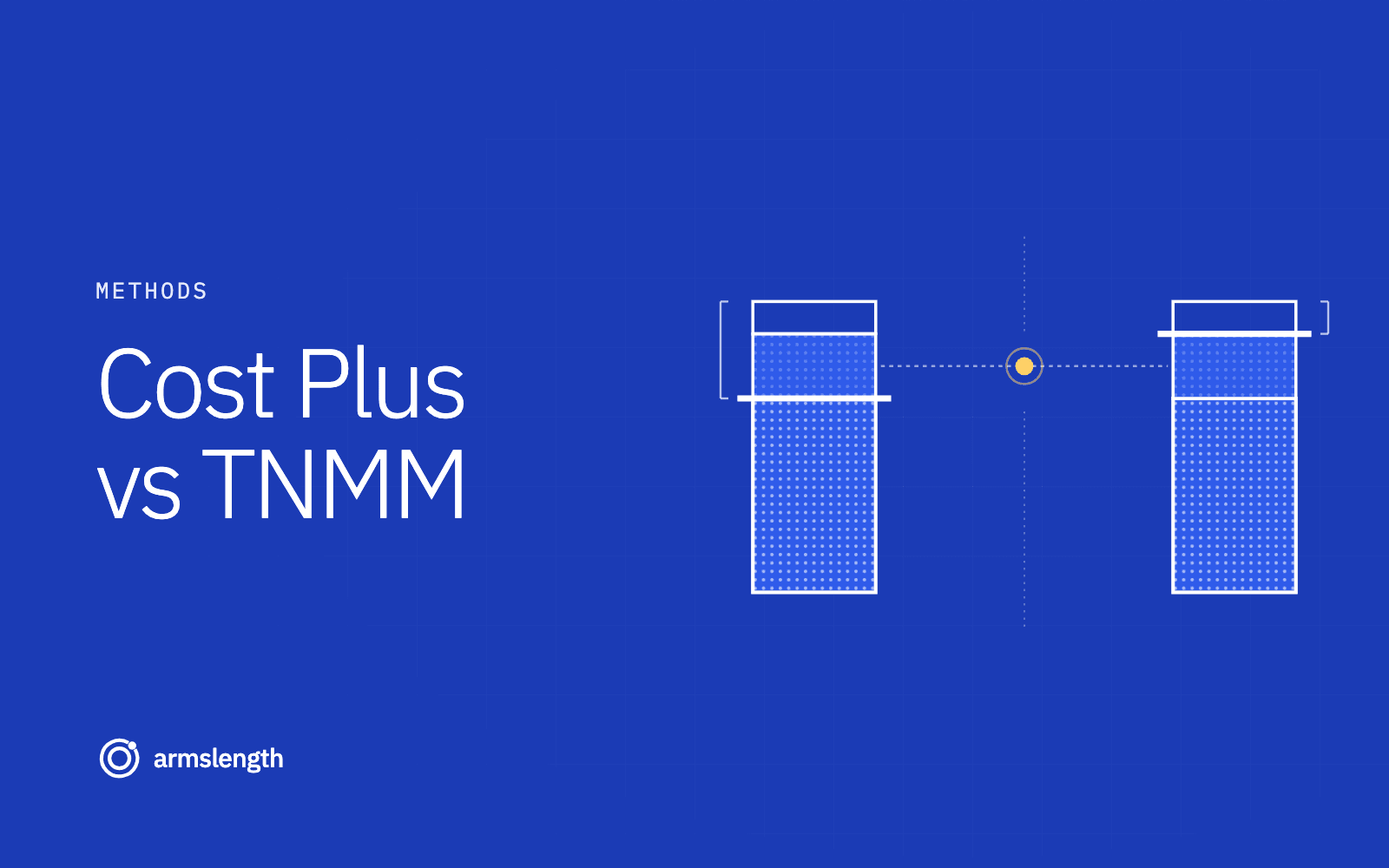
Cost plus and TNMM can both use costs as a reference point, but they are not the same transfer pricing method. This guide explains gross mark-up vs net cost plus, when each method fits, examples, audit risks, and documentation points.
More resources for your next workflow stepMore resources for your next workflow step
Browse the full resource library or contact us if you want recommendations for your specific use case.
The best transfer pricing method is the method that gives the most reliable measure of an arm's length result for the specific controlled transaction.
Use this sequence:
Delineate the transaction - identify what is actually being transferred and under what terms.
Run the functional analysis - map functions, assets, risks, control of risks, and economically significant contributions.
Look for direct price evidence - if a reliable CUP exists, it is usually the strongest method.
Assess gross-margin methods - use RPM or cost plus only if gross comparability and accounting consistency are good enough.
Assess one-sided net-margin methods - use TNMM/CPM where a routine tested party can be benchmarked reliably.
Consider profit split - use a two-sided approach where both parties make unique contributions or the business is highly integrated.
Apply jurisdiction-specific rules - confirm local preferences, safe harbors, Amount B adoption, documentation standards, and tested-party rules.
Note
frames method selection around the most appropriate method for the case, considering method strengths and weaknesses, the nature of the transaction, availability of reliable information, comparability, and the reliability of adjustments.
Many transfer pricing files choose a method too late, after the comparables search has already started. That creates a backward workflow: the available database result starts driving the economic story.
A defensible method-selection process works the other way around. The facts come first:
What transaction is being priced?
Which party performs routine functions?
Which party controls economically significant risks?
Does either party own or develop unique intangibles?
Is there direct price evidence?
Are gross margins reliable enough?
Can one side be tested without ignoring the other side's contribution?
Only after those questions are answered should the file decide whether CUP, RPM, cost plus, TNMM, or profit split is the most appropriate method.
Warning
A method can be easy to execute and still be wrong. TNMM is often practical because company-level net margin data is available, but it is not a default method for every transaction.
Unique contributions on both sides, integrated operations
Can combined profits and contribution keys be measured reliably?
In practice, method selection often comes down to whether direct price evidence, gross margin evidence, or net margin evidence is the most reliable evidence available for the actual transaction.
Step 1: Delineate the Controlled Transaction
Do not start with the method. Start with the transaction.
For each controlled transaction, document:
the property, service, financial instrument, or intangible being transferred
legal terms and actual conduct
contractual rights and obligations
pricing period, volume, duration, and geography
functions performed by each party
assets used, including intangibles
risks assumed and, more importantly, who controls those risks
business strategy and market circumstances
The same legal invoice can hide different economic transactions. For example, "distribution" may mean a routine buy-sell distributor, a commissionaire, a full-risk entrepreneur, or an entity that also performs local DEMPE functions. Those profiles point to different methods.
Tip
If the controlled transaction is not clearly delineated, method selection becomes guesswork. The file should make the economic transaction legible before it argues for a method.
Step 2: Test for CUP First, But Do Not Force It
CUP is the most direct method because it compares prices rather than margins. It should be considered seriously where reliable uncontrolled price evidence exists.
CUP is usually strong when:
the same product or service is sold to both affiliates and independents
a commodity has a widely used quoted market price
a loan, guarantee, or other financial transaction can be benchmarked against comparable market terms
a license or service has genuinely comparable uncontrolled agreements
CUP is weak when:
the product, service, or right is unique or bundled
contract terms differ materially
pricing dates or market conditions are not comparable
If CUP is not reliable, the next question is whether a traditional transaction method using gross margins can be applied reliably.
RPM: buyer-side gross margin
The resale price method starts with the price charged to an independent customer and subtracts an arm's length gross margin for the reseller.
RPM tends to fit when:
the tested party buys goods from an affiliate and resells them to third parties
there is no substantial product transformation
the reseller does not own unique marketing intangibles
gross margins for comparable independent distributors are reliable
COGS and operating expense classification is consistent enough
RPM is usually weak when the reseller performs significant manufacturing, installation, technical services, brand development, or entrepreneurial market-building activity.
Cost plus: supplier-side gross mark-up
The cost plus method starts from the supplier's costs and adds an arm's length gross mark-up.
Cost plus tends to fit when:
the supplier is a contract manufacturer, toll manufacturer, or routine service provider
costs are a reliable value driver
the supplier does not own unique intangibles
gross mark-up data is available and accounting is comparable
pass-through costs and cost base definitions can be documented clearly
Cost plus is usually weak when the supplier bears major entrepreneurial risk, owns valuable IP, or has a cost base that cannot be compared reliably with independent suppliers.
Gross method decision table
Fact pattern
Likely gross method
Watch-out
Routine distributor resells finished goods
RPM
Gross margin classification and product/channel mix
Routine service provider performs back-office support
Cost plus or cost-based TNMM
Whether gross cost data is meaningful for services
Distributor performs major local brand-building
Maybe TNMM or profit split
Marketing intangibles may make RPM too narrow
Supplier owns unique technology
Usually not cost plus alone
Residual return may belong to IP contribution
Step 4: Use TNMM When a One-Sided Net-Margin Test Is Reliable
TNMM tests the net profit of a selected party relative to an appropriate base, such as sales, costs, or assets. In US terminology, the comparable profits method (CPM) plays a similar role.
TNMM is often used because net-margin data is more available than transaction-level price or gross-margin data. That practical advantage is real, but it does not remove the need for tested-party logic.
TNMM usually fits when:
one party is clearly less complex
the tested party performs routine functions
the tested party does not own unique and valuable intangibles
the tested party's transaction results can be segmented reliably
comparable companies with similar functions and risks are available
net margins are less distorted than price or gross-margin comparisons
and support the practical idea that the tested party is usually the party for which the method can be applied most reliably, often the less complex party without unique and valuable intangibles.
Step 5: Know When One-Sided Methods Fail
One-sided methods include RPM, cost plus, TNMM, and CPM. They work by testing one party and treating the other party's result as residual. That can be efficient and reliable for routine transactions, but it fails when the untested side is not merely residual in an economic sense.
Red flags that one-sided methods may be unreliable
Red flag
Why it matters
Both parties own or develop unique intangibles
Testing only one side may ignore valuable contributions by the other side
Both parties control key risks
A routine return may not reflect actual risk control
Operations are highly integrated
Separate-party benchmarking may not capture joint value creation
The tested party is not actually routine
The comparables set will understate its expected return
Segmentation is unreliable
Tested-party profitability may include unrelated transactions
The counterparty's residual profit is implausible
The method may allocate too much or too little profit to untested contributions
When profit split becomes more appropriate
The profit split method may fit where both sides make unique and valuable contributions or where the operations are so integrated that they cannot be evaluated reliably on a one-sided basis.
Profit split is common in fact patterns involving:
jointly developed technology
integrated global trading
shared platform economics
valuable intangibles on both sides
complex value chains where each party controls material risks
Warning
Do not solve a two-sided value-creation problem by calling one party "routine" because a database search is easier. That is a method-selection problem, not a benchmarking problem.
Step 6: Match the PLI to the Method and Facts
For TNMM or CPM, method selection is not complete until the profit level indicator is selected.
PLI
Formula
Typical use
Operating margin
Operating profit / sales
Distributors and sales entities
Net cost plus
Operating profit / operating costs
Service providers and contract manufacturers
Return on assets
Operating profit / operating assets
Asset-intensive manufacturing or leasing
Berry ratio
Gross profit / operating expenses
Limited circumstances, often distribution or agency-like profiles
The PLI should track the tested party's value driver. A routine distributor is often tested on sales; a routine service provider is often tested on costs; an asset-heavy manufacturer may require an asset-based indicator.
For cost-based returns, be careful not to confuse OECD cost plus with TNMM using net cost plus. The former is a gross method; the latter is a net-margin PLI.
Step 7: Consider Data Availability Without Letting It Decide Everything
Reliable data matters. A theoretically perfect method may fail if the data needed to apply it does not exist.
But data availability should be weighed with the economics, not used as a shortcut.
Data issue
Method-selection impact
Reliable internal CUP exists
CUP likely deserves priority
External price data lacks contract detail
CUP may be weak
Gross-margin data is inconsistent
RPM or cost plus may be unreliable
Net-margin data is available for routine comparables
TNMM may be practical
No reliable one-sided comparables exist
Consider profit split or another method
Only aggregated tested-party financials exist
Segmentation may be needed before any method works
Internal comparables before external comparables
Internal comparables often deserve early attention because they may provide transaction-specific evidence. A taxpayer that sells similar goods to independent customers, buys similar services from third parties, or borrows from banks under comparable terms should document why those internal references do or do not apply.
Rejected methods matter
A good method-selection section does not merely state the chosen method. It briefly explains why other plausible methods were rejected.
For example:
CUP rejected because no comparable uncontrolled price was available after reviewing internal transactions and market data.
RPM rejected because gross-margin accounting differences could not be reliably adjusted.
Cost plus rejected because the supplier owned unique manufacturing know-how and bore key risks.
TNMM rejected because both parties made unique contributions.
This creates an audit trail and shows that the selected method was reasoned, not automatic.
Practical Decision Tree
Use this as a working method-selection flow:
Question
If yes
If no
Is there a reliable CUP?
Use CUP or give it primary weight
Continue
Is the tested party a routine reseller with reliable gross-margin data?
Consider RPM
Continue
Is the tested party a routine supplier and cost base is reliable?
Consider cost plus
Continue
Is one party clearly less complex and benchmarkable at net level?
Consider TNMM/CPM
Continue
Do both parties make unique contributions or operate in a highly integrated way?
Consider profit split
Revisit transaction delineation and data
Do local rules provide a safe harbor or simplified approach?
Assess eligibility and documentation
Apply standard method selection
This flow is not a substitute for judgment. It is a way to prevent the common error of jumping directly to TNMM without checking whether a more direct method is reliable.
Jurisdiction Caveats
Transfer pricing methods are broadly similar across OECD-aligned systems, but local implementation matters.
OECD-aligned jurisdictions
Most OECD-aligned jurisdictions apply a "most appropriate method" concept. Traditional transaction methods are not automatically required, but reliable CUP evidence and reliable gross-margin methods should not be ignored.
United States
The US uses the best method rule. The method that provides the most reliable measure of an arm's length result should be selected based on the facts, comparability, data quality, and reliability of adjustments. US terminology can also differ: CPM is a net-profit method aligned broadly with TNMM, not the OECD cost plus method.
Amount B jurisdictions
Amount B may simplify pricing for certain baseline marketing and distribution activities where adopted and applicable. It does not replace the method-selection exercise for all distributors, and it does not apply to entities outside the defined scope.
Local tested-party preferences
Some jurisdictions scrutinize foreign tested parties, local comparables, loss-making comparables, or regional datasets more closely than others. A method that is technically sound globally may need a local defense around data selection and tested-party choice.
Safe harbors and simplified approaches
Safe harbors for low-value-adding services, small taxpayers, or specified transactions can reduce compliance burden. But safe harbors are jurisdiction-specific and may not bind the counterparty jurisdiction. Check whether using a safe harbor creates double-taxation risk.
Tip
For multi-country files, separate the global economic method from local implementation. The group may choose one coherent policy while still documenting local adaptations for data, safe harbors, Amount B, or filing requirements.
Method-Selection Examples
Example 1: Routine distributor
Facts: LocalCo buys finished goods from a related manufacturer and resells them to third-party customers. It performs sales execution, warehousing, and routine local marketing. It does not own local marketing intangibles.
Method reasoning: CUP is unavailable because there are no comparable uncontrolled sales. RPM is considered because the resale price is visible, but gross-margin comparables have inconsistent COGS classification. TNMM using operating margin may be more reliable if independent distributor net-margin comparables are available.
Likely result: TNMM or RPM depending on gross-margin reliability. The file should explain why one is more reliable than the other.
Example 2: Contract manufacturer
Facts: ManufacturerCo produces components using group specifications. The principal owns product IP, controls market risk, and commits to buy output. ManufacturerCo bears routine production risk.
Method reasoning: CUP is absent. Cost plus fits the supplier-side profile if reliable gross mark-up data and a consistent cost base exist. If gross accounting differences are material, TNMM using net cost plus may be more reliable.
Likely result: Cost plus or TNMM with net cost plus, depending on gross data quality.
Example 3: Joint technology platform
Facts: USCo and IrelandCo jointly develop platform technology. Each controls important R&D decisions and contributes unique engineering teams. The platform generates global subscription revenue.
Method reasoning: There is no reliable CUP. A one-sided TNMM analysis would treat one party as routine despite both parties making unique contributions.
Likely result: Profit split should be considered, with allocation keys tied to each party's contribution.
Example 4: Commodity sale
Facts: ProducerCo sells a standardized commodity to an affiliated trader. Independent parties use a public index adjusted for quality, timing, delivery location, and freight.
Method reasoning: CUP is likely strong if the quote is commercially relevant and adjustments are reliable.
Likely result: CUP, with detailed pricing-date and adjustment documentation.
Method-Selection Documentation Template
A concise method-selection section should cover:
Section
What to include
Transaction delineation
What is being priced and what the parties actually do
Functional analysis summary
Functions, assets, risks, risk control, and intangibles
Available data
Internal comparables, external price data, gross margins, net margins
Methods considered
CUP, RPM, cost plus, TNMM/CPM, profit split
Rejected methods
Specific reasons each plausible method was not selected
Chosen method
Why it provides the most reliable result
Tested party and PLI
If one-sided, why this party and indicator are appropriate
Local caveats
Jurisdiction-specific rules, safe harbors, Amount B, local data expectations
The goal is not to write a long theoretical essay. The goal is to show a reviewer that the method follows from the facts and data.
Common Mistakes
Mistake 1: Selecting TNMM by default
TNMM is common, but common does not mean automatic. If a reliable CUP or gross method exists, skipping it without analysis weakens the file.
Mistake 2: Treating data availability as the whole answer
Database availability matters, but it cannot turn a complex entrepreneurial entity into a routine tested party.
Mistake 3: Confusing cost plus with net cost plus
OECD cost plus is a gross method. Net cost plus is a PLI often used under TNMM. The file should be clear about which method and profit line are being used.
Mistake 4: Ignoring the counterparty
Even in a one-sided method, the counterparty's functions and assets matter. If the residual profit allocated to the counterparty is not economically coherent, revisit the method.
Mistake 5: Overlooking local rules
A method can be economically sensible and still need local tailoring for documentation, safe harbors, Amount B, tested-party acceptance, or comparable data expectations.
Frequently Asked Questions
Is there a required hierarchy of transfer pricing methods?
Under OECD guidance, the standard is the most appropriate method, not a rigid hierarchy. However, if CUP and another method can be applied with equal reliability, CUP is usually preferred because it directly tests price. Traditional transaction methods may also be preferred over profit methods where reliability is equal.
When should I use CUP?
Use CUP when you have reliable uncontrolled price data for a highly comparable transaction. This often happens with commodities, standardized products, comparable financial transactions, or genuine internal uncontrolled transactions.
When should I use TNMM?
Use TNMM when one party is clearly less complex, reliable net-margin comparables are available, and direct price or gross-margin methods are less reliable. TNMM is often practical for routine distributors, manufacturers, and service providers.
When is profit split better than TNMM?
Profit split is usually more appropriate where both parties make unique and valuable contributions, both control key risks, or operations are highly integrated. In those cases, testing only one party may not reflect the economics.
Do I need to analyze every method in the local file?
You generally should address plausible methods, not every method at equal length. A concise explanation of why CUP, RPM, cost plus, TNMM, or profit split was accepted or rejected is usually more useful than boilerplate.
Can the same group use different methods for different transactions?
Yes. Method selection is transaction-specific. A group might use CUP for commodity purchases, TNMM for routine distribution, cost plus for shared services, and profit split for jointly developed IP.
How does tested-party selection affect method choice?
One-sided methods require a tested party. If no party is sufficiently routine and benchmarkable, a one-sided method may fail. Tested-party selection and method selection should therefore be analyzed together.
Can local safe harbors replace method selection?
Sometimes a safe harbor or simplified approach can reduce the analysis required for eligible transactions. But safe harbors are local, may be elective, and may not bind the other jurisdiction. Document eligibility and double-taxation implications.
 Borys UlanenkoCEO, ArmsLength AI