Published March 27, 2026Updated August 16, 202630 min read
Transfer Pricing Methods: The Complete Guide (2026)Transfer Pricing Methods: The Complete Guide (2026)
A practitioner-focused tour of OECD transfer pricing methods—CUP, RPM, cost plus, TNMM, and profit split—with Amount B, functional analysis, and how to document method selection defensibly.
Borys UlanenkoCEO, ArmsLength AI
30min read
Contents↓
Contents
TL;DR key takeaways
Transfer pricing methods translate the arm's length principle into a testable price or profit outcome; method choice must follow the transaction, available evidence, and applicable law.
Traditional transaction methods (CUP, resale price, cost plus) focus on prices or gross returns; profit methods (TNMM, profit split) focus on net profit or combined profit allocation.
Functional analysis (FAR) should drive method selection—not the other way around—and must align with contracts and actual conduct.
Amount B offers a simplified return-on-sales matrix for in-scope baseline distributors only in adopting jurisdictions; it does not replace TNMM for most transactions.
Strong documentation connects the functional analysis, method decision, comparable screening, calculations, agreements, and actual conduct in one reproducible evidence chain.
How to price contract and toll manufacturing arrangements: tested party selection, cost plus vs TNMM, cost-base design, capacity utilization, inventory and warranty risk, benchmarking, documentation, and audit issues.
How to price contract R&D arrangements: distinguishing routine research services from entrepreneurial IP development, DEMPE and risk control, cost plus vs TNMM, cost-base and mark-up issues, tax/accounting caveats, documentation, audit issues, and examples.
Cost plus and TNMM can both use costs as a reference point, but they are not the same transfer pricing method. This guide explains gross mark-up vs net cost plus, when each method fits, examples, audit risks, and documentation points.
More resources for your next workflow stepMore resources for your next workflow step
Browse the full resource library or contact us if you want recommendations for your specific use case.
The five standard OECD transfer pricing methods are CUP, resale price, cost plus, TNMM, and profit split. CUP compares the controlled price directly with an uncontrolled price. Resale price and cost plus test gross returns for routine distributors or suppliers. TNMM tests a one-sided net margin. Profit split divides combined profit where both sides make unique or highly integrated contributions.
Method
Best first question
Usually tests
Strongest when
Dedicated guide
CUP
Is there a true uncontrolled price for the same or very similar transaction?
Price
Commodity, raw material, financing, or royalty evidence is highly comparable
Where the applicable law uses the arm's length principle, conditions in controlled transactions—such as sales of goods, services, licences, or financing—are tested against the conditions independent enterprises would have agreed in comparable circumstances. Article 9 of the OECD Model Tax Convention supplies the treaty framework; domestic law controls how the standard applies in each jurisdiction.
In practice, "arm's length" is not self-defining. You need a structured, defensible mechanism to translate the principle into a number. That is the purpose of transfer pricing methods.
A method that does not fit the transaction or is applied inconsistently can support an incorrect result and make the position harder to defend. Method selection therefore needs to be documented as a conclusion from the facts rather than treated as a standard label.
Note
The OECD Transfer Pricing Guidelines (Chapter II, ) frame the objective as finding the most appropriate method for the particular case. Under paragraphs 2.3 and 2.4, a traditional transaction method is preferred when it and a transactional profit method can be applied with equal reliability; if CUP and another method can be applied with equal reliability, CUP is preferred.
Understanding transfer pricing methods (before the detail)
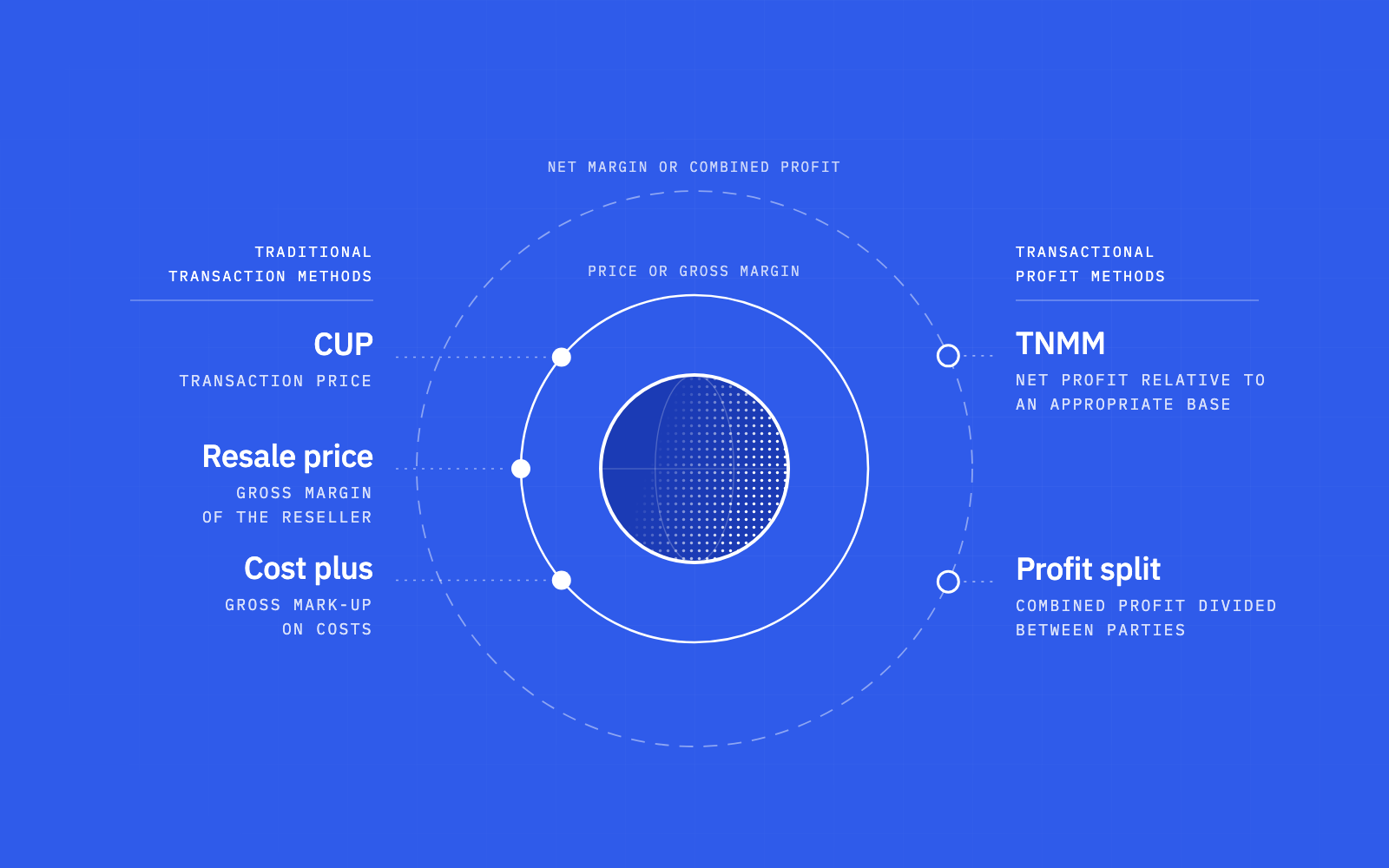
The diagram below groups the five OECD standard methods by family—transactional (price or gross margin) versus profit (net margin or combined profit).
Click the diagram to open the full-resolution PNG in a new tab.
Traditional transactional methods (the direct approaches)
These methods analyze the price of the transaction itself (or a gross margin derived from it).
Method
What it measures
Primary use case
Comparable Uncontrolled Price (CUP)
Transaction price
Commodities, raw materials, some IP licenses
Resale Price Method (RPM)
Gross margin of the reseller
Distributors with limited value-add
Cost Plus Method (cost plus)
Gross mark-up on costs
Contract manufacturers, many low-risk service providers
Transactional profit methods (the indirect approaches)
These methods analyze net profit arising from the controlled transaction (or allocate combined profit).
Method
What it measures
Primary use case
Transactional Net Margin Method (TNMM)
Net profit relative to an appropriate base
One-sided cases with a reliable tested party, segmentation, PLI, and comparable evidence
Transactional Profit Split Method (PSM)
Combined profit divided between parties
Unique intangibles, highly integrated operations
Tip
Gross-margin methods (RPM and cost plus) are particularly sensitive to consistent classification between cost of goods sold and operating expenses. TNMM may be less affected by some product differences, but it still requires reliable functional comparability, a suitable PLI, transaction-level financials, and justified adjustments.
Traditional transactional methods
1. Comparable Uncontrolled Price (CUP)
How it works
The CUP method compares the price charged in a controlled transaction to a comparable uncontrolled transaction under comparable circumstances. If conditions are sufficiently comparable, the uncontrolled price provides a direct arm's length measure.
Internal CUP: the same entity transacts with both a related and an unrelated party.
External CUP: independence is observed in the open market (for example, commodity benchmarks such as Platts or LME, where genuinely comparable).
When to use it
The product is a commodity with observable market pricing.
The entity sells the same (or closely similar) product to related and unrelated customers in comparable volumes and terms.
An IP license can be benchmarked against a specific uncontrolled agreement that is demonstrably comparable.
Strengths and limitations
Strengths
Limitations
Most direct method; closest to the arm's length ideal when CUP quality is high
Demands near-identical products, contracts, and economics
Often preferred when a credible CUP exists
Small differences in product or terms can swing price materially
Avoids profit-level comparables search when price comparables are sound
Often impractical for differentiated goods, bundled offerings, or novel intangibles
Note
describes CUP as the most direct and reliable way to apply the arm's length principle when a sufficiently comparable uncontrolled transaction exists—while acknowledging that achieving that level of comparability is often difficult in practice.
2. Resale Price Method (RPM)
How it works
RPM starts from the resale price to an independent customer, then subtracts an appropriate gross margin that reflects the reseller's functions, assets, and risks.
The tested party is a distributor that does not materially transform the product.
Value is added primarily through sales and marketing rather than manufacturing or unique IP.
Gross margin comparables are available for independent distributors with similar routines and risks.
Strengths and limitations
Strengths
Limitations
Well-suited to distribution-focused tested parties
Sensitive to how revenue, COGS, and discounts are classified
Less demanding on product comparability than CUP (in the right fact pattern)
Gross margins vary materially across business models even within industries
Can fit distribution where the resale gross margin is reliably comparable
Not a good fit if the reseller materially transforms the goods or makes unique contributions
Tip
For RPM, functional similarity is more important than product identity—but comparability of the property transferred still matters. The OECD allows broader product differences under RPM than under CUP, provided the reseller's functions, assets, risks, and economic circumstances are genuinely comparable. That said, comparing distributors across very different industries requires strong justification and careful adjustments; it is not a blanket license.
Amount B note (baseline distributors)
Amount B (in adopting jurisdictions) can provide a simplified and streamlined approach for certain baseline marketing and distribution activities, using a matrix-based return on sales outcome rather than a full RPM or TNMM study for eligible distributors. The transaction must satisfy the detailed scope criteria, including that it can be reliably priced with a one-sided method using the distributor as the tested party. Ownership of unique and valuable intangibles or assumption of economically significant risks may make that one-sided analysis unreliable, but performing a function associated with DEMPE is not, by itself, a stated automatic exclusion. Treat adoption status, elections, and scope as jurisdiction-specific.
If you need the parallel US terminology comparison, see CPM vs TNMM—US Comparable Profits Method aligns with OECD TNMM, not with RPM.
3. Cost Plus Method (cost plus)
How it works
Cost plus applies an appropriate gross mark-up to the supplier's direct and indirect costs incurred in the controlled supply. The cost base, accounting classification, functions, assets, risks, and comparable gross mark-up all need consistent support.
Formula (conceptually):Transfer price ≈ Cost base + Appropriate gross mark-up
Warning
Gross vs net—do not conflate cost plus and TNMM. The OECD cost plus method applies a mark-up to production costs to arrive at a gross profit. By contrast, TNMM's net cost plus PLI applies operating profit to total costs (COGS + operating expenses) to measure operating profitability. Different cost bases, different profit lines, different comparables universe.
OECD terminology vs US jargon
Tip
In OECD language, "cost plus" typically means mark-up on costs (gross return on costs). In US practice, "CPM" most commonly refers to the Comparable Profits Method—a net margin method aligned with TNMM. Do not conflate the two acronyms when talking to mixed US/OECD teams.
When to use it
The tested party is a contract manufacturer, toll manufacturer, or routine assembly operation.
The entity provides intra-group services where costs are a reliable value driver and intangibles are not central.
The entity does not bear significant market risk or own economically significant intangibles.
Strengths and limitations
Strengths
Limitations
Strong fit for many low-risk manufacturing or routine service entities
Sensitive to what is included in "cost" and how pass-throughs are treated
Economically intuitive where value is created through efficient execution
Supported by comparables in many routine services settings
Weak fit where intangibles, risks, or outbound marketing drive profit
Note
highlights typical strong use cases for cost plus—semi-finished goods sold between affiliates, long-term buy-and-supply arrangements, and many controlled services transactions.
Low value-adding intra-group services (LVAIGS)
For qualifying supportive services that are not part of the group's core business, OECD Chapter VII describes an elective simplified approach with a 5% mark-up on the relevant cost pool and no benchmarking study for that mark-up. The eligibility conditions and cost-pool rules are narrow. Domestic adoption and any local differences must be confirmed before the approach is used.
Tip
LVAIGS eligibility is narrower than it looks: services of corporate senior management, R&D, purchasing raw materials used in manufacturing or production, and financial transactions are among the categories the OECD excludes. Document why a service qualifies before defaulting to the 5% mark-up.
Transactional profit methods
4. Transactional Net Margin Method (TNMM)
How it works
TNMM examines the net profitability of the tested party relative to an appropriate base (commonly sales, total costs, or assets) and compares that outcome to independent comparable companies.
The profitability ratio is the profit level indicator (PLI). Common PLIs include:
PLI
Formula (conceptual)
Typical use
Operating margin (OM)
Operating profit ÷ Revenue
Distribution, services
Net cost plus (NCP)
Operating profit ÷ Total costs
Contract manufacturers, shared services
Berry ratio
Gross profit ÷ Operating expenses
Very narrow: see caution below
Return on assets (ROA)
Operating profit ÷ Assets
Asset-heavy operations
Warning
Berry ratio—use with extreme care. The OECD warns that Berry ratios are frequently applied in inappropriate circumstances. A Berry ratio is only suitable where the entity's value contribution is proportional to operating expenses and is not materially driven by the value or volume of products sold. Intermediaries that take inventory risk, perform significant sales or marketing functions, or contribute meaningful intangible value are generally not appropriate Berry ratio candidates. See our Berry ratio guide for the full conditions and worked examples.
Net-level benchmarking can wash out some accounting differences that distort gross benchmarks—within limits.
Comparables datasets usually offer broader coverage for net margins than for true transaction prices.
Many databases provide net-margin fields that can support a one-sided comparison, subject to their coverage and accounting limitations.
Benchmarking and documentation expectations
A TNMM analysis typically requires a structured comparables search, quantitative screens, adjustments where warranted, and a defensible arm's length range. The OECD does not mandate a specific statistical tool, but notes that methods such as the interquartile range may help narrow the range where residual comparability defects remain (see IQR calculation and IQR vs full range for jurisdictional practice).
Tip
Practice tip: retain a traceable, source-backed rationale for why each comparable candidate failed screening, not only why the accepted companies remained. That record allows another reviewer to reproduce the search.
AI-assisted benchmarking platforms can compress parts of this workflow while preserving an audit trail—particularly helpful when teams must defend accept/reject decisions at scale across many transaction types.
Strengths and limitations
Strengths
Limitations
Works across many business models when tested party selection is correct
Can mask economic differences if PLI/base mismatch
Large independent-company data availability for many jurisdictions
Requires disciplined tested-party and PLI narrative
Results can be reproduced when the data and calculation are retained
Company-specific items and accounting differences can distort the comparison
Tip
A TNMM result may be used as a corroborative check when another method is primary. A material conflict between methods should be investigated rather than averaged mechanically: check the transaction, comparability, accounts, assumptions, and whether each method actually tests the same controlled dealings.
Amount B interaction (conceptual)
For in-scope baseline distributors in adopting jurisdictions, Amount B can replace a full TNMM comparable exercise with a matrix outcome. It does not eliminate TNMM in non-adopting jurisdictions or where the transaction cannot be reliably priced with a one-sided method using the distributor as the tested party. Ownership of unique and valuable intangibles or assumption of economically significant risks may indicate that the one-sided test is not reliable; DEMPE involvement alone is not an automatic exclusion.
5. Transactional Profit Split Method (PSM)
How it works
PSM starts from combined profit and asks how independent parties would split it. Common variants include:
Contribution analysis: split based on relative FAR contributions when one-sided benchmarks are unreliable for either party.
Residual analysis: (1) allocate routine returns using one-sided methods where possible; (2) split the residual tied to unique intangibles and integrated value creation.
When to use it
Highly unique intangibles exist on both sides, or intangibles are co-developed and intertwined.
Operations are highly integrated—so one-sided testing is structurally unreliable.
AI- or data-intensive value chains where multiple group entities contribute proprietary data, models, infrastructure, and go-to-market in ways that resist clean one-sided comparables.
Strengths and limitations
Strengths
Limitations
Can be the only coherent approach when reliable one-sided comparables do not exist
Needs robust financial data for both parties (and often careful segmentation)
Reflects integrated value creation
Split keys and profit definitions are inherently judgment-heavy
OECD post-BEPS guidance emphasizes PSM for certain unique-contribution cases
Documentation intensity and controversy risk are typically higher
Note
discusses profit split in contexts involving unique and valuable contributions—not only as a method of last resort when everything else fails.
Hard-to-value intangibles (HTVI)
For hard-to-value intangibles, OECD Chapter VI permits tax administrations to treat ex-post outcomes as presumptive evidence about the appropriateness of the ex-ante pricing arrangements, subject to the framework's stated exemptions. Preserve the forecasts, assumptions, information available at pricing, sensitivity analysis, and explanations for material differences between projected and actual outcomes.
Valuation techniques for intangibles
The OECD also recognizes that when reliable comparables for intangibles do not exist, valuation techniques—particularly income-based or DCF-style approaches—may be useful as part of the arm's length analysis (Chapter VI). This is especially relevant for IP transfers, cost-sharing buy-ins, and restructuring compensation where PSM or CUP cannot produce a credible benchmark on their own.
Tip
An Amount B out-of-scope conclusion does not select the transfer-pricing method. Apply the ordinary most-appropriate-method analysis. If the transaction cannot be reliably priced with a one-sided method, that fact may support considering profit split or another method, but the conclusion must follow from the functions, contributions, risks, and available evidence.
Beyond the five: other methods and valuation techniques
The OECD recognizes five methods but does not prohibit other methods. allows an alternative where it is more appropriate to the facts and consistent with the arm's length principle. The file should explain why the recognized methods were regarded as less appropriate or not workable and why the selected alternative is appropriate.
An income-based valuation, including a discounted cash flow model, may be relevant in situations such as:
IP transfers and cost-sharing buy-ins where no comparable license or transaction exists.
Business restructurings where compensation for transferred value must be quantified.
Hard-to-value intangibles where projected income streams are the only available benchmark.
Note
Using an alternative method does not remove the need for support. Explain why the recognized methods were less appropriate or not workable and why the selected technique is appropriate and consistent with the arm's length principle.
The prerequisite: functional analysis (FAR)
The OECD frames this as accurate delineation of the actual transaction: before selecting a method, you must document functions, assets, and risks and test whether the contractual allocation of those elements is consistent with actual conduct:
Functions: manufacturing, distribution, R&D, marketing, procurement, treasury, management oversight—who does what, and at what level of sophistication?
Assets: tangibles, intangibles (legal ownership and economic substance under DEMPE), working capital, financial capacity.
Risks: market, inventory, credit, FX, warranty, R&D failure, obsolescence. Critically, the OECD requires that contractual risk allocation be tested against control over risk (decision-making and mitigation) and financial capacity to bear the risk. If an entity assumes risk on paper but lacks the people or capital to manage it, the risk allocation may be re-characterized.
The party with more complex operations, more valuable intangibles, and more significant economically substantiated risk generally earns a higher return—and is often not the right tested party for one-sided methods.
Tip
Method selection should read like a conclusion from the functional analysis and accurate delineation, not a template selected before the facts. State the evidence for risk control and financial capacity rather than relying on contractual labels.
OECD guidance ( to ) requires selecting the method most appropriate to the circumstances, considering the transaction, comparability, and available reliable data. Traditional transaction methods are preferred over profit methods when both are equally reliable; CUP is preferred when it and another method are equally reliable. Practical selection factors include:
Nature of the transaction: commodities often point to CUP; routine distribution toward RPM/TNMM (and potentially Amount B if in scope); routine manufacturing toward cost plus/TNMM; integrated IP toward PSM in strong cases.
Data availability: CUP needs true price comparables; TNMM needs robust net margin comparables; PSM needs both-sided financial visibility.
Comparability and adjustments: prefer methods needing fewer fragile adjustments—but do not pick convenience over fit.
Tested party profile: align the method with the least complex entity only when that entity is genuinely the right tested party.
OECD vs US §482 terminology at a glance. The OECD's “most appropriate method” framework and the US “best method rule” are separate legal analyses, although both focus on reliability under the facts. Key naming differences include:
OECD Cost Plus Method = gross mark-up on costs → US has an equivalent concept but the name "CPM" in US practice usually means Comparable Profits Method, which is a net-margin method.
OECD TNMM has closely analogous one-sided net-profit mechanics to the US Comparable Profits Method (CPM) under §1.482-5, but the authorities and procedural rules are not interchangeable.
OECD Profit Split should be compared with the US Profit Split Method under §1.482-6, which includes comparable and residual profit-split applications.
The US regulations also include a Comparable Uncontrolled Transaction (CUT) method for intangibles under §1.482-4, which is analogous to CUP applied to IP licenses.
When working across OECD and US frameworks, map the terminology before comparing conclusions. See CPM vs TNMM for a full comparison.
Compact method-selection framework
Use this screen before writing the method narrative. It keeps the analysis practical without pretending there is a mechanical hierarchy.
Step
Question
If yes, consider
If no / weak evidence
1
Is there a reliable uncontrolled price for this transaction?
CUP first, especially for commodities, raw materials, loans, or closely comparable licenses
Move to gross or profit methods
2
Is the routine party a reseller with a reliable third-party resale price?
RPM, if gross-margin comparability is strong
TNMM may be more reliable if COGS/OPEX classification or channel mix is noisy
3
Is the routine party a supplier whose costs are a reliable value driver?
Cost plus, if the cost base and gross mark-up are comparable
TNMM/net cost plus if gross cost bases cannot be reconciled
4
Is one party clearly less complex and reliably benchmarkable at net level?
TNMM, with a defensible PLI and tested-party story
Profit split or another method may be needed
5
Do both sides contribute unique value or operate as an integrated business?
Profit split, often residual profit split if routines can first be benchmarked
Avoid profit split if a reliable one-sided method actually works
Note
The narrative should explain why rejected methods are less reliable, not merely state the selected method. A concise rejection table is often enough: CUP unavailable because no comparable price exists; RPM rejected because gross margins are distorted by embedded services; cost plus rejected because the supplier owns non-routine intangibles; TNMM rejected because neither party is routine.
Quick reference: method selection by transaction type
Transaction type
Often-primary methods
Common alternatives
Commodity purchase/sale
CUP
TNMM
Baseline distribution (Amount B eligible, adopting jurisdiction)
Amount B (SSA)
TNMM / RPM
Finished goods distribution
RPM or TNMM
CUP (rare, if resales are comparable)
Contract manufacturing
Cost plus or TNMM
—
Toll manufacturing
Cost plus
TNMM
Routine intra-group services
Cost plus, TNMM, or CUP (direct-charge where comparable third-party fees exist)
LVAIGS 5% simplified approach for qualifying supportive services
IP license (good external comparables)
CUP
TNMM sanity check
IP / intangibles (unique, integrated)
PSM
Residual structures with TNMM for routines
Highly integrated / digital operating models
PSM
Transactional methods only for clearly separable pieces
Financial transactions (Chapter X)
CUP-style pricing for loans (yield approach, credit analysis); specialized methods for guarantees, cash pools, hedging, captive insurance
Threshold question: is the purported debt respected as debt or re-characterized as equity? Risk-free / risk-adjusted return analysis for certain arrangements
US practitioners should also reference the best method rule under IRC §482 and the specific regulations (§1.482-3 through §1.482-6) when documenting method selection for US-filed returns.
2026 regulatory context: what practitioners are tracking
Amount B (simplified approach for baseline distributors)
Amount B was incorporated into the OECD Guidelines as an Annex to Chapter IV in February 2024 and is available for fiscal years beginning on or after 1 January 2025 where the relevant domestic framework applies it. It provides a simplified and streamlined approach for specified baseline marketing and distribution activities; it is not an additional recognized transfer-pricing method.
Scope is broader than just buy-sell distributors. Amount B also covers certain sales agents and commissionaires performing qualifying baseline activities. Transactions involving commodities, non-tangible goods, or services are outside the qualifying transaction definition. The remaining scope criteria include whether the transaction can be reliably priced with a one-sided method using the distributor as tested party; ownership of unique and valuable intangibles or assumption of economically significant risks may prevent that conclusion.
The pricing framework has several moving parts:
A global matrix segmented by industry grouping (3 groups) and factor intensity (5 classifications), producing a return on sales ranging from approximately 1.5% to 5.5%.
A ±0.5% compliance band around the matrix outcome.
An operating expense cross-check guardrail.
For qualifying jurisdictions, a data-availability mechanism that adjusts outcomes where local comparables data is limited.
Implementation is jurisdiction-specific: verify the applicable domestic rules, effective period, elections or options, scope, exclusions, and documentation directly with the relevant tax authority.
Tip
If Amount B is available, document why the transaction is in or out of scope using the actual functions and facts. A contractual “distributor” label does not establish eligibility.
Dispute resolution and method documentation discipline
The OECD's 2026 Manual on Effective Mutual Agreement Procedures provides current procedural guidance for competent authorities and taxpayers using MAP. A method file should preserve the facts, agreements, calculations, and adjustment history that may be needed if double taxation later requires treaty relief.
Prepare the method narrative, comparable-screening rationale, and supporting functional analysis contemporaneously under the applicable documentation rules. Reconstructing the reasoning later makes it harder to show which facts and information were available when the price was set.
Common pitfalls to avoid
Skipping FAR and jumping straight to TNMM because it is familiar.
Testing the wrong party—for example, applying TNMM to the entity that owns valuable intangibles and bears entrepreneurial risk.
Stale comparables without a disciplined rollover or refresh policy when the business changes materially.
Contract-method mismatch (for example, contractual buy-sell language with a cost-plus testing story that does not reconcile economically).
Method shopping visible in file versioning or inconsistent narratives across entities.
Thin rejection memos in benchmarking—especially missing sources, thresholds, and consistency across reviewers.
Ignoring secondary checks when another credible method signals a different arm's length band.
Conclusion: documentation is the product
Transfer pricing methods are only as strong as the analysis underneath them. The most defensible files tend to share three traits:
A fact-led FAR that makes method choice feel inevitable (or at least well-justified among true alternatives).
Alignment between agreement design, invoicing, and actual conduct.
Benchmarking that produces a credible range and can explain—in writing—every company screened in or out.
There is no default "best" method. The OECD framework asks for the most appropriate method for the particular case, given reliability of comparables and data. However, the OECD does maintain a hierarchy: traditional transaction methods (CUP, RPM, cost plus) are preferred over profit methods when both can be applied with equal reliability, and a reliable CUP takes priority over all other methods. In practice, TNMM is common because net margin data is frequently available—but prevalence does not mean automatic correctness.
Is TNMM the same as US CPM?
They are closely analogous one-sided net-profit methods, but they are not the same legal rule. TNMM is described in the OECD Guidelines and applied through relevant domestic law; CPM is defined in US Treasury Regulation §1.482-5. See the TNMM and CPM guide.
When is CUP better than TNMM?
When you can demonstrate high-quality comparability on price for the controlled transaction—often in commodities, certain raw materials, or some licensable IP with close uncontrolled evidence.
Why is profit split used more often in intangibles-heavy cases?
Because unique intangibles and integrated development may make one-sided benchmarks unreliable for either party. PSM is designed for consolidated profit allocation problems that TNMM cannot slice cleanly.
Does Amount B replace benchmarking for all distributors?
No. Amount B addresses specified baseline marketing and distribution transactions where the relevant domestic framework applies it. Transactions outside its scope still require the method analysis prescribed by the applicable law.
What benchmarking evidence should the file retain?
Retain the database and release, access date, full search logic, initial population, sequential filter counts, raw results, source evidence, company-specific accept or reject reasons, financial mapping, adjustments, and range calculation. The benchmarking study guide provides the full reproducibility checklist.
How often should a benchmarking study be refreshed?
Refresh timing should follow the applicable documentation rules and the facts. A material business change, acquisition, new intangible, changed transaction, or altered functional profile may require a new search or analysis rather than a mechanical roll-forward.
What is the OECD simplified approach for low value-adding services?
For qualifying supportive intra-group services that are not part of the core business, OECD Chapter VII offers an elective simplified approach: a 5% mark-up on pooled costs with no requirement for a full benchmarking study. The service must genuinely be low value-adding—services of corporate senior management, R&D, purchasing raw materials used in manufacturing or production, and financial transactions are among the excluded categories.
What are hard-to-value intangibles (HTVI) and why do they matter?
HTVI refers to intangibles for which no reliable comparables exist and projections or valuation assumptions are highly uncertain at transfer. OECD Chapter VI permits ex-post outcomes to be used as presumptive evidence about the ex-ante pricing arrangements, subject to stated exemptions and safeguards.
Can I use methods other than the five OECD standard methods?
Yes. permits other methods when they are more appropriate to the facts and consistent with the arm's length principle. Explain why the recognized methods were less appropriate or not workable and why the alternative technique, such as a supported DCF or income-based valuation, is appropriate.
 Borys UlanenkoCEO, ArmsLength AI