Published June 20, 2025Updated March 11, 202614 min read
Regional vs Local Comparables: How to Choose for Transfer Pricing BenchmarkingRegional vs Local Comparables: How to Choose for Transfer Pricing Benchmarking
Local comparables are often more reliable when reasonably available and the tested party's market is domestic. Regional sets can be appropriate where local data is limited or the relevant market spans multiple jurisdictions. This guide covers jurisdiction preferences, documentation requirements, and when to apply geographic risk adjustments.
Borys UlanenkoCEO of ArmsLength AI
14min read
Contents↓
Contents
TL;DR key takeaways
OECD requires the 'most reliable available information'—same-market comparables are often more reliable, but the key test is reliability, not geography per se. The economically relevant market and data availability determine the right approach.
Regional comparables are acceptable when local data is limited or the regional market is 'reasonably homogeneous.' There is no universal minimum number of local comparables required before expanding geographically.
Japan and Australia have a preference for domestic comparables. India has no formal preference but foreign comparables may be disputed. China and Brazil have no general domestic preference per OECD country profiles.
Netherlands and UK state no formal domestic preference, though HMRC guidance says it normally makes sense to consider UK comparables first. Pan-European sets are accepted in some European jurisdictions but practice varies—check country by country.
When using foreign comparables, consider geographic risk adjustments—Mexico's SAT has published EMBI-based guidance, though its technical basis has been criticized and its application is debated.
We tested three AI configurations on 10 transfer pricing questions. ChatGPT with web search scored 83%, but models without web access fabricated most quotes. Here's what we learned.
The Berry Ratio (gross profit ÷ operating expenses) is a specialized PLI for low-risk distributors and agents. Learn when it's appropriate, when to avoid it, and how to defend your analysis—with calculation examples and jurisdictional guidance.
On November 10, 2025, HMRC updated INTM485120 with critical details on searching for comparables. The key takeaway? The Interquartile Range is not a default right - and relying on it blindly carries a median-sized risk.
More resources for your next workflow stepMore resources for your next workflow step
Browse the full resource library or contact us if you want recommendations for your specific use case.
Local comparables are often more reliable when they are reasonably available and the tested party's economically relevant market is domestic. Regional or multi-country sets can be appropriate where local data is limited or where the relevant market spans multiple jurisdictions with reasonably homogeneous economic circumstances. There is no universal minimum number of local comparables required before expanding geographically; the key test is reliability, supported by clear documentation of the search strategy, market definition, and any adjustments.
Regional comparables are acceptable when:
Local search yields insufficient reliable comparables for a meaningful analysis
The tested party operates across a regional market (e.g., European headquarters)
The regional market can be argued to be homogeneous in the relevant industry
Local data is insufficient due to database or market limitations
Decision Framework:
Situation
Use
Documentation
Sufficient reliable local comparables exist
Local only
Standard search documentation
Local search yields insufficient reliable comparables
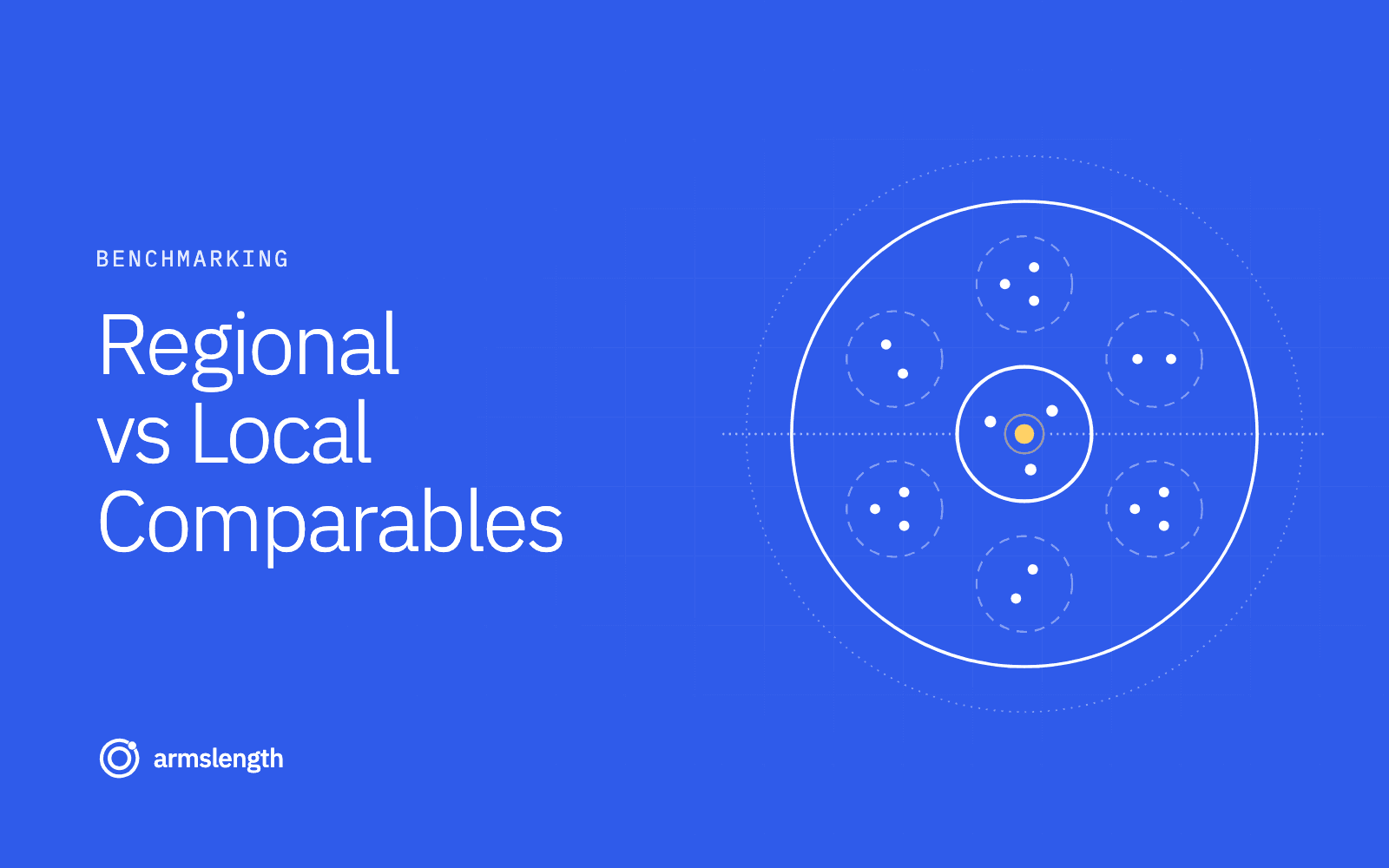
In transfer pricing benchmarking, you search for independent companies to compare against your tested party's profitability. The geographic scope of that search matters significantly.
Local Comparables: Companies from the same country as the tested party (same tax jurisdiction). Local comparables often better reflect the tested party's economic environment, though this depends on the actual market and industry; in some cases, subnational differences matter, and in others a regional market may be reasonably homogeneous.
Regional Comparables: Companies from multiple countries within a broader geographic area—such as Pan-European, ASEAN, or Latin American sets. These expand the pool but introduce potential geographic differences.
The fundamental trade-off is quality vs. quantity: a smaller set of high-quality local comparables is usually preferable to a larger set of distant comparables requiring adjustments.
The OECD emphasizes that geographic markets can significantly affect arm's length prices:
"Arm's length prices may vary across different markets even for transactions involving the same property or services."
The OECD stresses using the most reliable available information and cautions against letting compliance simplification dictate search criteria—while acknowledging that local comparables are not always available (). The geographic market determination should reflect where economic conditions are substantially the same, which may be one country or several.
Key point: Using regional comparables simply because it's easier (one pan-regional search) is not appropriate when better local data exists. However, "local" is not automatically "more reliable"—the assessment depends on the specific facts.
Regional Is Acceptable When Justified
The OECD acknowledges that regional markets can be appropriate. state that if an MNE's controlled transactions occur in several jurisdictions with "reasonably homogeneous economic circumstances," a multi-jurisdiction analysis can be appropriate:
"For a number of industries, large regional markets encompassing more than one jurisdiction may prove to be reasonably homogeneous."
US Treasury Regulations
US Treas. Reg. §1.482-1(d)(4)(ii)(A) provides explicit guidance:
Uncontrolled comparables "ordinarily should be derived from the geographic market in which the controlled taxpayer operates."
Practical reading when local comparables are unavailable:
First choice: Same geographic market comparables
Second choice: Different market comparables with appropriate adjustments
Last resort: Most similar market for which data is available—acknowledging greater uncertainty
Note: This is a practical interpretation, not a formal hierarchy stated in the regulation.
Tax Authority Preferences by Jurisdiction
Tax authorities vary significantly in their stance on local vs. regional comparables. The table below reflects OECD Transfer Pricing Country Profile Q8 responses plus practical observations.
Important: OECD Transfer Pricing Country Profiles are a useful starting point, but they are supplied by jurisdictions for information purposes and are not a substitute for domestic legislation, jurisprudence, administrative guidance, or local audit practice.
No formal preference; domestic commonly used; foreign may be disputed
Thailand
Preference: No
No formal preference per OECD profile
Australia
Preference: Yes (qualified)
Domestic preferred "all things being equal"; often expects explanation for foreign
China
Preference: No
No general domestic preference; domestic comparables may be favored where local market features matter, but foreign comparables may be acceptable if comparability criteria are met or reliable adjustments can be made
Germany
Preference: No
Practice often focuses on comparable markets; domestic may be more persuasive
Netherlands
Preference: No
Pan-European accepted if geographic differences don't materially affect comparability
UK
Preference: No (formal)
No formal domestic preference, but HMRC guidance says it normally makes sense to consider UK comparables first; foreign comparables may be appropriate where UK comparables are unavailable, flawed, or the relevant market is broader
Small EU
Varies
Pan-European often used in practice given data limitations, but country practice varies—check jurisdiction by jurisdiction
Brazil
Preference: No
Domestic or foreign comparables are assessed case by case, considering the facts, economically relevant characteristics, and reliability of available information
Poland
Preference: Yes (qualified)
No official legal preference for domestic comparables, but local data is generally viewed as more comparable where available; regional/European benchmarks are commonly used when reliable domestic data is insufficient
Japan: Domestic Preferred
Japan's OECD country profile indicates a preference for domestic comparables. Using Asia-Pacific or global sets while Japanese comparables exist may be challenged. The rationale: Japan's market features—quality standards, consumer preferences, cost structures—are often best reflected by domestic companies.
Practical guidance: Start with Japanese comparables; document carefully if expanding to regional.
India: No Formal Preference, Practical Disputes
India's OECD country profile indicates no formal preference for domestic over foreign comparables in the legal framework. However, in practice, foreign comparables may be disputed depending on the facts and circumstances.
Practical guidance: Domestic comparables are commonly used and may reduce dispute risk. Indian databases like Prowess or AceTP provide good local coverage.
Thailand: No Formal Preference
Thailand's OECD country profile indicates no formal preference for domestic comparables. Regional ASEAN comparables may be acceptable depending on facts and circumstances.
Australia: Domestic Preferred When Available
The Australian Taxation Office's OECD country profile indicates domestic comparables are preferred "all things being equal," but acceptance depends on circumstances and data availability. Foreign comparables may require a clear explanation of why they were used.
Practical guidance: Australia often benefits from better domestic private-company availability than many countries, depending on databases used.
Netherlands: Pan-European Accepted
Dutch authorities explicitly state no domestic preference per the OECD country profile. Pan-European comparables are accepted "as long as geographic differences have no material impact on comparability." Pan-European sets are standard practice in the Netherlands.
UK: No Formal Preference, UK-First in Practice
The UK's OECD country profile states no formal domestic preference. However, HMRC guidance says that for a UK company it normally makes sense to consider UK comparables first; foreign comparables may be appropriate where UK comparables are unavailable, flawed, or the relevant market is broader. In practice, HMRC regularly accepts benchmarks mixing UK and continental European companies. Commonly used databases include FAME, Moody's Orbis (formerly Amadeus), and OneSource.
Small EU Countries
Luxembourg, Belgium, Ireland, and other small EU countries often rely on pan-European sets due to limited local data. Pan-European sets are accepted in some European jurisdictions and are often used in practice where local data is limited or the relevant market is regionally integrated, but country practice varies and should be checked jurisdiction by jurisdiction.
When Local Comparables Are Required
Conditions Making Local Preferred
Local preference in country profile: Japan (preference), Australia (preference), Ukraine (must prove foreign more reliable)
Sufficient reliable local comparables exist: If you have enough good local companies for a meaningful analysis, use them
Market-specific factors differ significantly: When local conditions diverge from regional norms
Regulated industries: Where local regulations directly affect profitability
What Is "Sufficient"?
No OECD or universal legal minimum exists for the number of comparables. The OECD guidance does not prescribe a threshold. In practice, some advisers treat roughly five observations as a useful signal to consider broadening the search, but the governing test is reliability, not count.
Quality trumps quantity: 4 highly comparable local companies may be better than 15 loosely comparable regional ones
Practitioner heuristic(not a rule): Some practitioners consider broadening the search when local results fall below roughly 5, but this is a practice observation rather than a legal or OECD-backed position
The OECD prioritizes reliability over quantity—there's no requirement to perform an "exhaustive search of all possible sources" once you have sufficient reliable data.
Definition of "Local"
"Local" typically means same country as the tested party (same tax jurisdiction).
US exception: US regulations define "geographic market" as any area where economic conditions are substantially the same—which may include multiple countries if conditions are similar.
EU context: Pan-European is sometimes treated as quasi-local due to the single market, but it's formally still "regional."
Rule of thumb: Assume "local = same country" unless told otherwise by the jurisdiction.
When Regional Comparables Are Acceptable
Primary Justifications
Insufficient local data: The primary reason for regional expansion. If the local search does not yield enough reliable comparables for a meaningful analysis, expansion is justified.
Tested party's business is regional: If the tested party operates across a region (e.g., European hub serving multiple EU markets), regional comparables may better reflect its market.
Comparable economic circumstances: If countries in the region have no material differences in relevant economic factors—or differences can be adjusted for.
Small or developing market: If the tested party is in a small economy with a niche industry, you may have no choice but to use regional or analogous market comparables.
Commonly Used Regional Groupings
Region
Typical Grouping
Notes
Pan-European
EU + EFTA
Accepted in some jurisdictions (NL, UK); practice varies—check country by country
Nordic
Sweden, Norway, Denmark, Finland
Frequently pooled; similar economic profiles
Benelux
Belgium, Netherlands, Luxembourg
Commonly grouped
North America
US + Canada
Usually expect local first due to large databases
LATAM
Latin American countries
Common due to data limitations
ASEAN
Southeast Asian countries
More variability; depends on industry and country
Pan-Africa
African continent
Often necessary due to data scarcity
Documentation Justifications
When using regional comparables, document:
Local search attempted: "Initial attempts to identify suitable local comparables in [Country] were not successful..."
Why local insufficient: "Only 2 companies met the criteria, which was insufficient for a meaningful range..."
Regional grouping rationale: "The search was extended to include [Region] because these economies are all [similar characteristics]..."
Economic homogeneity evidence: "Analysis of industry profit levels showed no significant difference between [Country A] and [Country B]..."
Adjustments considered: Document any adjustments made or explain why none were needed
Geographic Risk Adjustments
When using comparables from significantly different economic environments—particularly developed market comparables for an emerging market tested party—consider geographic risk adjustments.
What Are Geographic Risk Adjustments?
Modifications to comparable financial metrics to account for systematic differences in:
Risk profiles between locations
Cost structures (location savings)
Expected returns in different economic environments
When to Consider Adjustments
Consider Adjustment
Skip Adjustment
Using developed market comps for emerging market tested party
Reliable local comparables available
Material country risk profile differences
Regional market demonstrably homogeneous
Significant cost structure differences
Adjustment methodology would be unreliable
Mexico's EMBI-Based Adjustment (Mexico-Specific)
Mexico's SAT has published FAQ guidance commonly described as an EMBI-based country risk adjustment. This is Mexico-specific administrative guidance / audit practice—not a generally accepted OECD-standard adjustment. The approach has been criticized by practitioners and professional bodies (notably IMCP) for lacking strong technical support and international consensus.
Commonly Reproduced Approach:
The SAT FAQ approach is often described as applying the country risk adjustment to the sales/denominator of the comparable:
Country Risk Adjustment = Average Operating Assets × Mexico EMBI Spread
Adjusted Sales = Reported Sales + Adjustment
This differs from some interpretations that adjust operating profit directly. Practitioners should verify the current SAT position.
Example (illustrative): If a US comparable has $10M average operating assets and Mexico's EMBI spread is 2%:
Adjustment = $10M × 2% = $200K
This adjustment is then applied to comparability metrics per SAT guidance
Because of the controversy around this approach, it should be understood as a Mexico-specific debate rather than a model for other jurisdictions.
Tax Authority Positions on Adjustments
Country
Position
Mexico
SAT FAQ guidance on EMBI adjustment; often raised in audits; application debated
Skeptical of adjustments; prefers qualitative approach
US
Built into comparability concept; adjust for significant differences if possible
China
May adjust for location savings; especially if foreign parent benefits from China cost savings
OECD Caution
The OECD advises: make adjustments only if they "can be expected to increase the reliability of the results." Too many or too subjective adjustments can undermine credibility. If adjustments are so large they signal the comparables weren't really comparable, the analysis fails.
Database Coverage Considerations
Database coverage directly affects whether you can find local comparables or must go regional.
Major Databases
Database
Strong Coverage
Weaker Coverage
Moody's Orbis / TP Catalyst
Europe, North America, major Asia
Small emerging markets, Africa
Moody's Orbis national/country products (formerly Amadeus)
Europe (including private companies)
Rest of world
FAME / Orbis for the United Kingdom
UK and Ireland (detailed private company data)
Outside UK/Ireland
Compustat (S&P)
US, developed markets (public)
Emerging markets, private
Capital IQ (S&P)
Global listed companies
Private companies
Local Specialist Databases
Database
Country
Notes
Prowess/AceTP
India
Essential for India searches
JADE
Japan
Japanese private companies
WIND/CSMAR
China
Complements Orbis
Coverage Impact
Well-covered markets (Europe, US, major Asia): Local searches usually yield sufficient comparables
Practical reality: Database coverage gaps are a primary driver of regional searches—not just a theoretical consideration.
Secret Comparables Issue
In China, SAT has access to "secret comparables"—data taxpayers cannot access (confirmed in OECD country profile Q9). Just because your database search yields limited local data doesn't mean the authority is equally limited.
Practical Scenarios
Scenario A: Large Market, Local Preferred (Germany)
Facts: German distributor tested; Germany has robust database coverage.
Approach:
Search Moody's Orbis (or legacy Amadeus) with country = Germany
Find approximately 12 German distributors meeting criteria
Use Germany-only set
Common audit question: If pan-EU presented when German comparables existed, auditors often ask "Why not German companies?"
Scenario B: Small EU Country, Regional Accepted (Belgium)
Facts: Belgian manufacturing subsidiary; local search yields only 2 Belgian companies.
Approach:
Document Belgian search yielded insufficient results
Expand to Benelux + Germany + France
Final set: 10 companies from Western Europe
No country-risk adjustment (all developed EU economies)
Practice observation: Regional expansion is often seen in Belgian filings given the integrated EU market.
Scenario C: Regional with Risk Adjustment (Mexico)
Facts: Mexican contract manufacturer; suitable comparables found mostly in US.
Approach:
Compile 8 US manufacturing companies
Consider country risk adjustment per SAT guidance
Document adjustment methodology if applied
Test Mexican entity against adjusted range
Practice observation: Country risk adjustments are commonly raised in SAT audits when US comparables are used.
Scenario D: No Local Data, Analogous Markets (Kenya)
Facts: Kenyan IT services subsidiary; virtually no Kenyan company financials available.
Approach:
Document exhaustive local search
Use comparables from India and Philippines (similar service industries, cost structures)
Justify based on similar development level
Practice observation: In data-scarce markets, audits often focus more on functional comparability and the justification for proxy markets.
Documentation Best Practices
For Local Comparables Search
Search criteria: Country filter, industry codes, revenue range
Database(s) used: Name the sources
Results at each stage: "50 hits → 25 after screens → 7 final"
Rejection reasons: Why local companies were excluded
Confirmation: Statement that all relevant local companies were included
Additional Requirements for Regional Search
Justification narrative (early in Local File):
"A search for comparables solely within [Country] yielded only 2 companies, insufficient for meaningful analysis; therefore, the scope was expanded to [Region]."
Local search attempt evidence: Show you tried local first
Geographic criteria: Which countries included, which excluded, and why
Economic homogeneity support: Evidence regional market is comparable
How many local comparables do I need before using regional?
No OECD or universal legal minimum exists. In practice, some advisers treat roughly five observations as a useful signal to consider broadening the search, but the governing test is reliability, not count. Quality matters more than quantity—4 highly comparable local companies may be better than 15 loosely comparable regional ones. Document your reasoning either way.
Can I mix local and foreign comparables in one set?
Yes, this is commonly done and generally acceptable. Include all good local comparables, then supplement with regional to reach a reasonable sample. Disclose which comparables are domestic vs. foreign and address any systematic differences in results. If foreign comparables show systematically different margins than local ones, investigate why before combining.
Our tested party operates across multiple countries—do we need local comparables in each?
If doing separate analyses per country entity, normally use local comparables for each country. If the tested party is a combined regional entity (e.g., European hub with branches), a regional set may be appropriate—but document the business model and economic homogeneity. Best practice: include at least some local comparables per country with material intercompany transactions.
Do I need to adjust regional comparables for geographic differences?
Evaluate whether material differences exist. If comparables are from similar countries (e.g., within EU), you may conclude no adjustment is needed—but document that conclusion explicitly. If using developed-market comparables for an emerging-market tested party, consider country risk or cost adjustments. In Mexico specifically, SAT FAQ guidance on EMBI-based adjustments is often raised in audits when foreign comparables are used, though the technical basis for this adjustment has been criticized by practitioners and professional bodies.
What if the tax authority rejects my regional approach?
Understand the reason for rejection:
If they believe local was available: Revisit your analysis; possibly conduct a fresh local search
If they want adjustments: Engage on how to refine the analysis
If contentious: Present dual analysis (local-only vs. local+regional) showing the conclusion holds either way
Consider MAP or APA for future disputes. Show flexibility—often compromise involves incorporating some local comparables the authority suggests.
How should I document my geographic search strategy?
Include a clear section titled "Comparable Search Strategy" that:
States the local search was conducted first
Explains the outcome and why it was insufficient
Describes the regional expansion and rationale
Cites OECD support ( on homogeneous regional markets)
Includes any adjustments or homogeneity evidence
Provides appendix with flowchart or list of all comparables considered with their countries
Which databases should I use for local searches?
Depends on the country:
Europe: Moody's Orbis national/country products (formerly Amadeus), Orbis, FAME / Orbis for the United Kingdom (UK & Ireland)
US: Compustat, Capital IQ, Orbis
India: Prowess, AceTP
Japan: JADE, Orbis (Japan filter)
China: WIND, CSMAR, Orbis
Australia: Orbis (Australia filter)
Use multiple databases if needed to ensure you haven't missed local comparables. Document which databases were used in your report.
What's the difference between "local" and "domestic" comparables?
These terms are generally used interchangeably in transfer pricing—both mean comparables from the same country as the tested party. The US regulations technically define "geographic market" more broadly (any area with substantially similar economic conditions), but in practice, most jurisdictions treat "local" as meaning "same country."
Related OECD Guidance
The OECD Transfer Pricing Guidelines provide guidance on geographic comparability and market considerations:
Chapter I: Arm's Length Principle – Discusses geographic market as a comparability factor and when regional analysis is appropriate ()
 Borys UlanenkoCEO of ArmsLength AI