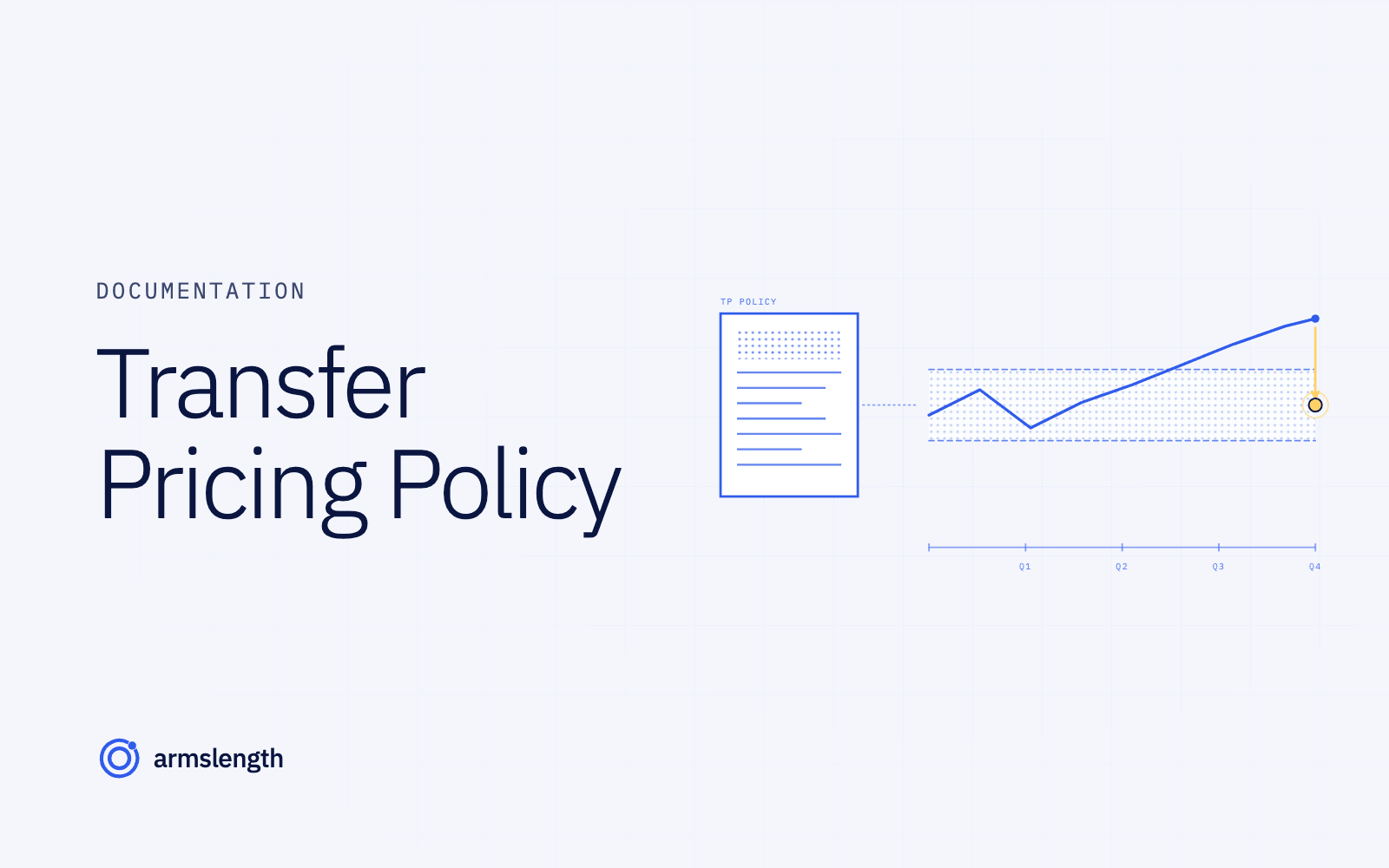
Transfer Pricing Policy: How to Create and Document Your TP FrameworkTransfer Pricing Policy: How to Create and Document Your TP Framework
How to create a transfer pricing policy that's compliant, practical, and defensible. Covers policy structure, common mistakes, and implementation best practices.
Borys UlanenkoCEO of ArmsLength AI
12min read
Contents↓
Contents
TL;DR key takeaways
A transfer pricing policy documents your MNE's arm's length pricing approach for all intercompany transaction types.
Good policies balance consistency (same approach globally) with flexibility (jurisdiction-specific adjustments).
Policy should cover pricing methodology, adjustment mechanisms, documentation requirements, and governance.
Common mistakes: policies that don't match actual practice, no update mechanism, overly rigid pricing.
Review and update transfer pricing policies annually to reflect business changes and regulatory developments.
Business restructurings trigger intensive transfer pricing scrutiny. Learn what documentation you need before, during, and after a restructuring—including exit charge calculations, valuation requirements, and how to avoid common pitfalls that invite audit adjustments.
Strong intangibles documentation, consistent with OECD Chapter VI (intangibles) and Chapter V (documentation), requires identifying all relevant IP, distinguishing legal ownership from entitlement to returns using the DEMPE framework, and ensuring arm's length compensation for each contributor. This guide covers DEMPE analysis, valuation approaches, hard-to-value intangibles, CCAs, and common documentation gaps.
More resources for your next workflow stepMore resources for your next workflow step
Browse the full resource library or contact us if you want recommendations for your specific use case.
A transfer pricing policy is a formal document that establishes how your multinational enterprise will set prices and terms for intercompany transactions. It provides the framework for consistent, arm's length pricing across all controlled transactions and serves as the foundation for your transfer pricing documentation.
Note
Transfer pricing policy definition: A written framework that documents an MNE's approach to pricing intercompany transactions consistently with the arm's length principle, including methodologies, governance procedures, and compliance processes.
What is a Transfer Pricing Policy?
A transfer pricing policy is your organization's playbook for pricing intercompany transactions. It answers fundamental questions:
What methods will we use to price each type of transaction?
How will prices be set and adjusted?
Who is responsible for transfer pricing decisions?
When will prices be reviewed and updated?
What documentation will we maintain?
Unlike transaction-specific documentation, a transfer pricing policy establishes the overall framework that guides how all controlled transactions should be priced across the MNE group.
Why Have a Formal Policy?
Benefit
Description
Consistency
Ensures similar transactions are treated consistently across entities
Compliance
Demonstrates proactive arm's length commitment to tax authorities
Efficiency
Streamlines pricing decisions and reduces ad-hoc analysis
Governance
Establishes clear roles and accountability
Audit defense
Shows systematic approach rather than opportunistic pricing
Tip
Tax authorities view a documented transfer pricing policy favorably—it demonstrates that your pricing is systematic and arm's length by design, not by coincidence.
Policy vs Documentation vs Agreements
Transfer pricing involves multiple layers of documentation. Here's how they relate:
Document
Purpose
Scope
Updates
Transfer Pricing Policy
Establishes pricing framework
MNE-wide
Annually
Master File
Documents global operations
MNE-wide
Annually
Local File
Supports specific entity pricing
Entity/country
Annually
Intercompany Agreement
Legally binds transaction terms
Transaction-specific
When terms change
Benchmarking Study
Provides arm's length evidence
Transaction type
Every 3 years
How They Connect
Policy sets the methodology for each transaction type
Intercompany agreements implement policy for specific transactions
Benchmarking studies validate that policy produces arm's length results
Local Files document how policy is applied in each jurisdiction
Master File describes the overall TP policy framework
Warning
A common audit issue: intercompany agreements don't reflect actual policy, or policy doesn't match what's described in documentation. Ensure alignment across all layers.
Essential Transfer Pricing Policy Elements
A comprehensive transfer pricing policy should address six key areas:
1. Transaction Coverage
Identify all intercompany transaction types within the MNE and specify which are covered by the policy:
Transaction Category
Examples
Goods
Finished products, raw materials, components
Services
Management fees, IT services, shared services
Intangibles
Royalties, license fees, cost sharing
Financial
Intercompany loans, guarantees, cash pooling
For each category, specify:
Transaction types included
Materiality thresholds (if any)
Special treatment for certain transactions
2. Method Selection
Document the transfer pricing method(s) to be used for each transaction type:
Method selection should be based on functional analysis, not just administrative convenience. Document why each method is "most appropriate" for the transaction type per .
3. Pricing Mechanisms
Specify how prices will actually be set:
Price-setting approaches:
Target margin — Prices set to achieve target PLI from benchmarking
Cost-based — Mark-up applied to actual or budgeted costs
Market-based — Prices derived from comparable transactions
Formula-based — Prices calculated using agreed formula
Adjustment mechanisms:
When and how prices are adjusted
Year-end true-up procedures
Treatment of budget vs. actual variances
Currency fluctuation handling
4. Benchmarking and Update Process
Document how arm's length ranges are established and maintained:
Benchmarking frequency — How often studies are refreshed (typically every 3 years)
Database sources — Which databases will be used (Orbis, Amadeus, etc.)
Search criteria — Standard screening parameters
Update triggers — What changes require mid-cycle updates
5. Documentation Requirements
Specify documentation standards:
Requirement
Timing
Responsibility
Master File
Annual (before filing deadline)
Group TP function
Local File
Annual (per local deadlines)
Local finance + Group TP
Intercompany agreements
Before transaction begins
Legal + Tax
Benchmarking studies
Every 3 years minimum
Group TP or advisors
Year-end true-up calculations
Within 90 days of year-end
Finance
6. Governance and Oversight
Establish clear accountability:
Policy owner — Who maintains and updates the policy
Approval authority — Who approves pricing decisions and changes
Review cadence — Annual policy review process
Escalation procedures — How to handle disputes or unusual transactions
Training — How staff are educated on policy requirements
Transfer Pricing Policy Governance Checklist
01Policy owner identified with clear accountability
02Annual review process documented and scheduled
03Approval authority defined for different transaction values
04Training program for relevant finance/tax staff
05Escalation path for non-standard transactions
06Change management process for policy updates
07Monitoring process for compliance with policy
Transfer Pricing Policy Template Structure
A well-structured policy document typically includes these sections:
Section 1: Introduction and Purpose
Policy objectives
Scope and applicability
Definitions
Regulatory framework (OECD Guidelines, local law references)
Section 2: Organizational Overview
Group structure summary
Business model description
Key intercompany flows (refer to Master File)
Section 3: Transaction Categories
For each category (goods, services, intangibles, financial):
Transaction types covered
Functional profiles of typical parties
Pricing method(s) to be applied
PLI or margin targets
Pricing mechanism (how prices are set)
Section 4: Pricing Procedures
Annual budgeting/forecasting process
Price adjustment mechanisms
Year-end true-up procedures
Currency handling
Section 5: Documentation Standards
Master File and Local File requirements
Benchmarking study requirements
Intercompany agreement standards
Record retention
Section 6: Governance
Roles and responsibilities
Review and approval processes
Policy update procedures
Training requirements
Section 7: Appendices
Intercompany agreement templates
Standard pricing schedules
Benchmarking study summaries
Compliance checklists
Creating Your Policy: Step-by-Step
Step 1: Inventory Intercompany Transactions
Before writing policy, understand what you're pricing:
List all intercompany transaction types
Identify transaction values by type and entity
Map transaction flows
Identify materiality thresholds
Step 2: Perform Functional Analysis
For each transaction type, document:
Functions performed by each party
Assets employed
Risks assumed
Characterization of each party (routine vs. entrepreneur)
Step 3: Select Transfer Pricing Methods
For each transaction type:
Identify applicable methods
Select most appropriate method with justification
Document why alternatives were not selected
Align with existing benchmarking studies
Step 4: Establish Pricing Mechanisms
Determine how prices will be set in practice:
Target margins from benchmarking
Cost allocation methodologies
Adjustment and true-up procedures
Currency conventions
Step 5: Draft Policy Document
Write the policy following the template structure:
Keep language clear and practical
Include specific procedures, not just principles
Reference OECD Guidelines where appropriate
Ensure consistency with existing documentation
Step 6: Implement and Train
Roll out the policy:
Communicate to affected functions (finance, tax, operations)
Train staff on key requirements
Update intercompany agreements to align
Establish compliance monitoring
Common Transfer Pricing Policy Mistakes
Policy Pitfalls to Avoid
01Policy doesn't match actual practice—prices set differently than documented
02No update mechanism—policy becomes stale as business changes
03Overly rigid pricing—doesn't allow for market changes or exceptional circumstances
04Too vague—doesn't provide actionable guidance for pricing decisions
05Ignores local requirements—one-size-fits-all doesn't work globally
06No year-end adjustment process—actual results fall outside target range
07Disconnected from intercompany agreements—contracts say different things
08No governance structure—unclear who is responsible for what
Policy vs. Practice Disconnect
The most common and serious issue is when policy documentation doesn't reflect actual business practice:
Example: Policy states management fees are charged at cost plus 5%, but actual charges vary based on local tax considerations.
Risk: Tax authorities may disregard the policy entirely if it's demonstrably not followed, undermining all your documentation.
Solution: Ensure policy accurately reflects what you actually do. If practice varies for valid reasons, document those variations in the policy.
Policy Implementation and Monitoring
Implementation Timeline
Phase
Activities
Timeline
Assessment
Transaction inventory, current state review
Month 1-2
Design
Functional analysis, method selection
Month 2-4
Documentation
Draft policy, stakeholder review
Month 4-5
Approval
Management sign-off
Month 5-6
Training
Staff education, system updates
Month 6-7
Go-live
New policy effective
Month 7+
Compliance Monitoring
Ongoing monitoring ensures policy is followed:
Quarterly reviews: Compare actual pricing to policy targets
Year-end true-ups: Adjust prices if results fall outside range
Exception reporting: Track transactions that deviate from policy
A comprehensive transfer pricing policy should include: (1) scope and transaction coverage, (2) method selection for each transaction type, (3) pricing mechanisms and adjustment procedures, (4) documentation requirements, (5) governance structure, and (6) review and update processes. The goal is to provide clear guidance on how intercompany transactions should be priced consistently with arm's length standards.
How often should transfer pricing policies be updated?
Policies should be reviewed at least annually and updated when material changes occur. Common triggers include: business restructurings, new transaction types, regulatory changes, audit findings, or material changes in benchmarking results. A policy that isn't current creates audit risk.
Is a transfer pricing policy required by law?
While few jurisdictions explicitly require a written policy, most require documentation that includes the methodology used for pricing controlled transactions. A formal policy demonstrates systematic arm's length compliance and is viewed favorably by tax authorities. OECD Guidelines recommend documentation of pricing methodology.
Who should own the transfer pricing policy?
Typically, the Group Tax function or Head of Transfer Pricing owns the policy, with input from Finance, Legal, and business operations. The policy should have executive sponsorship (CFO or Tax Director) and clear accountability for maintenance and compliance.
How detailed should a transfer pricing policy be?
Detailed enough to guide actual pricing decisions, but not so rigid that it can't accommodate business realities. Include specific methods and target ranges, but allow for documented exceptions. Staff should be able to use the policy to price transactions without escalating every decision.
What's the difference between policy and intercompany agreements?
The policy establishes the framework and methodology for pricing. Intercompany agreements are legal contracts that implement the policy for specific transactions between specific entities. Policy is internal guidance; agreements are binding contracts. Both should align—discrepancies create audit risk.
 Borys UlanenkoCEO of ArmsLength AI