Danish Tax Authority vs. EET Group (June 2024): Transfer Pricing Case AnalysisDanish Tax Authority vs. EET Group (June 2024): Transfer Pricing Case Analysis
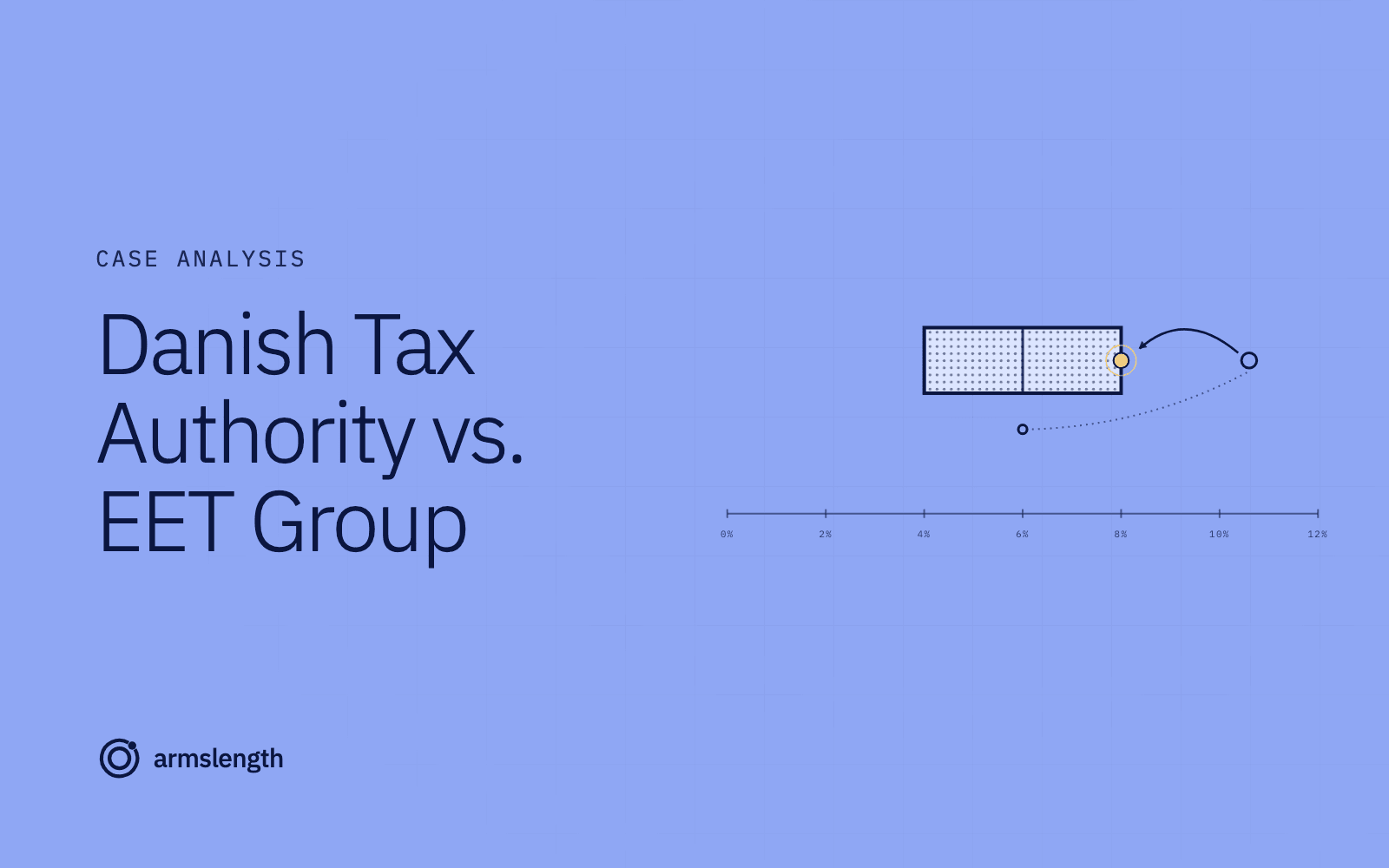
In this landmark Danish transfer pricing dispute, the Eastern High Court ruled in favor of EET Group, rejecting a DKK 129 million adjustment and setting important precedents for method selection and range application.
Borys UlanenkoCEO of ArmsLength AI
15min read
Contents↓
Contents
TL;DR key takeaways
Danish High Court upheld EET Group's TP, prioritizing economic substance over method label (TNMM vs. RPM).
Adjustments should be to the nearest point in the arm's length range, not automatically the median.
Robust documentation, even if imperfect, prevented a discretionary assessment by tax authorities.
Aligning TP policies with actual business operations and consistent analysis are crucial.
In this landmark Kenyan transfer pricing case, the Tax Appeals Tribunal upheld the tax authority's rejection of the Resale Price Method in favor of TNMM, resulting in a significant tax adjustment for Avic's vehicle assembly operations.
In this Italian transfer pricing case, the Supreme Court addressed when loss-making comparables may be retained and why exclusions require case-specific support under OECD-aligned analysis.
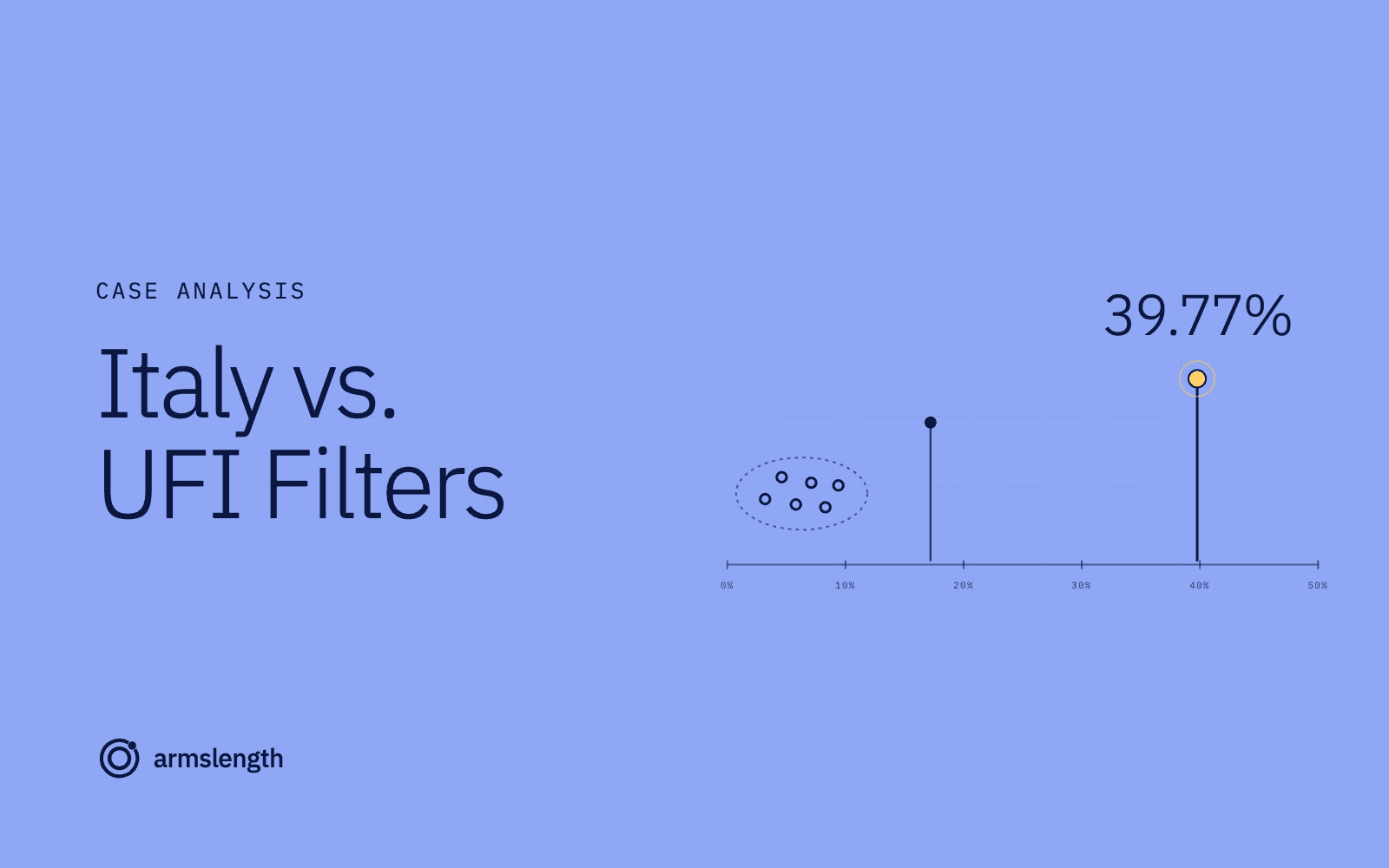
In this high-profile transfer pricing case, UFI Filters successfully defended its 39.77% intra-group markup against the Italian tax authority, highlighting the critical importance of proper comparability analysis.
More resources for your next workflow stepMore resources for your next workflow step
Browse the full resource library or contact us if you want recommendations for your specific use case.
In a high-stakes transfer pricing battle, the Danish Tax Authority (Skattestyrelsen) challenged EET Group A/S – one of Europe's largest IT distributors operating in 23 markets – over transactions totaling an income adjustment of DKK 128.8 million for 2010–2012. The case centered on how EET Group priced goods sold from its Danish parent company to its foreign sales subsidiaries, and whether those prices reflected an arm's length outcome. In June 2024, Denmark's Eastern High Court delivered a landmark judgment largely in favor of EET Group, rejecting the proposed income increase and establishing important precedents for transfer pricing methodology and range application.
1. Overview & Context
Case Background
EET Group A/S, headquartered in Denmark, supplies IT and technology products to a network of its own distribution subsidiaries across Europe. The controlled transactions at issue were the sales of goods from EET Group A/S to its foreign distribution affiliates for resale in local markets.
EET Group Transaction Structure
EET Group A/S
🇩🇰
Danish Parent Company
IT Products Supplier
Earns Residual Profit
Danish Tax Authority claimed insufficient profit
IT Products Supply
Transfer Price Payment
Foreign Distribution Subsidiaries
🇪🇺
Local Market Resellers
Routine Distributors
Target Gross Margin
Operating in 23 European markets
Key Dispute Focus
The Danish Tax Authority claimed EET's transfer prices were not arm's length, proposing a DKK 128.8M adjustment. The courts ultimately sided with EET, validating their gross margin approach and rejected the tax authority's median-based adjustment.
In 2016, after reviewing EET's transfer pricing, the Danish Tax Authority made a discretionary assessment, claiming that EET's intercompany pricing was not at arm's length. They increased EET's taxable income for 2010–2012 by DKK 128,810,000, alleging that profits had been inappropriately shifted to the foreign sales companies.
EET Group disputed this adjustment, maintaining that its pricing was consistent with market rates and supported by thorough benchmarking analysis. The case wound its way through Denmark's tax appeals system – first to the National Tax Tribunal (Landsskatteretten), which in October 2020 largely sided with EET by drastically reducing the adjustment, and subsequently to the courts. By 2024 the dispute had reached the Court of Appeal (Eastern High Court), and it is now pending before the Danish Supreme Court as a matter of principle.
EET Group TP Case Timeline: 14-Year Dispute
2010
2016
2020
2024
2024
Hover over or click any point to see details about that stage of the EET transfer pricing case
Financial and Policy Significance
The immediate tax at stake (nearly DKK 129 million, or ~€17.3 million) is material for any company, and interest and potential penalties could amplify the impact. Beyond the monetary value, the dispute is a bellwether for transfer pricing enforcement in Denmark.
It touches on core questions—How should multinationals benchmark related-party transactions? Which profit level indicator is most appropriate? Should tax authorities always default to the median of a comparable range when making adjustments?—with implications for many other taxpayers.
A victory for the tax authority would strengthen a more formulaic, perhaps aggressive, approach to transfer pricing. Conversely, EET Group's success shows the importance of rigorous documentation and analysis by taxpayers, and it challenges the tax authority to consider the actual business model over one-size-fits-all policies.
Given that EET Group is a major player in its industry, the dispute has also been closely watched by the business community and tax professionals as an indicator of Denmark's tax climate and the reliability of OECD-aligned practices in local audits.
2. Core Transfer Pricing Issues
Several core transfer pricing issues lie at the heart of the EET Group A/S dispute:
Method Selection & Profit Level Indicator
A key contention was whether the Transactional Net Margin Method (TNMM) or the Resale Price Method (RPM) was the appropriate way to test EET's intercompany pricing. EET's transfer pricing documentation ostensibly stated TNMM as the chosen method, but in practice the company's analysis relied on gross profit margins – an approach more in line with the RPM (which focuses on gross margins of resellers).
The Danish Tax Authority argued for using a net profit margin indicator (consistent with TNMM) to evaluate the arm's length result, expressing skepticism about the reliability of a gross-margin-based comparison. This raised the question of methodological consistency: Should a taxpayer be allowed to justify pricing based on gross margin (resale price margin) if their documentation labels the method as TNMM?
Note
Under the Danish Tax Assessment Act (§ 2), the arm's length principle is to be applied in line with OECD Transfer Pricing Guidelines, which prescribe choosing the "most appropriate method" for the circumstances of the case.
EET argued that its setup justified treating the subsidiaries as the tested parties and using their gross margins as the gauge for arm's length pricing, since the pricing of products was largely determined by applying a target gross margin for the resellers. The tax authority, however, favored TNMM on the basis that differences in operating expenses and functions across companies could distort gross margin comparisons.
Benchmarking, Range and Adjustment Point
Another key issue was how to apply the results of a benchmarking study to EET's pricing, particularly the use of statistical ranges and which point in the range to use for adjustments.
In its 2016 assessment, the Danish Tax Authority performed a benchmark of comparable independent distributors and found that EET's results fell outside the acceptable arm's length range. The authority's large adjustment (DKK 128.8 million) effectively assumed that EET's transfer prices should have been set to achieve the median profit level of the comparables.
EET Group challenged this approach, contending that if any adjustment was warranted, it should be to the nearest point in the interquartile range (IQR) of the comparables' results, rather than automatically to the median.
Warning
OECD guidelines do not mandate using the median – they allow choosing a point in the arm's length range that best fits the facts and minimizes error.
The Eastern High Court ultimately agreed with EET's view, affirming that adjustments should be made to the nearest point in the range under Danish law (in this case, the third quartile was the nearest appropriate benchmark, not the median). This was a noteworthy departure from a more rigid median rule and underscored that arm's length is a "market norm" requiring case-specific judgment rather than mechanical application of statistics.
Comparability & Documentation Issues
Underpinning the method and range disputes were questions about the quality of comparables and the sufficiency of EET's transfer pricing documentation. The tax authority initially treated EET's documentation as inadequate to such a degree that it could make a discretionary income adjustment.
In Denmark, if a taxpayer's TP documentation is deemed essentially non-compliant or gravely deficient, the authorities gain latitude to adjust income based on their own estimates. EET's defense was that its documentation and benchmarking study were in fact robust: it had selected a set of comparable independent companies and performed detailed screening and adjustments to ensure comparability.
Some of the contentious points included:
Profit Level Indicator (PLI) mismatch: EET's report labeled the method as TNMM but then used gross margin (a RPM-style PLI) for analysis, which the tax authority saw as a documentation inconsistency.
Year-to-year consistency: The tax authority criticized changes in EET's comparable search criteria across the years, suggesting these could be seen as cherry-picking to suit each year's result.
Comparable selection and quality: The authority pointed out potential defects like the lack of segmentation in comparables' financial data and the need to compute "synthetic" gross margins for comparables from their financial statements.
Despite the authority's critiques, the Eastern High Court found that EET's documentation was not so materially deficient as to be equated with a lack of documentation. In other words, while there were imperfections, they were not severe enough to justify disregarding the analysis altogether.
3. Stakeholder Positions
Both the taxpayer and the tax authority presented contrasting positions on the transfer pricing method, comparables, and results:
Key Positions in the EET Group Transfer Pricing Case
Taxpayer (EET Group A/S)
Stated TNMM in documentation but effectively used a gross margin (RPM-like) analysis, arguing it aligned with their business model of setting target gross margins for distributors.
Tax Authority (Skattestyrelsen)
Criticized the mismatch between stated (TNMM) and applied (RPM-like) method. Preferred a net profit indicator (operating margin) consistent with TNMM.
Court Reasoning (Eastern High Court)
Validated EET's use of gross margin analysis as appropriate for their business model, prioritizing substance over the label used in the documentation.
4. Analysis & Court Decision
Court's Reasoning
The Eastern High Court and earlier the National Tax Tribunal largely sided with EET Group's position:
Strengths of EET Group's Arguments
EET's key strength was that its transfer pricing policy was closely tethered to commercial reality. The company demonstrated that its pricing model was grounded in how independent firms in the industry operate, which gave credence to its choice of method. The Eastern High Court explicitly validated this, noting EET was right to use a gross margin comparison for its arm's length analysis.
EET had substantial documentation prepared: it did not come empty-handed or with obviously flawed documentation. The fact that the court said the documentation was not so deficient as to be disqualified worked hugely in EET's favor – it meant the burden of proof remained with the Tax Ministry to show the prices were wrong.
Another strength was EET's argument on the adjustment point: it resonated with the core arm's length concept that any adjustments should be no more than necessary to achieve parity with uncontrolled conditions. By convincing the court that using the nearest quartile was more appropriate than the median, EET framed the tax authority's approach as overly aggressive or arbitrary.
Weaknesses in the Tax Authority's Case
The tax authority's case faltered because it appeared too formulaic and insufficiently grounded in the specific facts of EET's business. The insistence on median and net margin, while generally sensible, came across as rigid and not reflective of how EET actually operated.
The court was convinced that EET's specific situation – a niche distributor with certain business practices – justified an alternate approach. A weakness was the authority's failure to refute EET's core assertion that gross margin was the right metric for these transactions.
The authority also appeared to overplay the documentation non-compliance angle when the taxpayer had indeed produced extensive documentation. This all-or-nothing stance (full median adjustment or bust) proved to be a weakness when the tribunal and court were inclined to find a middle ground or accept the taxpayer's evidence.
Court Decision & Outcomes
The Eastern High Court delivered a judgment largely in favor of EET Group, rejecting the Danish Tax Authority's proposed income adjustment. The court found that:
The use of gross margin analysis was appropriate for EET's business model, despite being labeled as TNMM in the documentation
EET's documentation was not so deficient as to justify a discretionary assessment
Any adjustment, if warranted, should be to the nearest point in the arm's length range, not automatically to the median
This decision drastically reduced EET's potential tax liability. The case is now pending before the Danish Supreme Court, where the outcome could further influence transfer pricing practice in Denmark.
Potential Resolution Paths
At this juncture, with the case pending at the Supreme Court, several paths to resolution exist:
Litigation: The primary path is through the Supreme Court, which will examine the facts of EET's case and the broader legal principles.
Negotiated Settlement: The authorities and company might potentially agree to accept a partial adjustment and drop further appeals, though settlements in such high-profile principle cases are rare in Denmark.
Advance Pricing Agreement (APA): While not resolving the current dispute, EET could consider seeking a bilateral APA between Denmark and key countries for future years to prevent similar disputes.
Mutual Agreement Procedure (MAP): If Denmark's adjustments lead to double taxation, EET can request a MAP under tax treaties between Denmark and the respective countries.
5. Key Takeaways
The EET Group case yields several lessons for multinationals and tax advisors:
Thorough Documentation and Consistent Analysis Matter
Having comprehensive and internally consistent transfer pricing documentation is essential. Any inconsistencies (such as saying you're using TNMM but actually using a gross margin analysis) will be scrutinized. Changing search criteria or approaches between years should be minimized or well-explained.
Tip
High-quality documentation can preserve the taxpayer's rights – in Denmark, it kept the burden of proof on the tax authority.
Taxpayers should invest in detailed functional analysis, careful comparable selection, and clear explanation of methods to avoid giving tax authorities an easy target.
Align Transfer Pricing Policies with Business Realities
A major reason EET Group prevailed is that its transfer pricing policy was rooted in how its business actually operated. This highlights a best practice: design transfer pricing models that make business sense and reflect the real functions and risks of each entity.
The High Court explicitly reminded that the arm's length standard in Denmark is a "market norm" requiring concrete, case-by-case assessment, not just mechanical application of general formulas. Both taxpayers and tax authorities should be flexible and fact-driven.
Understanding of Statistical Range Use
Companies often use the interquartile range to enhance reliability when screening comparables, which was validated in this case. More notably, the EET case sets a precedent that an adjustment to the nearest point in the range can be more appropriate than defaulting to the median.
Taxpayers should document where their results fall relative to the full range and IQR and consider explaining what an appropriate adjustment point would be if an adjustment were needed. Rather than simply assuming median in all circumstances, be prepared to argue for a different point if justified by the data.
Quality Over Quantity in Comparables
A practical insight for benchmarking practitioners is the reaffirmation that the quality of comparables matters far more than having a big sample size. The court was satisfied with comparables sets as small as 7 companies because they were carefully chosen.
It's better to have a tight set of truly comparable companies than a broad set that introduces noise. Document the reasons for excluding potential comparables meticulously to preempt arguments that the selection was biased.
6. Final Thoughts
From a policy perspective, the EET dispute may signal a need for recalibration on the tax authority's part. It illustrates that Danish courts expect the tax authority to engage deeply with the specifics of a case rather than apply overly standardized approaches.
For taxpayers, the case reinforces that meticulous analysis and alignment with real-world economics are your best defense in transfer pricing. Choose the right method for the right reasons, document it thoroughly, benchmark diligently, and don't treat transfer pricing as a box-checking exercise.
By applying these lessons, firms and taxpayers can better navigate transfer pricing and minimize the likelihood of ending up in protracted disputes like EET Group's decade-long battle with the Danish Tax Authority.
Frequently Asked Questions
How did the court view the mismatch between EET's stated method (TNMM) and their actual analysis (gross margin/RPM)?
The court prioritized substance over form, finding that EET's actual approach (gross margin analysis) was appropriate for their business model despite being labeled differently in documentation. This emphasizes that the economic reality of how prices are set is more important than rigid adherence to method labels.
What does the EET case tell us about using the median versus other points in the arm's length range?
The case established an important precedent in Denmark that tax authorities cannot automatically default to the median when making adjustments. If a taxpayer's result falls outside the arm's length range, an adjustment to the nearest point in the range (such as the third quartile) may be sufficient to satisfy the arm's length principle.
How important was EET's documentation quality to the outcome?
While not perfect, EET's documentation was substantial enough that the court did not deem it "essentially non-compliant." This was key because it kept the burden of proof with the tax authority to demonstrate that EET's pricing was not arm's length, rather than shifting the burden to EET to prove it was correct.
What might the Danish Tax Authority do differently after this case?
The tax authority may need to update internal guidelines on when median adjustments are appropriate versus when other points in the range should be considered. They might also strengthen their review process for taxpayer documentation and prepare more robust counter-analyses rather than defaulting to discretionary estimates when documentation has minor flaws.
How can companies apply the lessons from this case to their own transfer pricing?
Companies should ensure their transfer pricing approach reflects their actual business model and decision-making processes. They should document the economic rationale for method selection and maintain consistency in benchmarking criteria across years. When results fall near but outside an arm's length range, they can now cite this case to argue for a minimal adjustment to the nearest point rather than the median.
 Borys UlanenkoCEO of ArmsLength AI